
Learning from the Past – Earning from the Present – Growing from the Future
Episode: 14
Summary of the previous Articles
Greetings to the readers of Auto Mark. In the last 13 episodes, we have written in great detail on electric vehicles and informed people about the emergence and current situation of electric vehicles in Pakistan, in which the basic details of electric vehicles, hybrid vehicles and PHVs, as well as the REEV (range extended electric vehicle), were also discussed in detail.
Reason of present Article
Now we have realized that the demand for EV scooters, sooters and 3 wheeler rikshaws are increasing in Pakistan. There are many business opportunities in this evolutionary EV Automotive sector and necessary to study it in detail.
Therefore, in the coming episodes, we will try to guide people about two-wheelers and three-wheelers electric vehicles in Pakistan.
In addition to the current situation in Pakistan, we will also inform about the future of electric motorcycles and the models currently available in the market and discuss the opportunities for EV 2 & 3 wheelers business in near future and the gaps in the market related to them so that businessmen and buyers can decide to do business or buy an electric two-wheeler with full confidence.
EV Revolution by 2 Wheelers in Pakistan
The green mobility revolution is indeed being spearheaded by two-wheelers. Electric bikes (EVs) are growing exponentially as surging petrol costs make fossil-fuel rides unaffordable. Two-wheeler EVs are leading the charge by offering significantly lower operating costs and zero emissions compared to traditional motorcycles.
Electric two-wheelers are changing the landscape of urban commuting with several distinct advantages:
- Massive Cost Savings: An electric bike or scooter costs a fraction of a petrol-powered motorcycle to run. Charging a two-wheeler overnight can cost up to 10 times less than filling a tank, potentially saving riders thousands of rupees monthly.
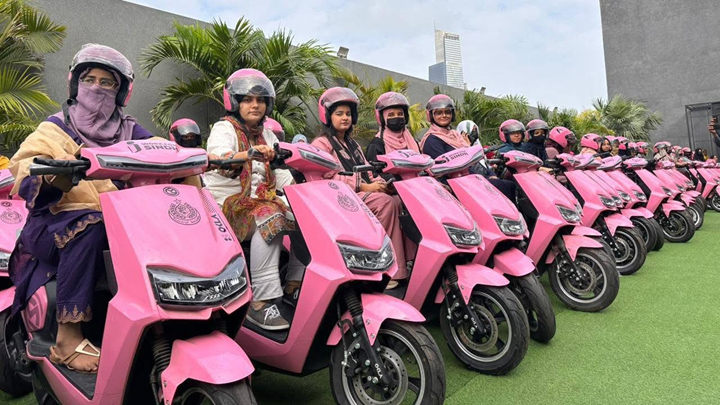
- Accessibility and Inclusion: E-bikes are proving to be lightweight, quiet, and user-friendly. They provide a much-needed, affordable mobility alternative for students, working professionals, and female commuters across cities like Lahore and Karachi.
- Innovative Technology & Infrastructure: Leading brands have expanded in Pakistan, introducing long-term battery warranties. Startups such as Zyp Technologies are actively building out charging and swapping networks, making EVs more convenient for long-distance commutes.
- Government & Private Sector Support: Green mobility projects—including massive rental service initiatives like the e-bike fleets in Punjab—are rolling out to reduce urban smog and traffic congestion.
- By providing a cheaper and cleaner ride: The two-wheeler EV market is the practical, everyday face of the green revolution.
EV revolution in Pakistan is entirely being driven by 2-wheelers. With over 30 million motorcycles on the road, this shift provides an affordable solution to inflation and high petrol prices. Sales have surged recently, shifting from a niche trend into practical, daily-commuter reality.
Current Market Status
- Explosive Sales: Driven by surging petrol prices nearing Rs. 400 per liter, sales for electric bikes and scooters have skyrocketed, making up over 10% of monthly vehicle registrations.
- Localization & Brands: The market is heavily supported by Chinese technology and Completely Knocked Down (CKD) kit imports. Popular local assemblers and brands dominate major cities like Karachi, Lahore, and Islamabad.
- Manufacturing: The Engineering Development Board (EDB) has issued over 60 manufacturing licenses to local assemblers to encourage domestic EV production.
Government Subsidies & Schemes (PAVE Program)
The Pakistani government, under the New Energy Vehicle (NEV) Policy 2025–2030, has allocated Rs. 9 billion to drive the transition. The PAVE Program provides concrete financial incentives to make EVs affordable.
- Electric 2-Wheelers: Buyers receive up to a Rs. 80,000 subsidy and zero-interest financing (up to Rs. 200,000) payable over 2 years.
- Electric 3-Wheelers (Rickshaws/Loaders): Buyers get up to a Rs. 400,000 subsidy and financing up to Rs. 1,100,000 with a maximum loan tenor of 3 years.
- Special Quotas: 25% of all subsidized vehicles are reserved for female riders and students.
Real-World Benefits vs. Challenges
- Economic Savings: Commuting on an electric two-wheeler is roughly 5 to 10 times cheaper than riding a petrol bike, saving riders thousands of rupees monthly. Excise departments also offer significant perks, such as \(95\%\) exemptions on registration fees and motor vehicle taxes in provinces like Punjab.
- Infrastructure Bottlenecks: Although public charging infrastructure is growing—with plans for 3,000 stations nationwide—the majority of charging and battery swapping is still done at home.
- Supply & Demand: High demand has occasionally outpaced the local supply of imported CKD kits, leading to temporary waiting lists for top-tier scooter models.
Status of 2 Weeler EV in Pakistan
The Pakistani electric two-wheeler market has expanded rapidly, with localized assembly and imported completely built-up (CBU) models. The top 10 companies providing electric scooters and motorcycles in Pakistan feature models with diverse speed, range, and battery options (especially Lithium-based packs). [1, 2, 3
Leading brands available across Pakistan:
- Metro E-Vehicles (MetroEV)
- Key Models: M6 Empower, E8S Pro, T9 Sport, Metrix
- Highlight: Popular for real-world reliability and diverse speed options. Models range from PKR 184,000 to PKR 335,000.
- Yadea
- Key Models: T5L, G5, Ruibin, M3H
- Highlight: Supported by Eiffel Industries, Yadea is an international brand known for reliable Lithium/Graphene setups, smart connectivity, and strong warranties (up to 4 years on LFP batteries).
- Evee Electric
- Key Models: S1 Air, S1, Gen-Z, C1 Air
- Highlight: A local favorite for stylish, lightweight scooties. Gen-Z and Air models generally range from PKR 215,000 to 275,000.
- Vlektra
- Key Models: Retro, Bolt, E-Classic Pro
- Highlight: Premium build quality and sporty, neo-retro designs. Speeds range from 70 to 105 km/h, making them full-fledged motorcycle replacements.
- Crown Electric Mobility
- Key Models: Flash, Fairy, E Turbo Eco Pro
- Highlight: Known for Lithium LFP (Lithium Iron Phosphate) battery integration and extensive nationwide after-sales networks.
- MS Jaguar
- Key Models: E-70, Miso, Bolt, E-125
- Highlight: One of the earliest EV pioneers in Pakistan. They offer classic 70cc-style builds and comfortable urban models.
- Okla
- Key Models: OKT
- Highlight: Emerging international name providing longer-range urban commuters equipped with powerful motors.
- Pakzon Electric
- Key Models: Sparrow, PE-70G, PE-70L-SE
- Highlight: Focuses on affordable commuting with both Graphene and Lithium battery variant options starting around PKR 145,000.
- Jolta Electric
- Key Models: JE-70D, JE-Scooty
- Highlight: A pioneer in local EV manufacturing, famous for converting classic, rugged 70cc motorcycle bodies into electric daily drivers.
- Eveon
- Key Models: Eveon For
- Highlight: Designed strictly for modern urban commuters, offering intelligent braking, digital displays, and zero fuel costs.
Market Share of 2 Wheelers in Pakistan
Pakistan’s electric two-wheeler market has entered a phase of explosive growth, capturing over 10% of total monthly motorcycle sales in major urban centers. Driven by surging petrol costs and supportive government policies under the PAVE program, EV registrations have surged 212% year-on-year, fundamentally shifting urban mobility across the country.
Current Market Dynamics
- Overall Market Share: While total two-wheeler market volumes (predominantly internal combustion engines) hover around 26 to 30 million units on the road, EVs now account for roughly 5% to 10% of total annual industry sales.
- Sales Surge: Over 125,000 units were registered by the end of May, with single months (like April) seeing over 40,000 EV units sold across the country.
- Scooters vs. Motorcycles: The market is highly skewed towards EV scooters, which make up about 90% of EV two-wheeler sales, leaving traditional EV motorcycles with a 10% share.
Market Share of 2 Wheelers EV instead of 4 Wheelers EV sale in Pakistan
Electric two-wheelers (EV 2Ws) heavily dominate the EV market in Pakistan, capturing an estimated 90% or more of total national EV sales. While electric cars are mostly niche and out of reach for the average consumer, skyrocketing petrol prices have pushed EV 2W market penetration to over 10% of all new monthly motorcycle sales.
Electric 2-Wheelers (Mass Adoption)
- Market Share & Sales: EV bikes have seen sales triple recently, with the segment capturing over 10% to 12% of the overall monthly two-wheeler market. By the end of May, registrations for 2W EVs alone reached 125,511 units.
- Market Dominance: Compared to passenger cars, 2Ws account for the vast majority of all electric vehicles sold in the country.
- The Drivers: Commuters are pivoting to brands to avoid staggering petrol costs. Charging an electric bike only costs about Rs. 1 to 2 per kilometer, compared to Rs. 10 per km for petrol bikes.
- Local Production: Over 40 companies have secured licenses from the Engineering Development Board to assemble and manufacture 2Ws, relying heavily on Chinese technology.
Why the Massive Gap?
- Total Cost of Ownership (TCO): With inflation hitting working-class commuters hard, saving significantly on daily petrol bills via a 2W EV is a necessity, whereas buying a 4W EV remains an unattainable luxury for most.
- Infrastructure Reliance: 2Ws can be conveniently charged at home (or via the country’s extensive rooftop solar setup). Conversely, 4Ws rely heavily on public charging stations, which are still highly limited outside of major metropolitan hubs.
Market gap for 2 Wheelers EV business in Pakistan
The most significant market gap for a new two-wheeler EV business in Pakistan lies in commercial-grade delivery fleets, localized lithium-ion battery production, and high-speed performance motorcycles. The entry-level scooty market is currently crowded with imported Chinese models.
Pakistani auto market requires targeting these distinct gaps:
1. Fleet Electrification for Logistics
- The Gap: The boom in e-commerce, food delivery, and courier services (like Foodpanda, Bykea, and Daraz) has created high demand for rugged, heavy-duty utility bikes, yet the market is heavily saturated with fragile, lightweight “scooties.”
- The Opportunity: New entries can focus on commercial B2B models featuring heavy rear cargo racks, long-range batteries (120+ km per charge), and swappable battery systems.
2. Premium/High-Speed Motorcycles
- The Gap: There is a distinct shortage of local options for riders looking to replace standard 125cc-150cc petrol bikes (like the Honda CD 70, CG 125, or Yamaha YBR) with equivalent electric power.
- The Opportunity: Capitalizing on the gap for performance motorcycles that offer speeds of 80–100 km/h, torque, and the rugged suspension required for Pakistan’s roads.
3. Localization and After-Sales Support
- The Gap: Customers express frustration over the reliance on imported Completely Knocked Down (CKD) kits, which causes shortages in spare parts. Furthermore, most buyers are cautious about investing in EVs because of low resale value and a general lack of trained mechanics outside major cities.
- The Opportunity: A new business can secure long-term loyalty by heavily localizing parts (which qualifies manufacturers for tax concessions under the government’s auto policies), and offering robust, city-wide maintenance networks and battery warranties.
4. B2B Battery Swapping Infrastructure
- The Gap: Charging infrastructure is nearly nonexistent in urban centers like Lahore, Karachi, and Islamabad.
- The Opportunity: Rather than just selling bikes, a new entry can capture market share by building centralized battery swapping stations at strategic points within cities, solving range anxiety and charging downtime for delivery riders.
Regulatory & Entry Information
The Engineering Development Board (EDB) has licensed over 40 companies under the government’s EV initiatives, which aim for electric two-wheelers to comprise 50% of new sales by 2030. New entrants are highly encouraged to review the official Ministry of Industries and Production guidelines for duty-free plant/machinery imports and concessional custom duties.
To be continue, connect with Automark and say with us “Grow Automotive Grow Pakistan”
قناعت نہ کرعالم رنگ و بو میں
چمن اور بھی اشیاں اور بھی ہیں
تو شاہیں ہے پرواز ہے کام تیرا
تیرے سامنے اسماں اور بھی ہیں
This exclusive article written by @Mumtaz Hussain on ‘Green Revolution is EV Revolution Coming by 2 Wheelers’. Published in Automark’s July-2026 printed and digital edition.