“Access to finance is important, but access to competitive manufacturing is even more important. Loans alone cannot build an economy unless they create factories, jobs, exports, and productivity.”
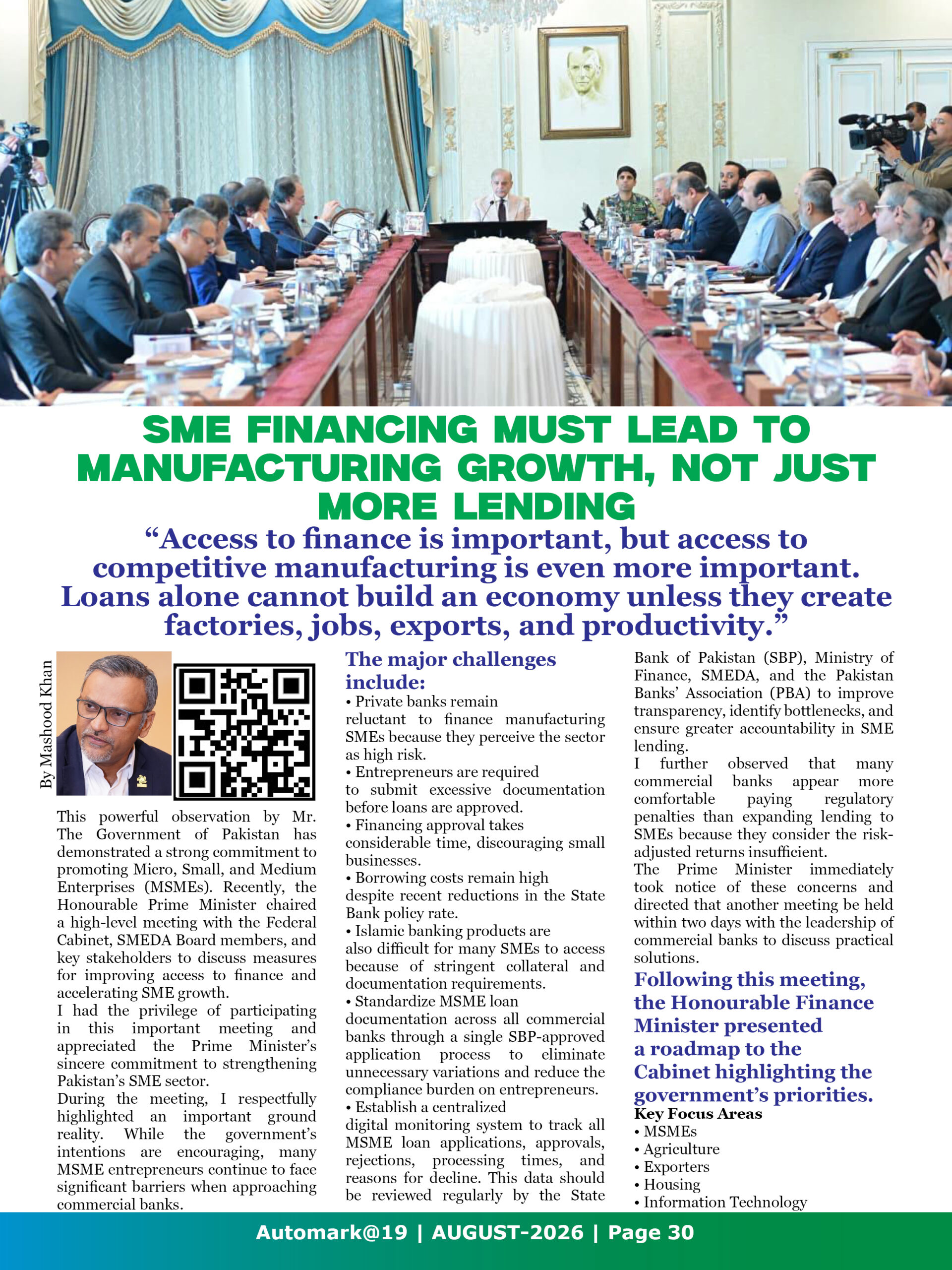
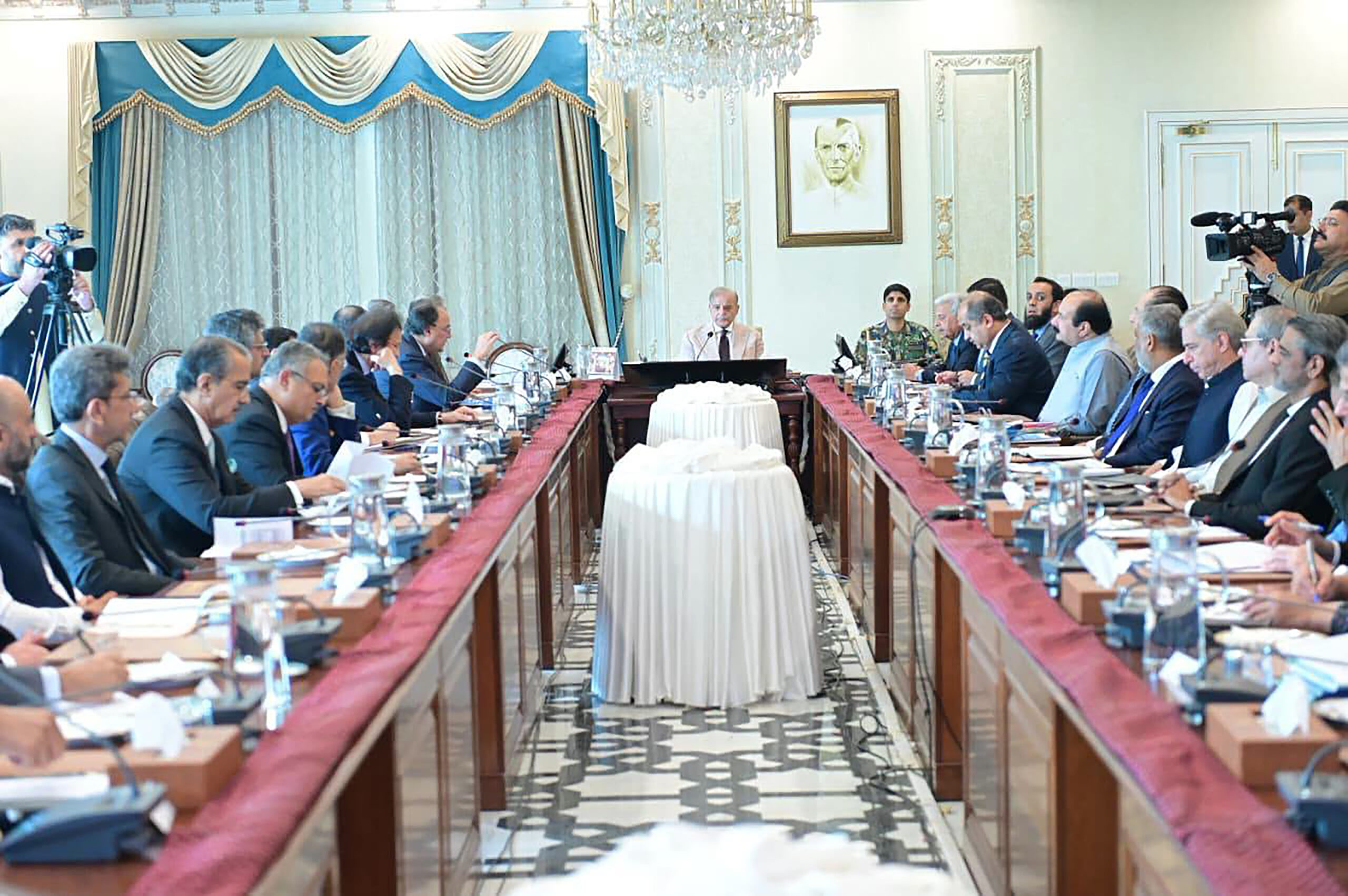
The Government of Pakistan has demonstrated a strong commitment to promoting Micro, Small, and Medium Enterprises (MSMEs). Recently, the Honourable Prime Minister chaired a high-level meeting with the Federal Cabinet, SMEDA Board members, and key stakeholders to discuss measures for improving access to finance and accelerating SME growth.
I had the privilege of participating in this important meeting and appreciated the Prime Minister’s sincere commitment to strengthening Pakistan’s SME sector.
During the meeting, I respectfully highlighted an important ground reality. While the government’s intentions are encouraging, many MSME entrepreneurs continue to face significant barriers when approaching commercial banks.
The major challenges include:
- Private banks remain reluctant to finance manufacturing SMEs because they perceive the sector as high risk.
- Entrepreneurs are required to submit excessive documentation before loans are approved.
- Financing approval takes considerable time, discouraging small businesses.
- Borrowing costs remain high despite recent reductions in the State Bank policy rate.
- Islamic banking products are also difficult for many SMEs to access because of stringent collateral and documentation requirements.
- Standardize MSME loan documentation across all commercial banks through a single SBP-approved application process to eliminate unnecessary variations and reduce the compliance burden on entrepreneurs.
- Establish a centralized digital monitoring system to track all MSME loan applications, approvals, rejections, processing times, and reasons for decline. This data should be reviewed regularly by the State Bank of Pakistan (SBP), Ministry of Finance, SMEDA, and the Pakistan Banks’ Association (PBA) to improve transparency, identify bottlenecks, and ensure greater accountability in SME lending.
I further observed that many commercial banks appear more comfortable paying regulatory penalties than expanding lending to SMEs because they consider the risk-adjusted returns insufficient.
The Prime Minister immediately took notice of these concerns and directed that another meeting be held within two days with the leadership of commercial banks to discuss practical solutions.
Following this meeting, the Honourable Finance Minister presented a roadmap to the Cabinet highlighting the government’s priorities.
Key Focus Areas
- MSMEs
- Agriculture
- Exporters
- Housing
- Information Technology
- Renewable Energy
The government also proposed:
- Performance-based incentives through taxation and capital relief measures.
- Formation of a Core Working Group comprising the Ministry of Finance, State Bank of Pakistan (SBP), SECP, SMEDA, and the Pakistan Banks’ Association (PBA).
- Increasing SME financing from the current 7% of private sector credit (June 2026) to 10% within the next 24 months.
- Expanding outstanding SME financing from approximately PKR 900 billion to PKR 1.5 trillion.
- Increasing active SME borrowers from around 300,000 to 750,000 businesses.
These are ambitious and encouraging targets.
However, one important sector deserves greater attention—manufacturing, particularly engineering and value-added industries.
Manufacturing should be identified as a separate priority sector because it creates long-term economic value through production, employment, localization, technology transfer, and exports.
The government should also establish sector-wise financing targets for:
- Engineering Manufacturing
- Light Engineering
- Textile Manufacturing
- Auto Parts
- Electrical & Electronics
- Agricultural Machinery
- Chemicals
- Pharmaceuticals
- Food Processing
- Other value-added manufacturing sectors
Manufacturing enterprises generally require two different types of financing:
- Working Capital Financing for purchasing raw materials and managing production.
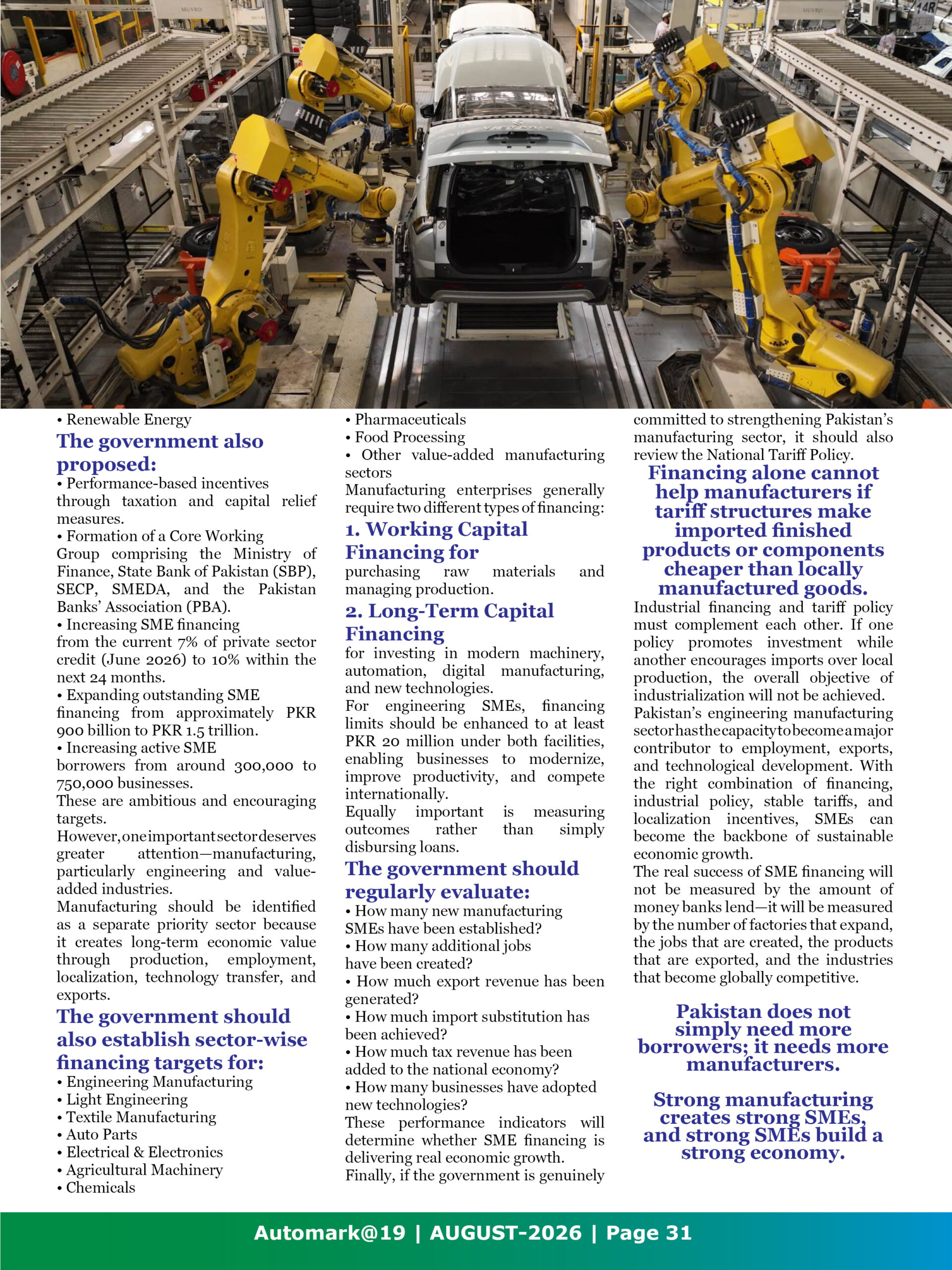
- Long-Term Capital Financing for investing in modern machinery, automation, digital manufacturing, and new technologies.
For engineering SMEs, financing limits should be enhanced to at least PKR 20 million under both facilities, enabling businesses to modernize, improve productivity, and compete internationally.
Equally important is measuring outcomes rather than simply disbursing loans.
The government should regularly evaluate:
- How many new manufacturing SMEs have been established?
- How many additional jobs have been created?
- How much export revenue has been generated?
- How much import substitution has been achieved?
- How much tax revenue has been added to the national economy?
- How many businesses have adopted new technologies?
These performance indicators will determine whether SME financing is delivering real economic growth.
Finally, if the government is genuinely committed to strengthening Pakistan’s manufacturing sector, it should also review the National Tariff Policy. Financing alone cannot help manufacturers if tariff structures make imported finished products or components cheaper than locally manufactured goods.
Industrial financing and tariff policy must complement each other. If one policy promotes investment while another encourages imports over local production, the overall objective of industrialization will not be achieved.
Pakistan’s engineering manufacturing sector has the capacity to become a major contributor to employment, exports, and technological development. With the right combination of financing, industrial policy, stable tariffs, and localization incentives, SMEs can become the backbone of sustainable economic growth.
The real success of SME financing will not be measured by the amount of money banks lend—it will be measured by the number of factories that expand, the jobs that are created, the products that are exported, and the industries that become globally competitive.
Pakistan does not simply need more borrowers; it needs more manufacturers. Strong manufacturing creates strong SMEs, and strong SMEs build a strong economy.
By Mashood Khan
Director – Mehran Commercial Enterprises
Expert Auto Sector / Former Chairman PAAPAM / Director – SMEDA
Published in Automark’s August-2026 printed edtion.