What I saw at Lahore Expo Centre was more than a three-day automobile exhibition. It was a glimpse of how fundamentally Pakistan’s automotive industry is beginning to change.
Having spent more than three decades in Pakistan’s automotive industry, I have seen the market move through very different phases, from a relatively protected market dominated by a few Japanese manufacturers, to increasing localization, changing consumer expectations, the arrival of Korean brands, and now a rapidly expanding wave of Chinese automotive technology and electrification.
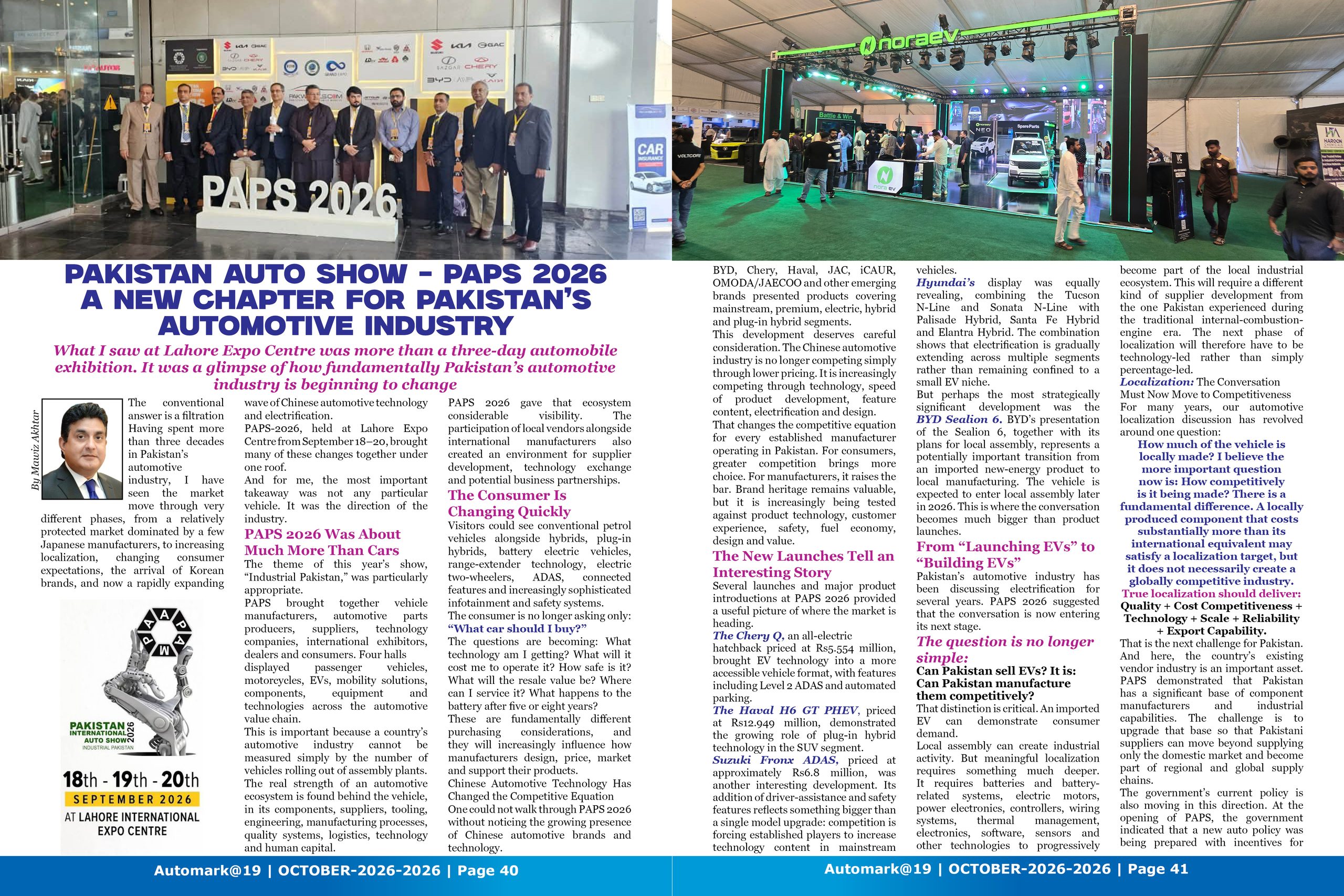
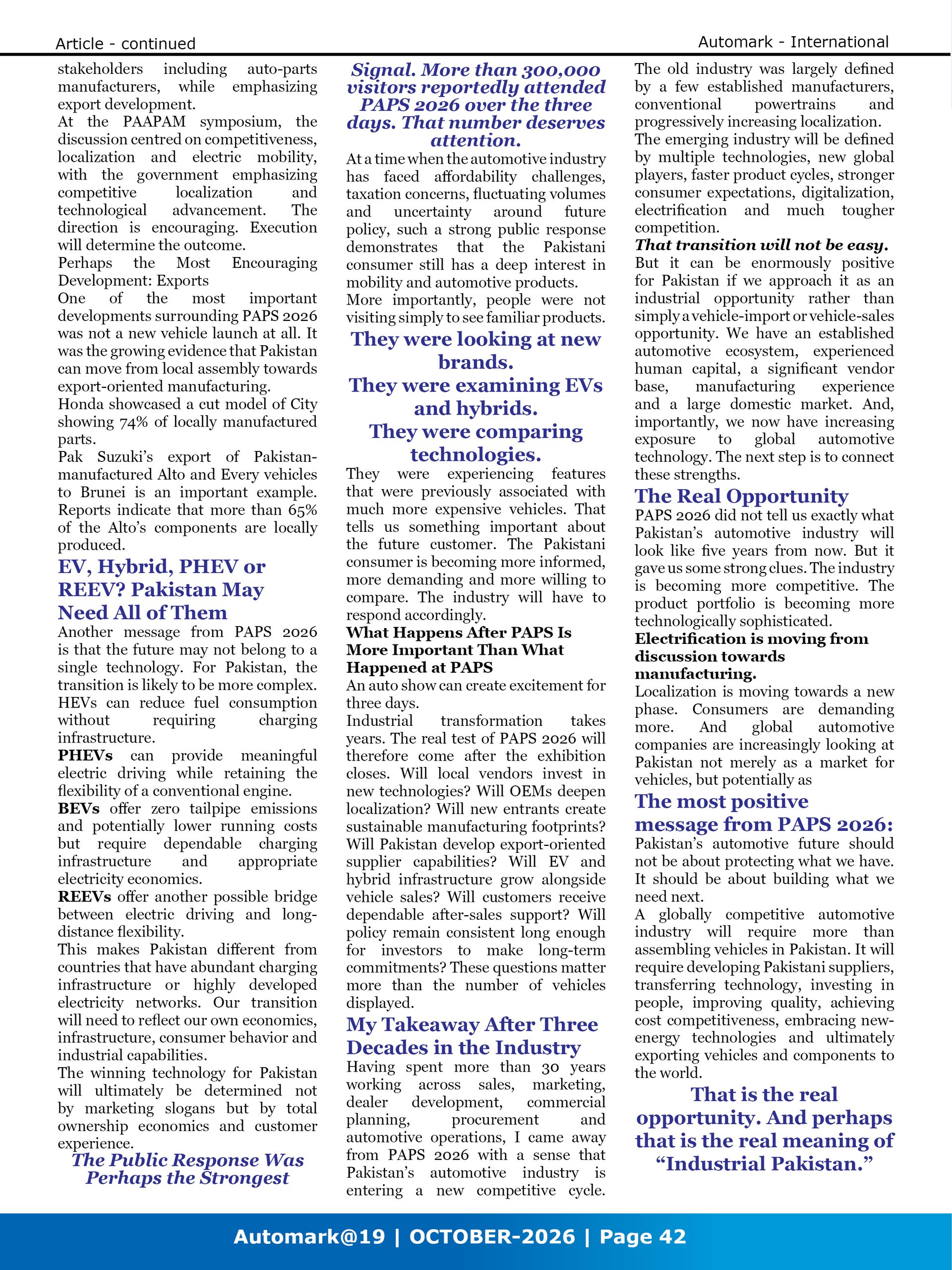
The Pakistan International Auto Show (PAPS) 2026, held at Lahore Expo Centre from September 18–20, brought many of these changes together under one roof.
And for me, the most important takeaway was not any particular vehicle. It was the direction of the industry.
PAPS 2026 Was About Much More Than Cars
The theme of this year’s show, “Industrial Pakistan,” was particularly appropriate.
PAPS brought together vehicle manufacturers, automotive parts producers, suppliers, technology companies, international exhibitors, dealers and consumers. Four halls
displayed passenger vehicles, motorcycles, EVs, mobility solutions, components, equipment and technologies across the automotive value chain.
This is important because a country’s automotive industry cannot be measured simply by the number of vehicles rolling out of assembly plants.
The real strength of an automotive ecosystem is found behind the vehicle, in its components, suppliers, tooling, engineering, manufacturing processes, quality systems, logistics, technology and human capital.
PAPS 2026 gave that ecosystem considerable visibility. The participation of local vendors alongside international manufacturers also created an environment for supplier development, technology exchange and potential business partnerships. The involvement of SMEDA as a strategic partner further underlined the importance of integrating SMEs into the industrial value chain. That, in my view, is one of the most encouraging aspects of this year’s show.
The Consumer Is Changing Quickly
Perhaps the most striking difference from the auto shows of the past was the sheer diversity of technology on display.
Visitors could see conventional petrol vehicles alongside hybrids, plug-in hybrids, battery electric vehicles, range-extender technology, electric two-wheelers, ADAS, connected features and increasingly sophisticated infotainment and safety systems.
The consumer is no longer asking only:
“What car should I buy?”
The questions are becoming: What technology am I getting? What will it cost me to operate it? How safe is it? What will the resale value be? Where can I service it? What happens to the battery after five or eight years?
These are fundamentally different purchasing considerations, and they will increasingly influence how manufacturers design, price, market and support their products.
Chinese Automotive Technology Has Changed the Competitive Equation
One could not walk through PAPS 2026 without noticing the growing presence of Chinese automotive brands and technology.
BYD, Chery, Haval, JAC, iCAUR, OMODA/JAECOO and other emerging brands presented products covering mainstream, premium, electric, hybrid and plug-in hybrid segments.
This development deserves careful consideration. The Chinese automotive industry is no longer competing simply through lower pricing. It is increasingly competing through technology, speed of product development, feature content, electrification and design. That changes the competitive equation for every established manufacturer operating in Pakistan. For consumers, greater competition brings more choice. For manufacturers, it raises the bar. Brand heritage remains valuable, but it is increasingly being tested against product technology, customer experience, safety, fuel economy, design and value.
The New Launches Tell an Interesting Story
Several launches and major product introductions at PAPS 2026 provided a useful picture of where the market is heading.
The Chery Q, an all-electric hatchback priced at Rs5.554 million, brought EV technology into a more accessible vehicle format, with features including Level 2 ADAS and automated parking.
The Haval H6 GT PHEV, priced at Rs12.949 million, demonstrated the growing role of plug-in hybrid technology in the SUV segment.
Suzuki Fronx ADAS, priced at approximately Rs6.8 million, was another interesting development. Its addition of driver-assistance and safety features reflects something bigger than a single model upgrade: competition is forcing established players to increase technology content in mainstream vehicles.
Hyundai’s display was equally revealing, combining the Tucson N-Line and Sonata N-Line with Palisade Hybrid, Santa Fe Hybrid and Elantra Hybrid. The combination shows that electrification is gradually extending across multiple segments rather than remaining confined to a small EV niche.
But perhaps the most strategically significant development was the BYD Sealion 6. BYD’s presentation of the Sealion 6, together with its plans for local assembly, represents a potentially important transition from an imported new-energy product to local manufacturing. The vehicle is expected to enter local assembly later in 2026. This is where the conversation becomes much bigger than product launches.
From “Launching EVs” to “Building EVs”
Pakistan’s automotive industry has been discussing electrification for several years. PAPS 2026 suggested that the conversation is now entering its next stage.
The question is no longer simple:
Can Pakistan sell EVs? It is: Can Pakistan manufacture them competitively?
That distinction is critical. An imported EV can demonstrate consumer demand.
Local assembly can create industrial activity. But meaningful localization requires something much deeper. It requires batteries and battery-related systems, electric motors, power electronics, controllers, wiring systems, thermal management, electronics, software, sensors and other technologies to progressively become part of the local industrial ecosystem. This will require a different kind of supplier development from the one Pakistan experienced during the traditional internal-combustion-engine era. The next phase of localization will therefore have to be technology-led rather than simply percentage-led.
Localization: The Conversation Must Now Move to Competitiveness
For many years, our automotive localization discussion has revolved around one question:
How much of the vehicle is locally made? I believe the more important question now is: How competitively is it being made? There is a fundamental difference. A locally produced component that costs substantially more than its international equivalent may satisfy a localization target, but it does not necessarily create a globally competitive industry. True localization should deliver:
Quality + Cost Competitiveness + Technology + Scale + Reliability + Export Capability.
That is the next challenge for Pakistan. And here, the country’s existing vendor industry is an important asset. PAPS demonstrated that Pakistan has a significant base of component manufacturers and industrial capabilities. The challenge is to upgrade that base so that Pakistani suppliers can move beyond supplying only the domestic market and become part of regional and global supply chains.
The government’s current policy is also moving in this direction. At the opening of PAPS, the government indicated that a new auto policy was being prepared with incentives for stakeholders including auto-parts manufacturers, while emphasizing export development.
At the PAAPAM symposium, the discussion centred on competitiveness, localization and electric mobility, with the government emphasizing competitive localization and technological advancement. The direction is encouraging. Execution will determine the outcome.
Perhaps the Most Encouraging Development: Exports
One of the most important developments surrounding PAPS 2026 was not a new vehicle launch at all. It was the growing evidence that Pakistan can move from local assembly towards export-oriented manufacturing.
Honda showcased a cut model of City showing 74% of locally manufactured parts.
Pak Suzuki’s export of Pakistan-manufactured Alto and Every vehicles to Brunei is an important example. Reports indicate that more than 65% of the Alto’s components are locally produced.
EV, Hybrid, PHEV or REEV? Pakistan May Need All of Them
Another message from PAPS 2026 is that the future may not belong to a single technology. For Pakistan, the transition is likely to be more complex.
HEVs can reduce fuel consumption without requiring charging infrastructure.
PHEVs can provide meaningful electric driving while retaining the flexibility of a conventional engine.
BEVs offer zero tailpipe emissions and potentially lower running costs but require dependable charging infrastructure and appropriate electricity economics.
REEVs offer another possible bridge between electric driving and long-distance flexibility.
This makes Pakistan different from countries that have abundant charging infrastructure or highly developed electricity networks. Our transition will need to reflect our own economics, infrastructure, consumer behavior and industrial capabilities.
The winning technology for Pakistan will ultimately be determined not by marketing slogans but by total ownership economics and customer experience.
The Public Response Was Perhaps the Strongest Signal. More than 300,000 visitors reportedly attended PAPS 2026 over the three days. That number deserves attention.
At a time when the automotive industry has faced affordability challenges, taxation concerns, fluctuating volumes and uncertainty around future policy, such a strong public response demonstrates that the Pakistani consumer still has a deep interest in mobility and automotive products.
More importantly, people were not visiting simply to see familiar products.
They were looking at new brands. They were examining EVs and hybrids. They were comparing technologies. They were experiencing features that were previously associated with much more expensive vehicles. That tells us something important about the future customer. The Pakistani consumer is becoming more informed, more demanding and more willing to compare. The industry will have to respond accordingly.
What Happens After PAPS Is More Important Than What Happened at PAPS
An auto show can create excitement for three days.
Industrial transformation takes years. The real test of PAPS 2026 will therefore come after the exhibition closes. Will local vendors invest in new technologies? Will OEMs deepen localization? Will new entrants create sustainable manufacturing footprints? Will Pakistan develop export-oriented supplier capabilities? Will EV and hybrid infrastructure grow alongside vehicle sales? Will customers receive dependable after-sales support? Will policy remain consistent long enough for investors to make long-term commitments? These questions matter more than the number of vehicles displayed.
My Takeaway After Three Decades in the Industry
Having spent more than 30 years working across sales, marketing, dealer development, commercial planning, procurement and automotive operations, I came away from PAPS 2026 with a sense that Pakistan’s automotive industry is entering a new competitive cycle. The old industry was largely defined by a few established manufacturers, conventional powertrains and progressively increasing localization. The emerging industry will be defined by multiple technologies, new global players, faster product cycles, stronger consumer expectations, digitalization, electrification and much tougher competition.
That transition will not be easy. But it can be enormously positive for Pakistan if we approach it as an industrial opportunity rather than simply a vehicle-import or vehicle-sales opportunity. We have an established automotive ecosystem, experienced human capital, a significant vendor base, manufacturing experience and a large domestic market. And, importantly, we now have increasing exposure to global automotive technology. The next step is to connect these strengths.
The Real Opportunity
PAPS 2026 did not tell us exactly what Pakistan’s automotive industry will look like five years from now. But it gave us some strong clues. The industry is becoming more competitive. The product portfolio is becoming more technologically sophisticated. Electrification is moving from discussion towards manufacturing. Localization is moving towards a new phase. Consumers are demanding more. And global automotive companies are increasingly looking at Pakistan not merely as a market for vehicles, but potentially as
The most positive message from PAPS 2026: Pakistan’s automotive future should not be about protecting what we have. It should be about building what we need next.
A globally competitive automotive industry will require more than assembling vehicles in Pakistan. It will require developing Pakistani suppliers, transferring technology, investing in people, improving quality, achieving cost competitiveness, embracing new-energy technologies and ultimately exporting vehicles and components to the world.
That is the real opportunity. And perhaps that is the real meaning of “Industrial Pakistan.”
#PAPS2026 #PakistanAutomotiveIndustry #AutomotiveIndustry #Localization #AutomotiveManufacturing #EV #Hybrid #PHEV #AutoParts #MadeInPakistan #PAAPAM #FutureOfMobility #Pakistan
This exclusive article has been written by Mawiz Akhtar and published in Automark’s October-2026 printed/digital edition.