
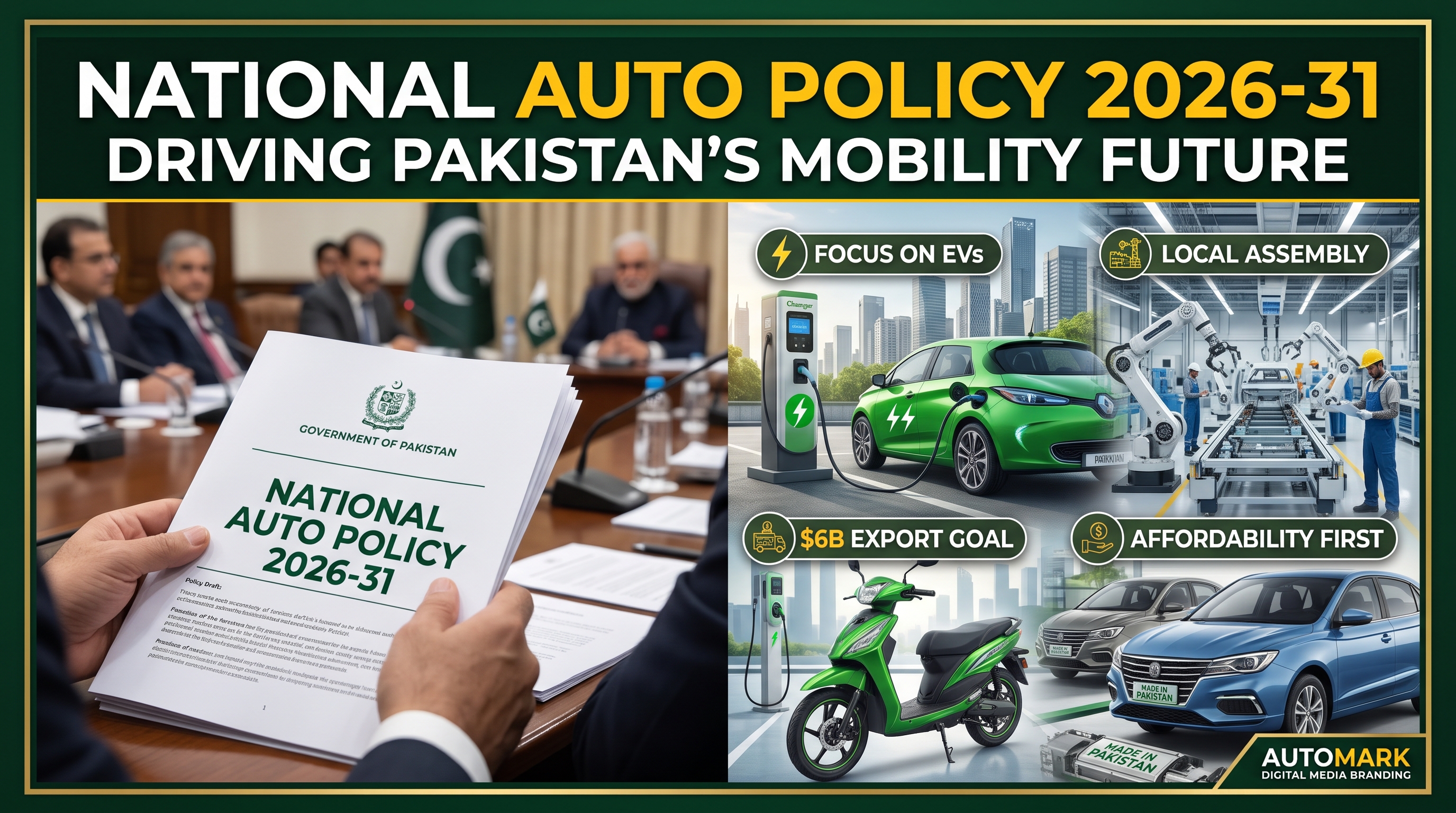
On Saturday, 7 November 2026, the federal government set out its new auto policy for 2026-31 at a joint press conference in Islamabad. Information Minister Attaullah Tarar and Haroon Akhtar Khan, Adviser to the Prime Minister on Industries and Production, presented it. Mr Tarar said the aim was to address speculation before the approval process moves ahead. For buyers, dealers and investors who have waited months for clarity, that is good news: the details are now public.
What the government said
- Cheaper vehicles. Duties on completely built units, assembly kits and components will fall each year until tariffs become
competitive after five years; the adviser said prices of all vehicles except luxury models will come down gradually [1][3]. Reducing
prices of vehicles below 1,300cc is the Prime Minister’s special priority [4][9]. Earlier reporting put the cap on car customs duty at
15% by FY2030-31, in slabs of 0, 5, 10 and 15% [16]. - Exports with rewards. Exporters get 5% DLTL, with 10% more on incremental growth; car makers qualify for DLTL when they
meet both export and local-manufacturing targets [1][3]. The export goal is US$6 billion over five years [9]. - Localisation and jobs. Local manufacturing is mandatory, with targets given to manufacturers, so that more plants and more
jobs are created in Pakistan [1]. - Buyer protection. Makers cannot take more than 20% of the price as advance at booking, which tackles the “on-money”
problem [2][5]. Earlier reporting adds a price lock after booking and a confirmed delivery date [16]. Third-party audits support
transparency [2]. - EV benefits. No CVT, withholding tax or FED on EVs priced up to US$50,000; EV loans up to Rs10m over five years;
charging-station equipment at 1% sales tax with customs duty removed; the Prime Minister’s 30% EV target for 2030 may come
sooner [1][3]. - Competition. Government says no automaker holds a monopoly: 16 car/SUV makers and about 100 two-wheeler makers
operate in Pakistan [1]. Mr Tarar invited manufacturers to set up EV plants and export [4]
Six pillars, one direction
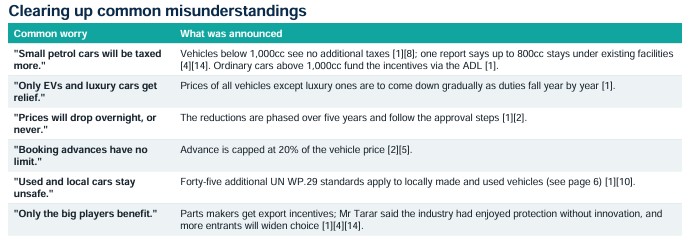
The policy rests on six pillars: cheaper vehicles, exports, localisation, vehicle safety, EV promotion and transparency. Prime Minister Shehbaz Sharif has approved it, and the Cabinet process has begun.
What buyers can expect
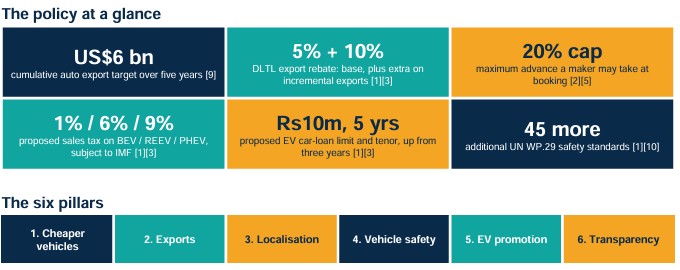
Duties on completely built units, assembly kits and components will fall each year until tariffs become competitive after five years. The adviser said prices of all vehicles except luxury models will come down gradually. Reducing prices of vehicles below 1,300cc is a personal priority of the Prime Minister.
Small-car owners can relax. Ministers said vehicles below 1,000cc face no additional taxes. One outlet reported the cut-off as 800cc, but most reports say 1,000cc. The incentives are instead funded by an Automotive Development Levy on vehicles above 1,000cc.
Buyers also get a booking safeguard. Manufacturers cannot take more than 20% of a vehicle’s price as advance, which targets the “on-money” practice that has frustrated many customers. Earlier reporting adds a price lock after booking and a confirmed delivery date.
A strong push for EVs
The proposed sales tax is 1% on fully electric vehicles, 6% on range-extended models and 9% on plug-in hybrids, subject to IMF approval. No capital value tax, withholding tax or federal excise duty applies to EVs priced up to US$50,000. The State Bank’s car-finance limit for EVs rises to Rs10 million, with the tenor extended from three to five years. Charging-station equipment gets 1% sales tax and zero customs duty, and the government will help fund the gap that holds back charging investment.
The momentum is real. Electric two-wheeler sales grew from 60,000 in FY2024-25 to 240,000 in FY2025-26, and the government believes the 30% EV share target for 2030 may arrive sooner.
Exports, jobs and competition
The policy sets a US$6 billion export target over five years. Exporters earn a 5% rebate (DLTL), with 10% more on incremental growth, and car makers qualify when they meet both export and local-manufacturing targets. Localization is mandatory, with targets for each manufacturer, so that more plants, vendors and jobs are created in Pakistan. Pakistan already has 16 car and SUV makers and about 100 two-wheeler makers, and more entrants are welcome.
Safer vehicles
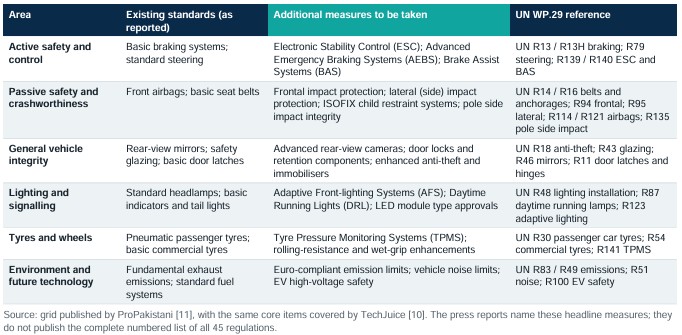
The policy adds 45 safety standards aligned with the UN WP.29 code, covering locally made and used vehicles. Media reports describe a step toward 69 mandatory regulations in total. The measures named include electronic stability control, advanced emergency braking, brake assist, side- and frontal-impact protection, ISOFIX child restraints, rear-view cameras, tyre pressure monitoring, adaptive lighting and EV high-voltage safety. Verification runs through PSQCA with third-party audits, and full adoption is targeted for the fourth quarter of 2028. The press reports name these headline measures but do not publish the full numbered list of all 45.
What still has to happen
Here is where clarity matters most. The press conference was a briefing to manufacturers and the public. It is not the legal notification, and benefits take effect as each step is completed:
- Prime Minister approval: done.
- IMF review: ongoing. The EV tax rates are subject to its approval, and talks on the 1% EV tax continue.
- Economic Coordination Committee: pending.
- Federal Cabinet: process begun.
- Parliament and a Finance Bill: pending.
- Notification: pending.
The IMF, ECC and Parliament sequence follows ProPakistani’s earlier reporting. One outlet described the policy as effective immediately, while others point to further approvals, so we treat benefits as taking effect once notified.
Where reports differ
Outlets gave different figures for the small-car cut-off (800cc or 1,000cc), the current EV loan limit (Rs2m or Rs3m) and the export target (a five-year total, or growth from about US$200 million to US$6 billion). Readers should treat the most widely reported figure as the working number until notification.
Our view
The package is simple to explain: lower tax and cheaper price, funded by a levy on larger petrol cars, with small cars left alone and buyers protected at booking. IMF clearance of the EV tax rates is the key item, since the remaining steps depend on it. A clear public briefing is the right first step, and the next one is a published, numbered list of the safety measures with dates.
Author’s Note
This article is built entirely on 19 news-media reports on the 7 November 2026 announcement. It is written for public awareness, to put accurate information in front of buyers, industry and investors. Where outlets differ, I have said so. The “Our view” section is SAAZ Re-Search’s assessment, not an official statement.
SAAZ Re-Search | Auto Sector Research | Islamabad, 8 November 2026
#Pakistan #AutoPolicy #AutoPolicy2026 #AutomotiveIndustry #ElectricVehicles #EV #NEV #VehicleSafety #Localisation #Exports #IMF #SAAZReSearch #PakistanEconomy #Automark