
Millat Tractors Limited’s Strategic Expansion into Pakistan’s Electric Two-Wheeler Market

- Author’s Note:
Pakistan’s automotive sector enters the last weeks of 2026 with a rare piece of news: the country’s largest tractor manufacturer, Millat Tractors Limited (MTL), is about to launch five lithium-ion electric motorcycles and scooters on 29 November 2026 at Expo Centre Lahore. This independent brief, prepared by SAAZ Re-Search on 26 November 2026, studies whether a heavy-engineering group built on iron castings, diesel engines and rural dealerships can win a place in an urban, fast-moving electric two-wheeler market.
What this report covers. We profile MTL and its group companies, map the net of tractor and non-tractor businesses that feed the new venture, explain the technology partnership with China’s Xiao Dao (XDAO), explore the electric bike and scooter trend in Pakistan, benchmark competitor prices, and assess which dealerships and service assets can help Millat sell and support two-wheelers. A business-plan sensitivity, policy review, risk assessment and full source list follow.
How to read the numbers. Company figures are from MTL filings, the PSX corporate briefing and broker notes reported in November 2026. Competitor prices are November 2026 retail tags. Market-volume figures marked as dealer estimates are not official statistics. Items labelled SAAZ view or illustrative are our own analysis and not company disclosures.
Pre-launch limitation. Millat has not yet published model names, battery capacities, motor ratings, range or prices. Wherever this report discusses Millat’s price position, it uses competitor benchmarks and planning assumptions, not confirmed company figures. SAAZ Re-Search will issue an update once the 29 November launch details are public.Data notes. Where sources differ, we show the more detailed company-level figure and say so. For example, the group non-tractor specification sheet lists diesel generating sets from 12.5 to 250 kVA, while one broker summary quotes 15 to 500 kVA; we use the specification sheet. Tractor industry volume is quoted as 28,000-30,000 units per year, with 28,791 units reported for FY26
Disclaimer
SAAZ Re-Search is an independent Pakistan-focused automotive and mobility intelligence desk. This document is research and does not constitute investment, legal or tax advice. All figures are as reported or are reasonable market estimates and may change after the launch.
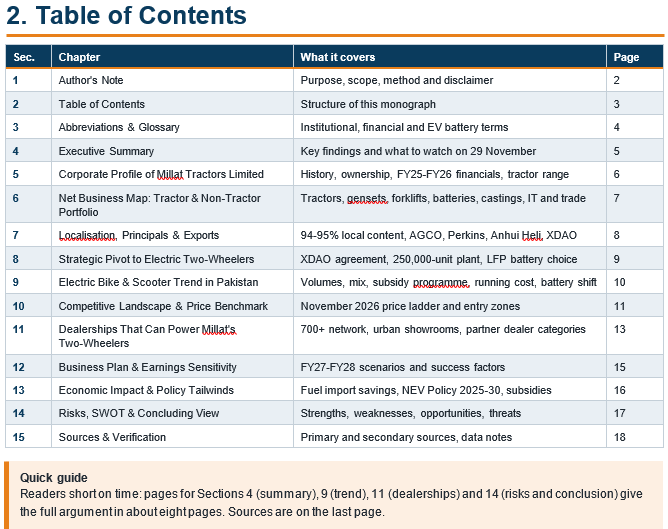
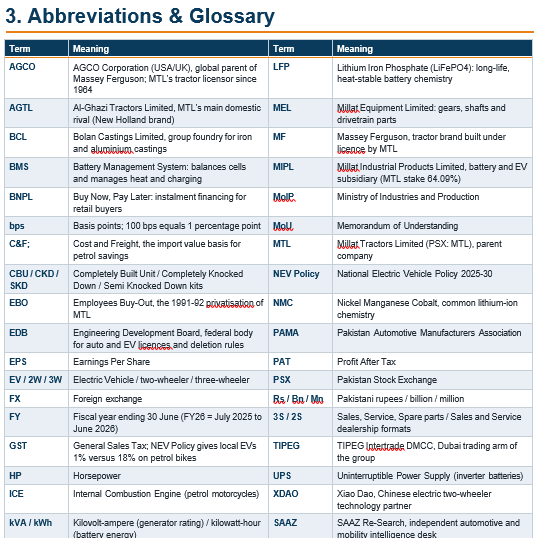

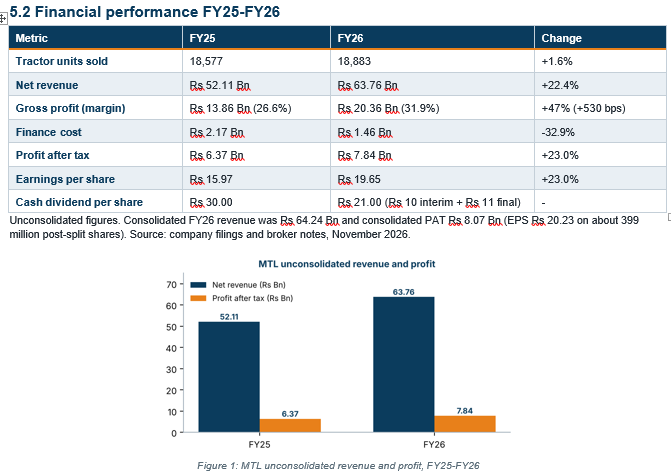
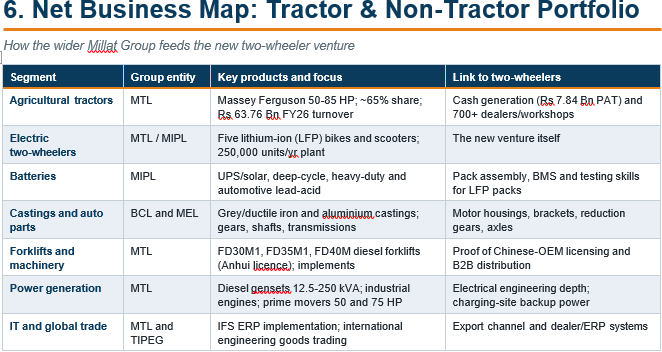
Millat Tractors is not an EV start-up. It is a Rs 63.76 billion engineering group with ~65% of Pakistan’s tractor market, a captive foundry, a gear maker, a battery maker, 200+ local vendors and 700+ dealers and workshops. In November 2026 it is turning those assets towards electric two-wheelers, the fastest-growing vehicle category in the country.
Key findings
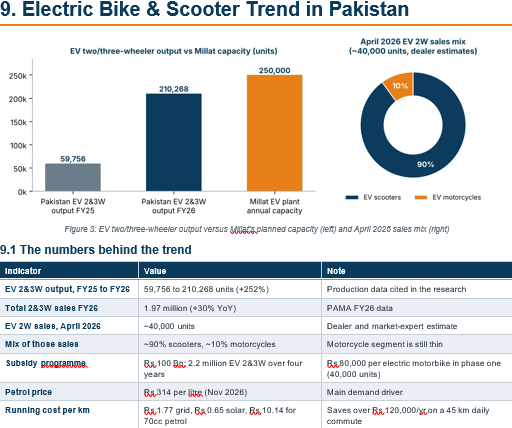
- – Why now. Domestic tractor demand is stuck near 28,000-30,000 units a year, and MTL’s own tractor sales fell from 30,203 (FY24) to 18,883 (FY26). Over the same period EV two/three-wheeler output rose 252% to 210,268 units, inside a 1.97 million-unit two/three-wheeler market.
- – What Millat is launching. Five lithium-ion (LFP) motorcycles and scooters, unveiled 29 November 2026 at Expo Centre Lahore, built by MIPL with XDAO platform and battery technology. Production has started on a plant sized at 250,000 units a year.
- – The edge. Local frames, castings, gears and battery packs, plus a service footprint no EV start-up has. Kit-assembled rivals run at roughly 15% localisation and have faced 30-day delivery backlogs.
- –The price question. Competitors span Rs 195,000 (Evee LX) to Rs 444,000 (Yadea Velax). SAAZ sees credible Millat entry zones at Rs 210-240k, Rs 270-315k and Rs 335-385k; these are our planning view, not announced prices.
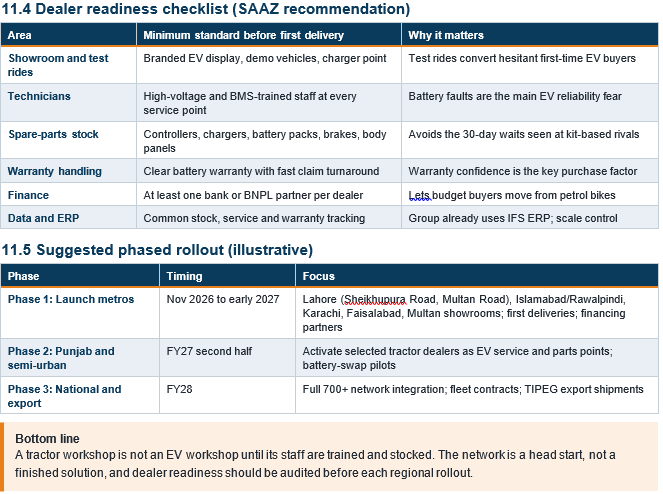
- – Dealerships. A two-tier model, with urban EV showrooms and 700+ tractor dealer integration for spares, diagnostics and battery swap, is the single most important differentiator in service confidence and rural reach.
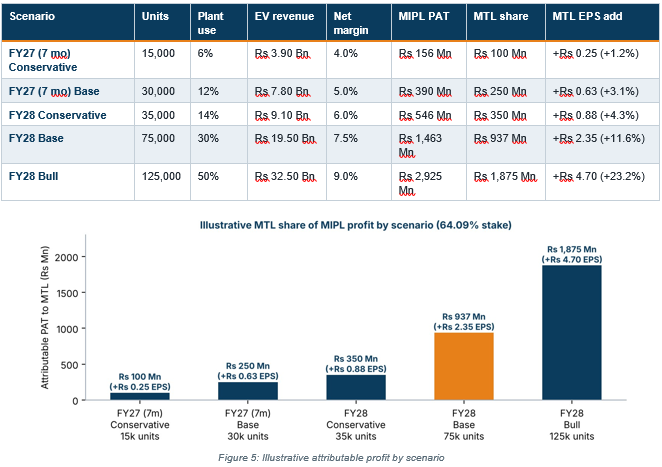
- – Earnings. Our illustrative base case (75,000 units in FY28) adds about Rs 937 million of attributable profit, or +Rs
- 2.35 EPS (~12% of FY26 consolidated PAT). Bull and conservative cases range from Rs 4.70 to Rs 0.88.
- – Main risks. Brand perception, battery quality and cell import dependence, consumer financing, competitor response and policy continuity.
What to watch on 29 November Model names, battery capacity (kWh), motor power, claimed range, warranty terms, launch prices, dealer list, financing partners and delivery timelines. These six disclosures will decide whether the plan below holds
5. Corporate Profile of Millat Tractors Limited
5.1 Origins, ownership and age
MTL was established in Lahore in 1964 (62 years ago) as Rana Tractors and Equipment Limited by brothers Rana Khudadad Khan and Rana Allahdaad Khan. It began by importing Massey Ferguson tractors and started
semi-knocked-down assembly on Sheikhupura Road in 1967. After nationalisation in 1972 under the Pakistan Tractor Corporation it was renamed Millat Tractors Limited.
Sikandar Mustafa Khan, Managing Director from October 1985, drove local engine assembly and machining and led the 1991-92 Employees Buy-Out. The group then added Bolan Castings (1993), Millat Equipment (1994) and Millat Industrial Products (1999). MTL is listed on the PSX with a market capitalisation of about Rs 118-120 billion (45% free float) and holds roughly 65% of the domestic tractor market against Al-Ghazi Tractors at 30-35%.
6.1 Diesel generating sets (12.5-250 kVA)
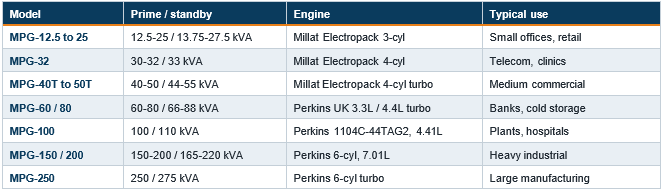
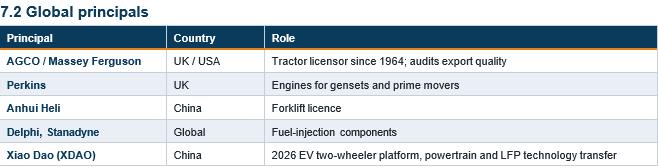
The range splits into a localised line (12.5-50 kVA, up to 75% local content on Millat Electropack engines) and a heavy commercial line (60-250 kVA on imported Perkins UK engines). Both use Leroy Somer or Stamford alternators with a 12-month / 1,200-hour warranty.
6.2 Forklift trucks and batteries
Forklifts are built under licence from Anhui Forklift Truck Group (Heli/TCM technology) at about 35% localisation. FD30M carries 3,000 kg, FD35M 3,500 kg and FD40M 4,000 kg at a 500 mm load centre and 3,000 mm lift height, powered by the Millat D3.1524 3-cylinder diesel (travel speed about 15.3 km/h, FD40M about 18 km/h).
MIPL’s 12V lead-acid range covers UPS/inverter (105-200 Ah), deep-cycle (55-200 Ah), heavy-duty MP series (120-155 Ah), automotive and maintenance-free (35-95 Ah) and small solar/bike batteries (4.5-55 Ah). The new two-wheelers use lithium-ion LFP packs through the XDAO technology transfer, not this lead-acid range; MIPL’s value is in its plant, test labs and power-electronics people.
7. Localisation, Principals & Exports
7.1 94-95% localisation
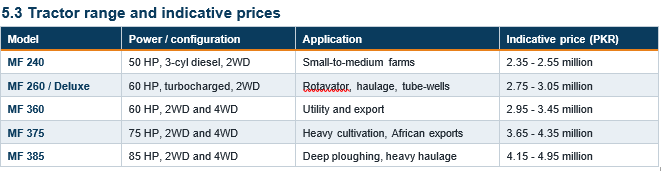
Unlike passenger-car assemblers that rely on imported CKD kits, MTL reaches 94-95% local content on the 50-85 HP tractor range. Castings come from Bolan Castings, gears and shafts from Millat Equipment, batteries from MIPL, and over 200 tier-1 and tier-2 vendors in Punjab and Sindh supply sheet metal, hydraulics, radiators and harnesses. The company says this keeps its cost per horsepower below comparable Indian and Chinese tractors.
7.3 Exports and own-brand milestone
MTL secured export rights from AGCO in 2015 and set up TIPEG Intertrade DMCC in Dubai. Tractor exports passed 2,500 units in FY24 but fell to 1,384 in FY26 after Afghanistan border closures stopped shipments (350 units had gone before the closure). Management targets 2,000 non-Afghanistan units, led by Mexico (600-700) and
Sub-Saharan Africa, helped by a December 2025 AGCO/Massey Ferguson agreement allowing exports to Africa under Millat’s own brand. The XDAO agreement gives Millat export rights for localised EVs, a similar template.
7.4 What transfers to two-wheelers
- Battery know-how: MIPL’s assembly lines and labs can be upgraded to LFP pack assembly and BMS integration.
- Precision parts: BCL and MEL can supply motor housings, gears and axles.
- Vendor base: 200+ suppliers for frames, suspensions, wheels, harnesses and plastics.
- Deletion expertise: long experience with progressive localisation under EDB oversight.
- Brand trust: rural credibility that urban EV brands struggle to reach.
8. Strategic Pivot to Electric Two-Wheelers
8.1 Why diversify
The tractor industry is cyclical and stagnant at 28,000-30,000 units, and FY26 demand leaned on the Punjab Green Tractor Scheme. Total two/three-wheeler sales hit a record 1.97 million units in FY26 (+30%). A group that cannot grow tractors at home can grow volume, margin and plant utilisation in electric two-wheelers.
8.2 The XDAO agreement and plant
Millat signed an MoU with Xiao Dao in May 2026 and a full cooperation agreement in October 2026. The structure is technology collaboration with progressive localisation, not a pure equity joint venture. XDAO supplies platforms, engineering and LFP battery technology; Millat keeps manufacturing control and export rights for localised EVs. MIPL has commissioned a dedicated plant with 250,000 units of annual capacity, above Pakistan’s entire FY26 EV two/three-wheeler output of 210,268 and 13 times MTL’s FY26 tractor volume. Production is under way; Millat’s director has said the aim is a locally supported EV ecosystem backed by its nationwide service infrastructure.
9.2 Five trend signals
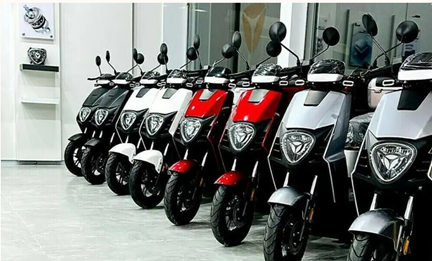
- – Scooters lead, bikes follow. About nine in ten EV two-wheelers sold are scooters. A full-size, motorcycle-style EV from a trusted name is a visible gap, and Millat’s lineup mixes both.
- – Fuel price and subsidy create the demand. High petrol prices and the government programme (Rs 80,000 per motorbike, phased to 2.2 million units) have pushed demand ahead of supply in several cities.
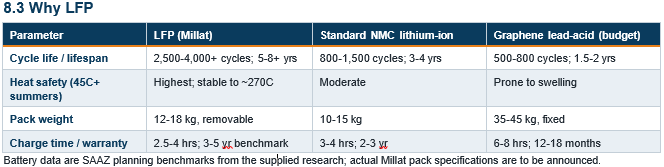
- – Chemistry is moving from graphene lead-acid to lithium and LFP. Yadea and Evee now sell LFP/lithium models, and Millat standardises on LFP across all five.
- – Localisation is the next battleground. Kit-based assemblers run near 15% local content; with four lithium battery plants reported under way, local packs and parts decide cost and delivery time.
- – Established industrial names are entering. Honda’s ICON e: and now Millat show that incumbents see EVs as a core category, shifting the contest from price alone to warranty, parts and service.
- SAAZ view
- Volume is likely to keep growing while petrol prices and subsidies hold, but the winners will be decided by service coverage and battery warranty, not headline price. That is where Millat’s network matters most.
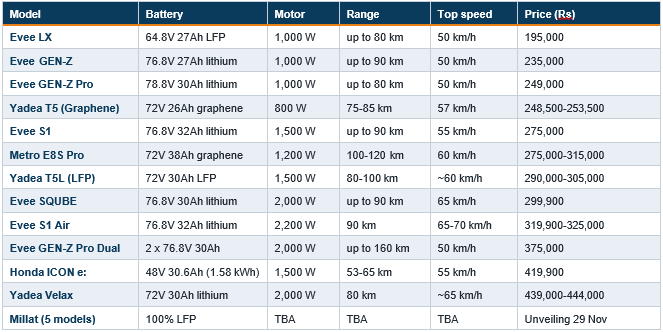
10. Competitive Landscape: Millat versus Rivals (continued)
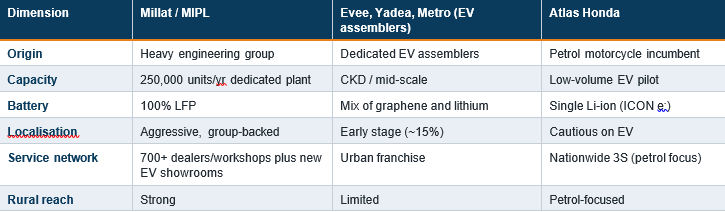
10.1 Basic differences
- – Against Atlas Honda: Millat has no petrol revenue to protect, so it can price and volume five models aggressively. Honda protects a 1.3 million-plus petrol motorcycle franchise and positioned its lone ICON e: at Rs 419,900 with a 53-65 km range.
- – Against kit-based EV brands: faster local frames, drivetrains and LFP packs, heat-resistant batteries as standard, and 700+ workshops. These brands have faced 30-day delivery backlogs and Rs 10,000-15,000 ‘own money’ premiums.
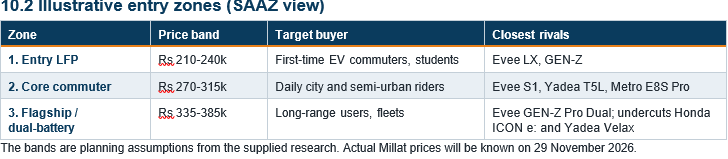
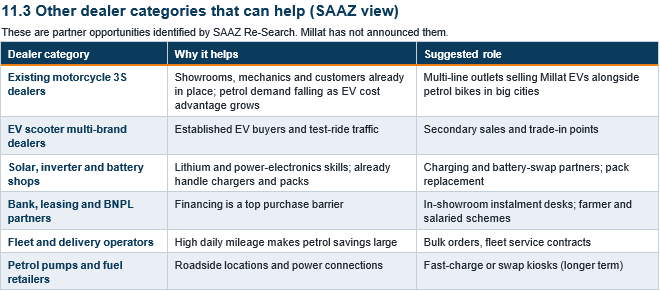
11. Dealerships That Can Power Millat’s Two-Wheelers
Where the tractor and non-tractor network helps, and which partner dealer types add reach
The biggest buyer worry for electric two-wheelers is not price. It is spare parts, battery warranty and a nearby workshop. Millat’s group network answers that worry in a way pure EV start-ups cannot. The company’s announced approach is two-tier, with a third export tier.
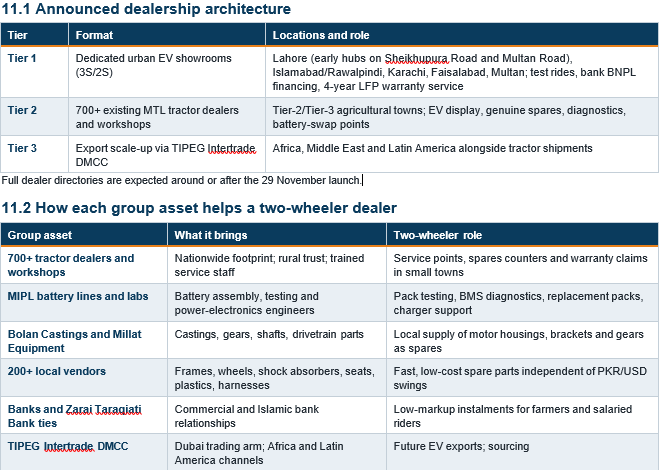
11. Dealership Readiness & Rollout (continued)
12. Business Plan & Earnings Sensitivity
The model below is illustrative. It assumes an ex-factory price of about Rs 260,000 per unit (roughly Rs 285,000-320,000 retail), MTL’s 64.09% stake in MIPL and a FY26 consolidated PAT base of Rs 8.07 Bn on about 399 million shares.
12.1 Success factors
- – Competitive LFP pricing at launch and fast activation of the dealer network.
- – Early margins are squeezed by imported cells; progressive localisation and NEV incentives (1% duty on EV parts, 1% GST, subsidies of Rs 65,000-80,000) widen them.
- – Bank and Islamic instalment partnerships are essential.
- – The agricultural brand must convert into modern urban mobility.
13. Economic Impact & Policy Tailwinds
13.1 Fuel import savings
At 14,400 km a year and 50 km per litre, each 70cc petrol motorcycle uses 288 litres. Replacing 75,000-100,000 of them saves 21.6-28.8 million litres a year, worth $14.04-18.72 million annually at a $0.65 per litre C&F; import price. Over one 5-year LFP battery life, net foreign-exchange savings after deducting imported cells are $52.2-69.6 million.

13.2 NEV Policy 2025-30
- – Target of 30% EV sales by 2030, administered by MoIP and EDB.
- – 1% customs duty on EV parts and cells; zero duty on plant machinery.
- – 1% GST on locally built EVs versus 18% on petrol bikes.
- – Consumer subsidies of Rs 65,000-80,000, registration waivers, reduced tolls and battery-swapping support.
- – Reported government plan of Rs 100 Bn to subsidise 2.2 million EV two/three-wheelers over four years.
13.3 Jobs and technology transfer
Direct assembly and battery engineering jobs at MIPL, high-voltage EV training for technicians at 700+ workshops, orders for 200+ local SME vendors, and a platform for Pakistan to become a regional exporter of affordable LFP electric two-wheelers.
Policy watch
Incentive levels, subsidy phasing and budget changes can move EV economics quickly. Policy continuity is one of the five key risks to the Millat plan.
14. Risks, SWOT & Concluding View
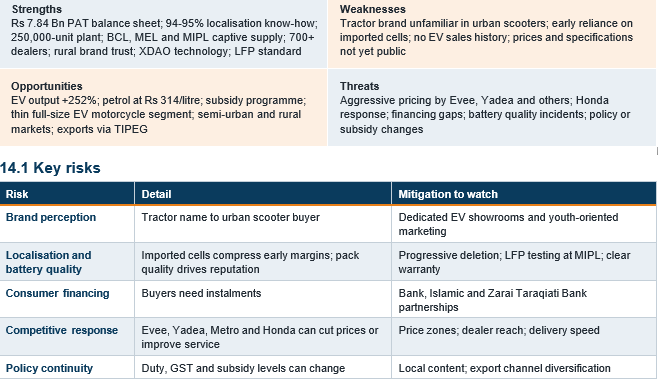
14.2 Concluding view
Millat brings scale, localisation know-how, a national service backbone, a battery and casting ecosystem and a strong balance sheet, assets that pure EV start-ups lack. Success will hinge on competitive LFP pricing at launch, rapid activation and training of the 700+ dealer network, and converting agricultural engineering trust into modern urban mobility. The official unveiling is on 29 November 2026; SAAZ Re-Search will update this report when model names and prices are public.
15. Sources & Verification
Primary company and regulatory sources
- Millat Tractors Limited (PSX: MTL) corporate briefing and FY26 / 1QFY27 financial statements, as summarised in the Topline Securities note of 24 November 2026.
- Millat Group non-tractor business portfolio and technical specification sheet (generators, forklifts, batteries, EV note).
- Engineering Development Board (EDB) Senate Committee EV production filings.
- Ministry of Industries and Production (MoIP), National Electric Vehicle Policy 2025-30.
- Pakistan Automotive Manufacturers Association (PAMA), FY26 sales data.
Media and market sources
- Profit by Pakistan Today and Business Recorder, 24-25 November 2026, and Profit by Pakistan Today, 12 May 2026 (Millat-Chinese partner agreement).
- Daily Pakistan, 24 November 2026: ‘Pakistan’s Tractor Giant enters Electric Bike Market with 5 New Models’.
- ProPakistani, 23 September 2026: ‘Industry Giant Takes on Electric Mobility: Millat Enters the EV Bike Market’; and 7 May 2026 report on the large-scale assembly plan.
- PakWheels, May 2026: Millat feasibility and MoU articles (April 2026 EV two-wheeler sales of about 40,000, ~90% scooters).
- TechJuice and Islamabad Scene, May 2026: Millat feasibility and MoU coverage, dealer estimates of EV sales mix.
- CW Pakistan, May 2026: Millat MoU and alignment with the NEV Policy 2025-30.
- The Express Tribune, 8 March 2026: Rs 100 Bn subsidy programme for electric two and three-wheelers (Rs 80,000 per electric motorbike).
- ProPakistani, 22 January 2025: Yadea Pakistan scooter launch (competitor context).
- Competitor retail price tags, November 2026 (Evee, Yadea, Metro, Honda Atlas).
Prior SAAZ Re-Search material
- SAAZ Re-Search research brief and monograph editions on Millat Tractors and electric two-wheelers dated 26 November 2026 (pre-launch editions), consolidated here.
Verification notes
- Company financial figures are unconsolidated unless marked consolidated.
- EV sales mix (90% scooters, 10% motorcycles) and ~40,000 April 2026 units are dealer and market-expert estimates, not official statistics.
- Price entry zones, dealer categories, readiness checklist, rollout phases and earnings scenarios are SAAZ Re-Search views or illustrations, not Millat disclosures.
- Millat model names, specifications and prices were not public as of 26 November 2026.
Compiled by SAAZ Re-Search
Independent Pakistan Automotive & Mobility Intelligence. Not investment advice. Data as of 26 November 2026. Pre-launch edition.