
Grow Automotive Grow Pakistan – Learning from the Past – Earning from the Present – Growing from the Future
Episode: 10
Summary of the Last Articles
Due to the length of the article, we are not presenting a summary of the previous installments this time. New readers will be content with copies of my previous article.
Now Read On…. Understanding of EV Models and Technology
Now, in the next few articles, we will examine the automotive market in Pakistan in general and the situation of the EV market in particular. In my initial articles, it was made clear that the automotive sector started with electric vehicles, and now, after almost a century and a half, the automotive industry and market are once again shifting towards electric vehicles based on modern technology of the new era, and it is hoped that in the coming years, electric vehicles will replace IC engines.
Public Trust Building in Adoption of EV
With the passage of time, the forecast of EV is becoming true. Awareness is coming among the public and the public has started accepting EVs to a large extent in the auto sector. Similarly, many leading automotive companies are introducing many models of their own EV vehicles in the Pakistani market. While many new models of EVs are coming in the auto market, a new problem has arisen for customers.
Unclear Options and Confusions
While buying an EV, they are finding it difficult to decide by selecting the model according to their needs and preferences. Because there are many types of EVs, there are also many types of EV models, about which customers don’t know much due to being new technology and they seem quite confused while making a decision. Therefore, I thought that first of all, the basic technology related to EVs and the technology given in the models available in Pakistan should be explained in simple words so that buyers can easily and confidently select the model. So let’s start with EV technology and then continue the discussion on EV models available in Pakistan.
Common Types of EV
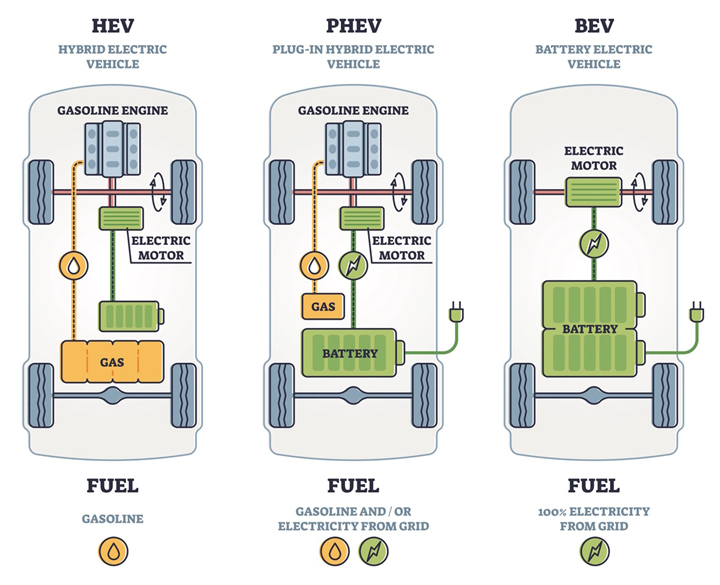
Electric vehicles (EVs) are generally classified into four main types based on their powertrain: Battery Electric Vehicles (BEVs), which run entirely on electricity; Plug-in Hybrid Electric Vehicles (PHEVs), which combine a battery and gas engine with plug-in capability; Hybrid Electric Vehicles (HEVs), which use a motor to assist a gas engine without plugging in; and Extended Range Electric Vehicle (EREV), which use electric motor to drives the wheels, and a small IC engine acts as a generator to recharge the battery.
- Battery Electric Vehicle (BEV): These all-electric vehicles rely solely on rechargeable battery packs (no gasoline engine) and produce zero emissions. They are charged via an external power source. Examples: Tesla Model 3, Nissan Leaf, Chevy Bolt.
- Plug-in Hybrid Electric Vehicle (PHEV): These vehicles use both an electric motor (powered by a battery) and an internal combustion engine. They can be plugged in to charge but also run on gasoline for longer ranges. Examples: Toyota RAV4 Prime, Ford Escape PHEV.
- Hybrid Electric Vehicle (HEV): Conventional hybrids use both a petrol engine and an electric motor. They cannot be plugged in; the battery is charged through regenerative braking and the engine. Examples: Toyota Prius, Hyundai Ioniq Hybrid.
- Extended Range Electric Vehicle (EREV): A type of EV where the electric motor drives the wheels, but a small internal combustion engine acts as a generator to recharge the battery when it runs low, providing a longer range than a standard BEV.
These vehicles are becoming increasingly popular, offering options ranging from daily city driving with zero emissions (BEVs) to long-distance, versatile driving (PHEVs/HEVs). A Battery Electric Vehicle (BEV) is a fully electric vehicle powered exclusively by electricity stored in an onboard high-voltage battery pack, driving an electric motor without any internal combustion engine or fuel dependency. BEVs produce zero tailpipe emissions, require external charging, and utilize regenerative braking to enhance efficiency.
A Battery Electric Vehicle (BEV) is a Fully Electric Vehicle Powered exclusively by Rechargeable lithium-ion Battery Packs, containing No Internal Combustion Engine, Fuel Tank, or Exhaust System. Relying solely on electricity from the grid, BEVs offer Zero-Emissions, Quiet n Vibertion Free Driving, and Lower Maintenance.
Key Aspects of BEVs
- Propulsion: Electricity is stored in high-capacity, on-board batteries, driving one or more electric motors for acceleration.
- Charging: Batteries are recharged via external power sources, ranging from domestic sockets (slow) to public DC fast chargers (fast).
- Efficiency: BEVs are highly efficient, converting a higher percentage of energy into vehicle movement compared to combustion engines.
- Performance: Known for instant torque, providing quick acceleration, regenerative braking to boost efficiency.
- Range: While heavily affected by cold weather, modern BEVs frequently provide over 400 Kms of range.
BEV Market Trends in Pakistan (2025-2026):
As of early 2026, the Battery Electric Vehicle (BEV) market in Pakistan is experiencing a transition from niche, luxury-oriented adoption toward a more diverse, albeit cautious, market. While 2025 marked a turning point with increased model launches and the entry of major Chinese manufacturers, the market is currently balancing high enthusiasm for lower running costs against infrastructural limitations and concerns over resale value.
- Dominance of Chinese Manufacturers: The market is heavily influenced by the entry of Chinese giants, with BYD leading in market excitement following its 2024 debut, offering competitive models like the Atto 3 and Seal. Other players like MG, HAVAL, Chery and others are expanding their footprint, diversifying choices beyond high-end luxury, and moving toward mid-range SUVs.
BEV Popular Models in Pakistan:
The BYD Atto 3 is a compact electric SUV featuring a 49.92 kWh to 60.48 kWh Blade Battery (depending on region/variant) providing a range up to 420-480 km (WLTP). Priced around PKR 8.99 million in Pakistan, it offers a 150 kW/310 Nm motor, 0-100 km/h in 7.3–7.9 seconds and high-tech safety.
The 2026 MG ZS EV is an electric SUV offering up to 440 of range with a 72kWh battery option, or a 51kWh standard range model, with prices ranging from PKR 9,690,000, positioning it as an affordable, family-friendly EV option in several markets.
The Honri Ve is an electric vehicle (EV) that is locally assembled in Pakistan by Dewan Farooque Motors Limited (DFML). Honri Ve 2.0 (approx. 200km range) and Honri Ve 3.0 (approx. 300km range) priced with a significant discount, VE 2.0 av at Rs. 3,599,000 and VE 3.0 at Rs. 4,399,000. These prices represent a reduction of Rs. 600,000, valid for limited stock.
The Deepal S07 SUV (crossover) and L07 (sedan) were officially launched in Pakistan in August 2024 by Master Changan Motors Limited (MCML). As a premium electric brand under Changan Auto, the company introduced these models as completely built-up (CBU) units to mark their entry into the local high-end electric vehicle market. Both vehicles feature a claimed range of over 500 km. PKR 14.99 million, this RWD SUV features a 66.8 kWh battery, offering a ~485 km range, 255 HP, and a fastback design with frameless doors.
The Audi e-tron is a premium, fully electric luxury SUVs and GT sports cars that combines high-performance electric driving with advanced technology and sophisticated design. Available models in Pakistan include the Q8 e-tron (used prices ranging from PKR 3.85–4.75 crore) and the new Q6 SUV e-tron Signature (priced at PKR 2.78 crore). Key features include Quattro all-wheel drive, high-capacity batteries, and fast-charging capabilities
Geely Riddara (RD6)
Capital Smart Motors is showcasing the Geely Riddara (RD6), a high-performance electric pickup with a 455 km range with price starting from PKR 13,299,000. Variant: BEV (Fully Electric), Battery Pack 86 kWh, Range Approximately 455 km, Performance 0–100 km/h in 4.5 seconds, and1030 kg loading capacity.
2. Extended Range Electric Vehicle (EREV/REEV)
Extended Range Electric Vehicles (EREV) and Range-Extended Electric Vehicles (REEV) are essentially the same technology, featuring a battery-electric powertrain with a small petrol/gasoline engine that acts solely as a generator to recharge the battery. Unlike conventional hybrids, the engine does not drive the wheels directly.
Key Aspects of EREV/REEV
- How They Work: The vehicle is powered by electricity from a battery and electric motor. When the battery is low, a “range extender” (engine) turns on to generate electricity and charge the battery while driving.
- Difference from PHEVs: While Plug-in Hybrids (PHEV) often use the engine to directly drive the wheels (parallel), EREVs use a series-connected structure where the engine is only a generator.
- Advantages: They Eliminate Range Anxiety, offering longer driving ranges than typical BEV and PHEV.
- Driving Experience: They provide the responsiveness and smooth acceleration of an EV, as the engine does not directly affect acceleration
EREV Market Trends in Pakistan
The Extended Range Electric Vehicle (EREV) market in Pakistan is experiencing a significant, driven by the need to overcome “range anxiety” associated with pure battery electric vehicles (BEVs). This shift is highlighted by the recent introduction of specialized models boasting extensive total driving ranges, with 2025–2026 being a crucial turning point for adoption, infrastructure growth, and local assembly initiatives.
- Arrival of REEVs and Long-Range Models: The market has officially entered the Range Extended Electric Vehicle era with the launch of models like the Forthing Friday REEV, which offers a total driving range of 1,150 km.
- Major Brand Entry: Chinese EV giant BYD is partnering with Mega Conglomerate to set up a factory in Karachi by mid-2026, launching models with extended ranges that include both battery-electric and plug-in hybrid options.
- Segment Diversification: 2025 saw a shift from experimental models to a wider range of options, including compact city cars (Gigi, Honri), luxury EVs, and family-friendly SUVs, with Deepal S07 and L07 already on the market.
- Overcoming Range Anxiety: EREVs are seen as offering all-electric city driving with a gasoline-powered generator for long-distance, intercity travel.
- Rising Fuel Costs: Extreme increases in petrol prices make the lower operating costs of EREVs are highly attractive.
EREV Popular Models in Pakistan:
1-Deepal S05 REEV (Master Changan Motors)
The Deepal S05 REEV, produced by Master Changan Motors in Pakistan, is a groundbreaking Range-Extended Electric Vehicle, with volume production starting in early 2026. This SUV offers a combined range exceeding 1,000 km, powered by a 215 HP (160 kW) motor with a RWD and a 1.5L Range Extender Engine.
- Range: Approximately 155 km – 200 km in pure EV mode, with a combined range often exceeding 1,000+ km.
- Fuel Efficiency: ~20-24 KM/L (city/highway).
Price: As of Feb 2026, the S05 REEV Premium is priced around PKR 9,999,000 (ex-factory, excluding freight).
2. Forthing Friday REEV (CSM)
Capital Smart Motors (CSM) has reduced the price of the Forthing Friday Range Extender Electric Vehicle (REEV) to PKR 9,999,000 (a PKR 1 million reduction) until March 31, 2026. This 5-seater SUV offers up to 1,150 km total range (combined battery and engine), and features a 57.8 kWh battery, 201 hp output.
- Range: It features a 31.9 kWh battery for pure electric driving (up to 600 km), with a 1.5L range extender petrol engine.
- Features: Includes Level 2 ADAS, a 14.6-inch infotainment display, and a 360-degree camera.
- Price: Pre-launch pricing was announced at PKR 10,999,000 for the REEV variant.
We will continue to provide knowledge and information about modern automobiles, mobiles and electric vehicles. In the next installments, we will give complete details about other EV models, especially HEV and PHEV, so that customers who buy EVs can decide to adopt EVs with their own needs and mental and emotional satisfaction. Stay connected with Auto Mark. Until the next article, may Allah bless you.
نئی خواہشوں کی ہوں وادیاں
وہاں کم ہی فکر معاش ہو
سر سبز ہوں جہاں منزلیں
وہیں خوب تر کی تلاش ہو
This exclusive and very informative article on ‘UNDERSTANDING OF EV MODELS AND TECHNOLOGY’ written by @Mumtaz Hussain and published in Automark Magazine’s March-2026 printed and digital edition.