There is an old saying in manufacturing: companies don’t change because they see the future; they change because the present stops working.
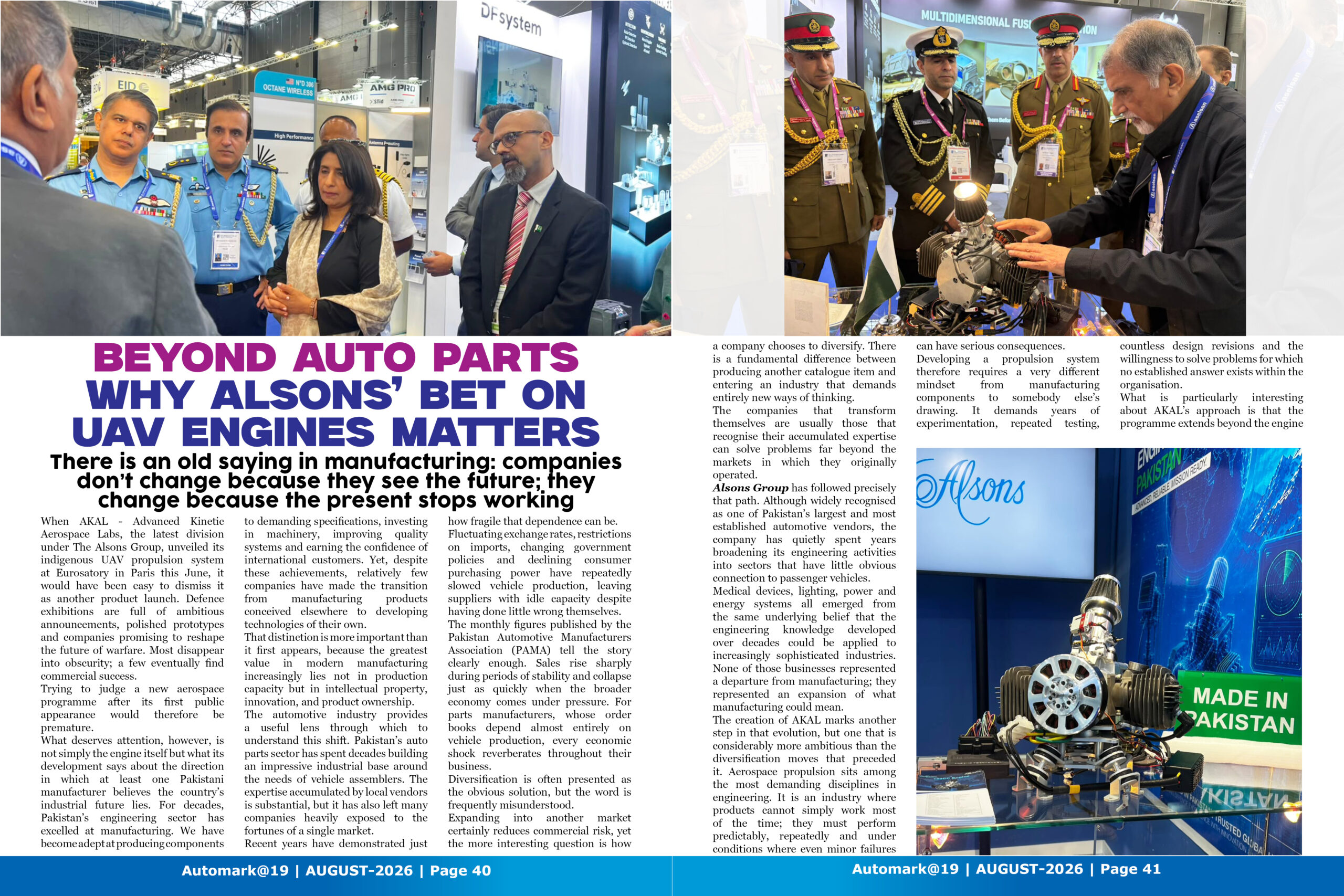
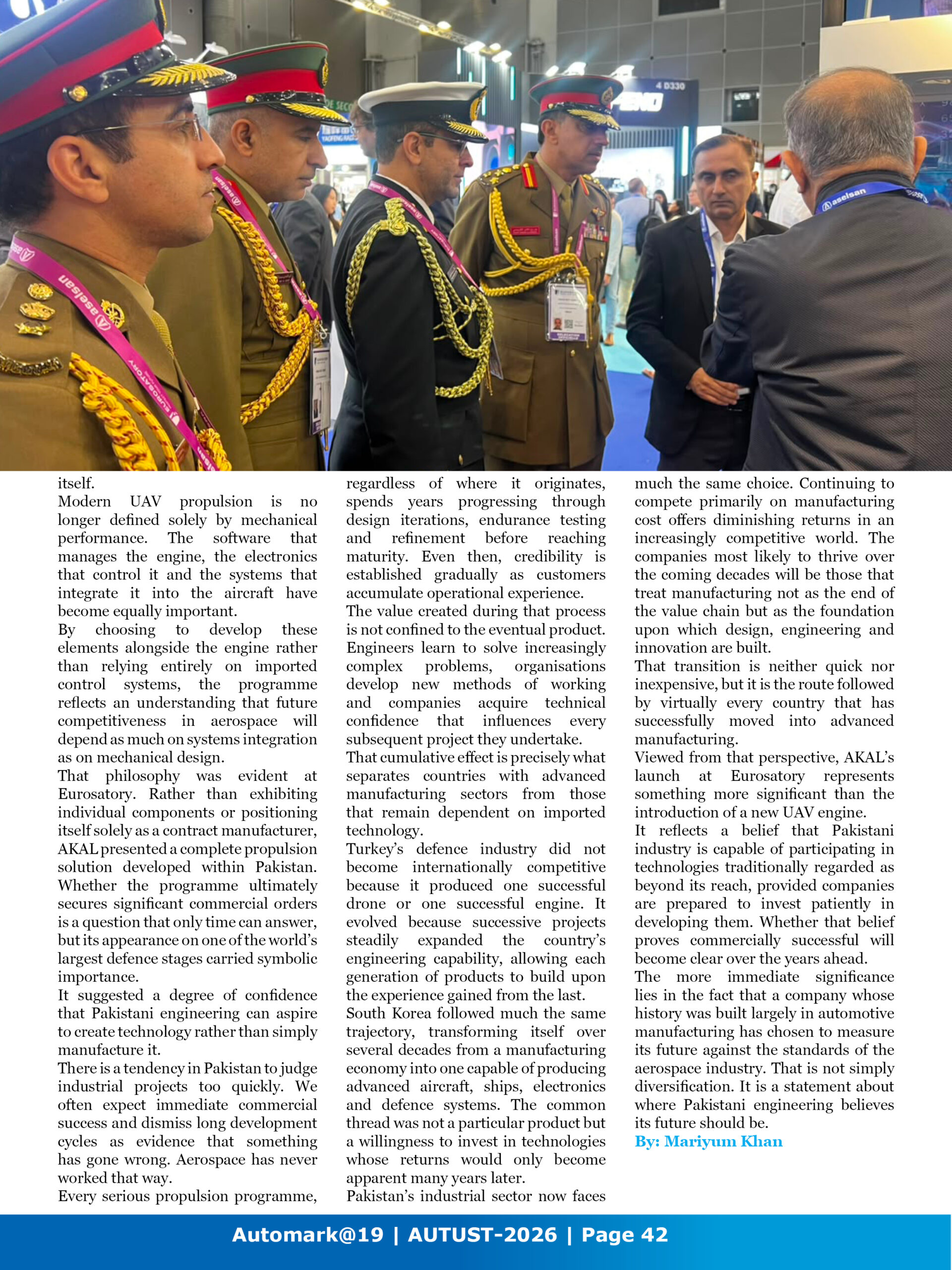
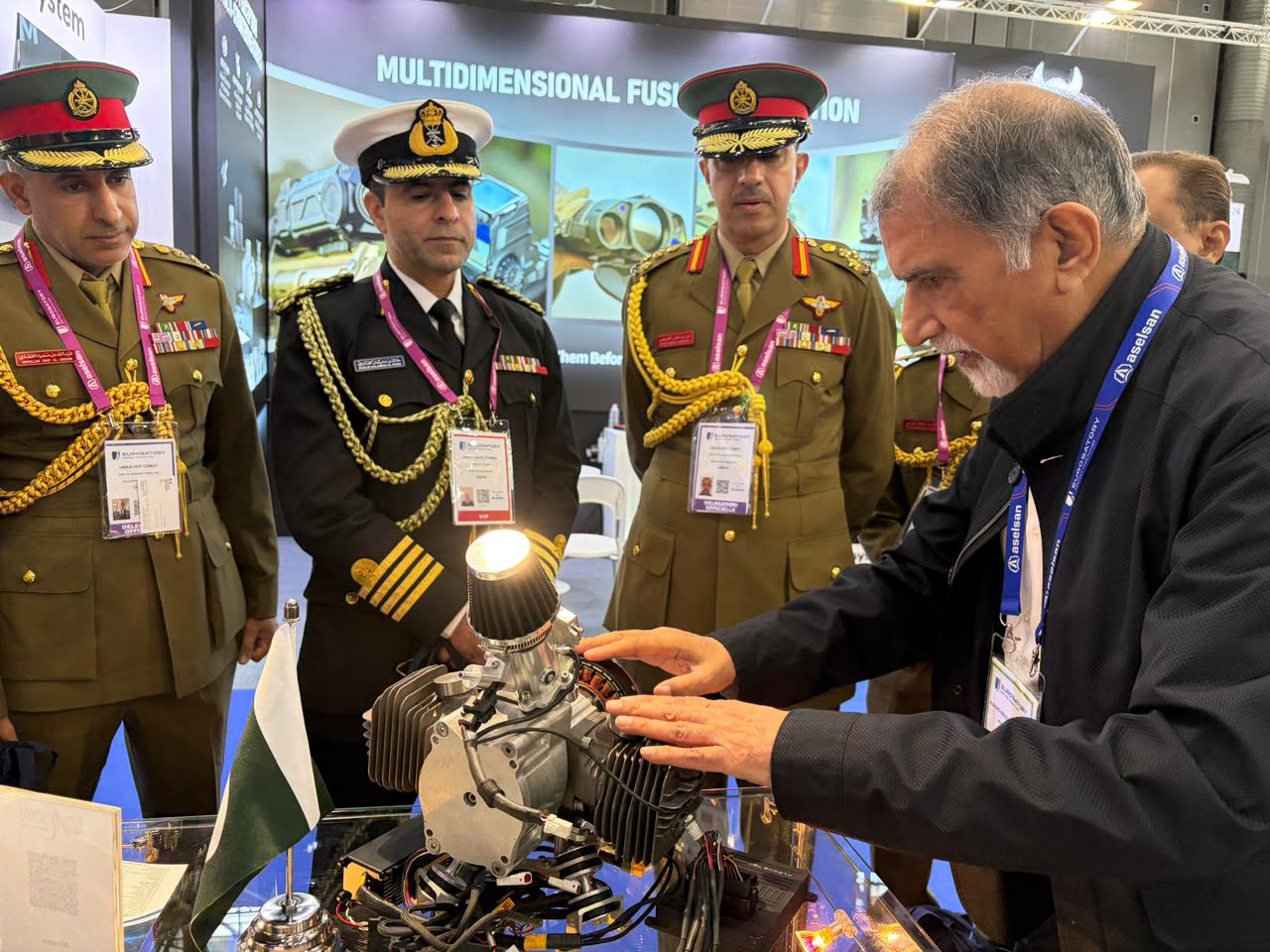
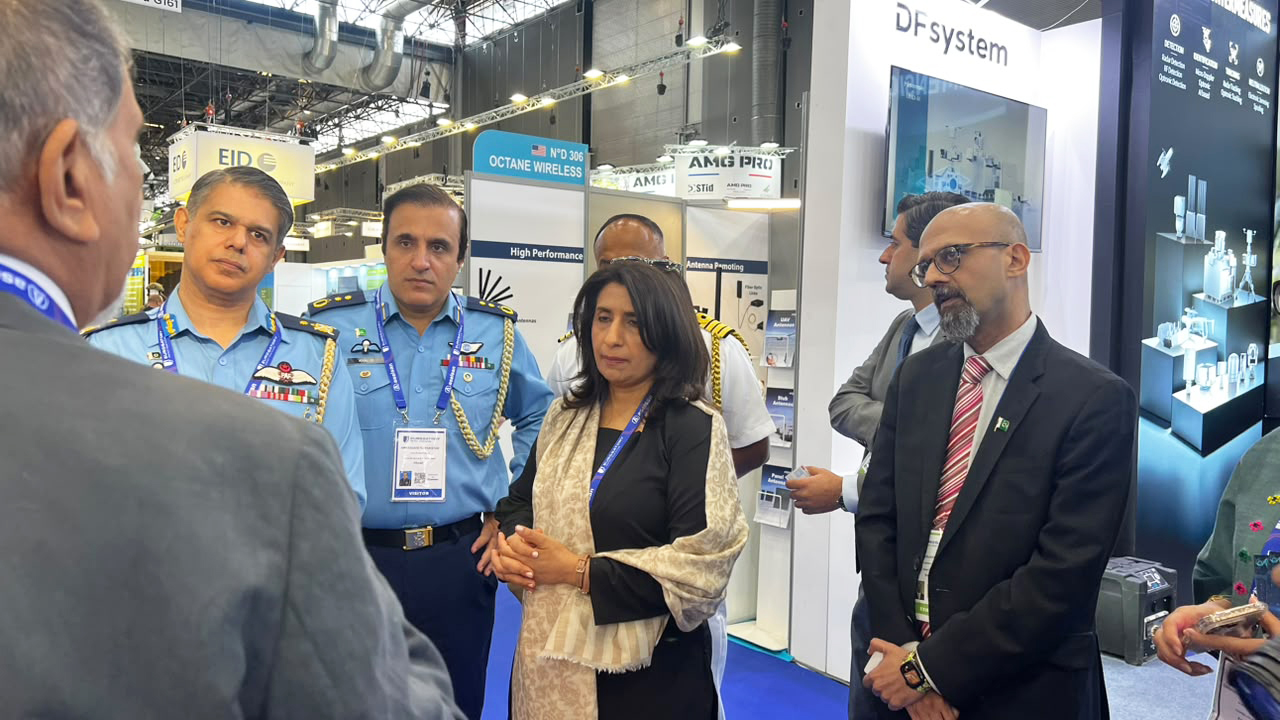
When AKAL – Advanced Kinetic Aerospace Labs, the latest division under The Alsons Group, unveiled its indigenous UAV propulsion system at Eurosatory in Paris this June, it would have been easy to dismiss it as another product launch. Defence exhibitions are full of ambitious announcements, polished prototypes and companies promising to reshape the future of warfare. Most disappear into obscurity; a few eventually find commercial success.
Trying to judge a new aerospace programme after its first public appearance would therefore be premature.
What deserves attention, however, is not simply the engine itself but what its development says about the direction in which at least one Pakistani manufacturer believes the country’s industrial future lies. For decades, Pakistan’s engineering sector has excelled at manufacturing. We have become adept at producing components to demanding specifications, investing in machinery, improving quality systems and earning the confidence of international customers. Yet, despite these achievements, relatively few companies have made the transition from manufacturing products conceived elsewhere to developing technologies of their own. That distinction is more important than it first appears, because the greatest value in modern manufacturing increasingly lies not in production capacity but in intellectual property, innovation, and product ownership.
The automotive industry provides a useful lens through which to understand this shift. Pakistan’s auto parts sector has spent decades building an impressive industrial base around the needs of vehicle assemblers. The expertise accumulated by local vendors is substantial, but it has also left many companies heavily exposed to the fortunes of a single market. Recent years have demonstrated just how fragile that dependence can be. Fluctuating exchange rates, restrictions on imports, changing government policies and declining consumer purchasing power have repeatedly slowed vehicle production, leaving suppliers with idle capacity despite having done little wrong themselves. The monthly figures published by the Pakistan Automotive Manufacturers Association (PAMA) tell the story clearly enough. Sales rise sharply during periods of stability and collapse just as quickly when the broader economy comes under pressure. For parts manufacturers, whose order books depend almost entirely on vehicle production, every economic shock reverberates throughout their business.
Diversification is often presented as the obvious solution, but the word is frequently misunderstood. Expanding into another market certainly reduces commercial risk, yet the more interesting question is how a company chooses to diversify. There is a fundamental difference between producing another catalogue item and entering an industry that demands entirely new ways of thinking. The companies that transform themselves are usually those that recognise
their accumulated expertise can solve problems far beyond the markets in which they originally operated.
Alsons Group has followed precisely that path. Although widely recognised as one of Pakistan’s largest and most established automotive vendors, the company has quietly spent years broadening its engineering activities into sectors that have little obvious connection to passenger vehicles.
Medical devices, lighting, power and energy systems all emerged from the same underlying belief that the engineering knowledge developed over decades could be applied to increasingly sophisticated industries. None of those businesses represented a departure from manufacturing; they represented an expansion of what manufacturing could mean.
The creation of AKAL marks another step in that evolution, but one that is considerably more ambitious than the diversification moves that preceded it. Aerospace propulsion sits among the most demanding disciplines in engineering. It is an industry where products cannot simply work most of the time; they must perform predictably, repeatedly and under conditions where even minor failures can have serious consequences. Developing a propulsion system therefore requires a very different mindset from manufacturing components to somebody else’s drawing. It demands years of experimentation, repeated testing, countless design revisions and the willingness to solve problems for which no established answer exists within the organisation.
What is particularly interesting about AKAL’s approach is that the programme extends beyond the engine itself.
Modern UAV propulsion is no longer defined solely by mechanical performance. The software that manages the engine, the electronics that control it and the systems that integrate it into the aircraft have become equally important. By choosing to develop these elements alongside the engine rather than relying entirely on imported control systems, the programme reflects an understanding that future competitiveness in aerospace will depend as much on systems integration as on mechanical design.
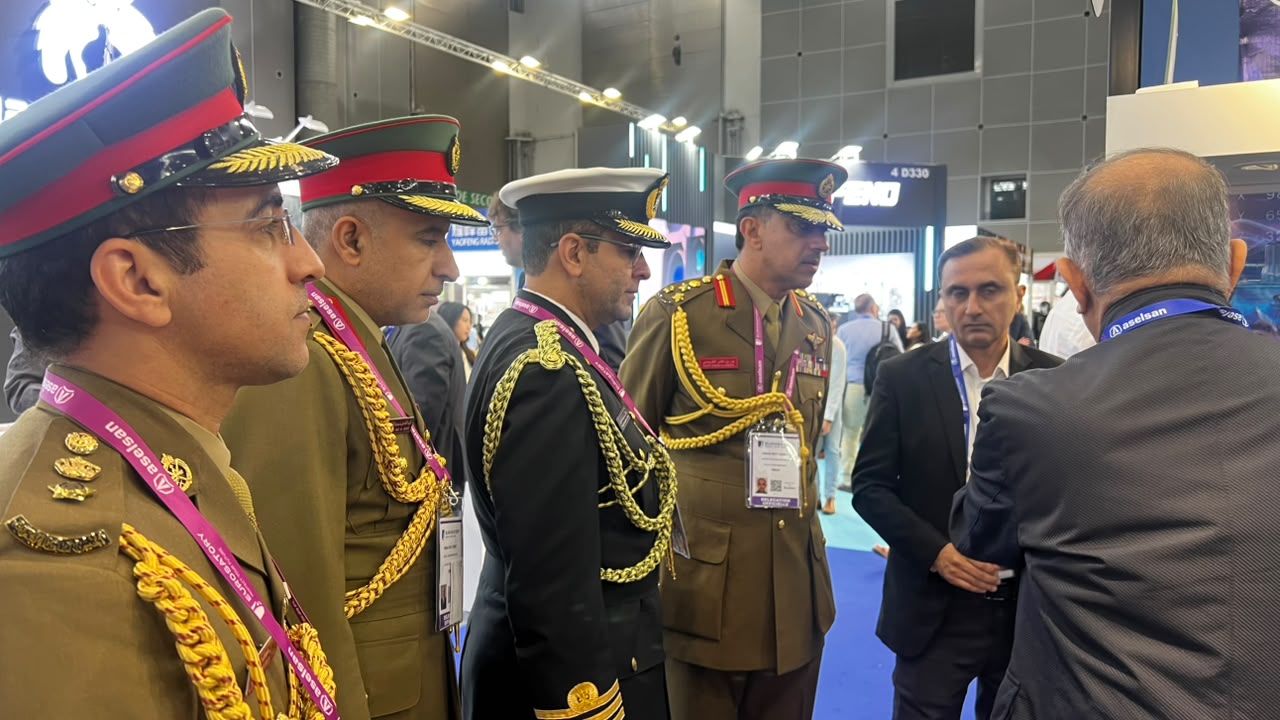
That philosophy was evident at Eurosatory. Rather than exhibiting individual components or positioning itself solely as a contract manufacturer, AKAL presented a complete propulsion solution developed within Pakistan. Whether the programme ultimately secures significant commercial orders is a question that only time can answer, but its appearance on one of the world’s largest defence stages carried symbolic importance. It suggested a degree of confidence that Pakistani engineering can aspire to create technology rather than simply manufacture it.
There is a tendency in Pakistan to judge industrial projects too quickly. We often expect immediate commercial success and dismiss long development cycles as evidence that something has gone wrong. Aerospace has never worked that way. Every serious propulsion programme, regardless of where it originates, spends years progressing through design iterations, endurance testing and refinement before reaching maturity. Even then, credibility is established gradually as customers accumulate operational experience. The value created during that process is not confined to the eventual product. Engineers learn to solve increasingly complex problems, organisations develop new methods of working and companies acquire technical confidence that influences every subsequent project they undertake.
That cumulative effect is precisely what separates countries with advanced manufacturing sectors from those that remain dependent on imported technology. Turkey’s defence industry did not become internationally competitive because it produced one successful drone or one successful engine. It evolved because successive projects steadily expanded the country’s engineering capability, allowing each generation of products to build upon the experience gained from the last. South Korea followed much the same trajectory, transforming itself over several decades from a manufacturing economy into one capable of producing advanced aircraft, ships, electronics and defence systems. The common thread was not a particular product but a willingness to invest in technologies whose returns would only become apparent many years later.
Pakistan’s industrial sector now faces much the same choice. Continuing to compete primarily on manufacturing cost offers diminishing returns in an increasingly competitive world. The companies most likely to thrive over the coming decades will be those that treat manufacturing not as the end of the value chain but as the foundation upon which design, engineering and innovation are built. That transition is neither quick nor inexpensive, but it is the route followed by virtually every country that has successfully moved into advanced manufacturing.
Viewed from that perspective, AKAL’s launch at Eurosatory represents something more significant than the introduction of a new UAV engine. It reflects a belief that Pakistani industry is capable of participating in technologies traditionally regarded as beyond its reach, provided companies are prepared to invest patiently in developing them. Whether that belief proves commercially successful will become clear over the years ahead. The more immediate significance lies in the fact that a company whose history was built largely in automotive manufacturing has chosen to measure its future against the standards of the aerospace industry. That is not simply diversification. It is a statement about where Pakistani engineering believes its future should be.
By: Mariyam Khan