Home Blog Page 40

Honda CBR 250RR showcased at Honda Virtual Motorcycle Show

Let’s not confuse this bike with the Honda CBR 250R that we have in India. The Honda CBR 250RR is a bike that was a racetrack machine which was made production-ready. Honda has revealed the bike at Honda Virtual Motorcycle show. It’s an online event that Honda had to conduct as most of the gatherings in the world have been cancelled. Read further and know more about the Honda CBR 250RR.

Honda CBR 250RR Design
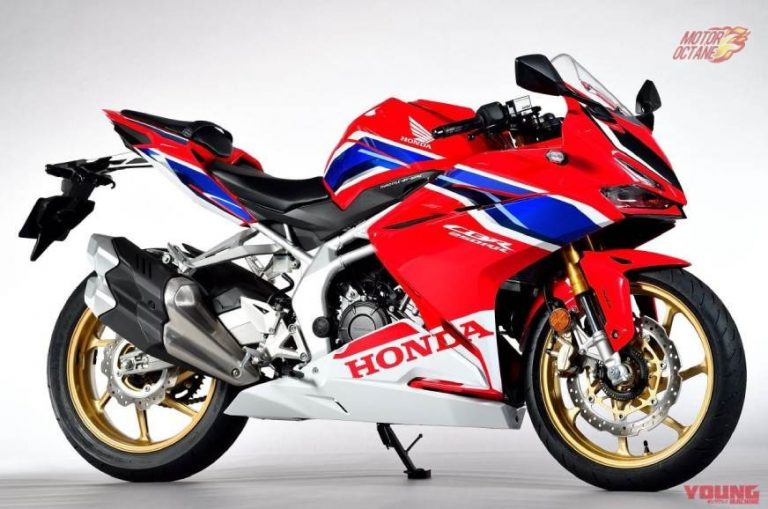
The Honda CBR 250 RR gets the design elements from the Honda Fireblade. The bike has been made sharp and aggressively looking. The faring of the vehicle is pointed at the front. The headlights are integrated in a striking manner and the LED daytime running lights are placed above it. The windshield looks rather short and the mirrors do not jut out as much. The wheel of the bike gets golden alloys and these look great with the HRC WorldSBK bike paint scheme. The front forks of the bike are golden in colour to match the wheel and also the disc brakes have a golden tinge on the inner rim.

The tank of the bike has a sculpted look with a good amount of shoulders. The badging of the Honda and CBR is in the form of stickers and there are not raised logos. The bike gets a dual-port exhaust at the back and a complete step-up racing type dual seat. This design has definitely evolved over time and the Honda CBR 250RR looks like a monster.

Specifications
The Honda CBR 250RR gets the most power-focused engine on a 250cc bike. The bike is a pocket rocket in true sense. The engine is a 4 cylinder power plant and it now packs 3 more horses. Its a 40 bhp bike and all this power come at 12500 rpm. The bike is ready to take on the Kawasaki ZX-25R. But it is also rumoured that the Kawasaki will make 45 BHP. You might be thinking what is so special about a 4 cylinder 250cc bike? Being a 4 cylinder the bike is a very high revving and fast-revving motor. Although the top speed might me not as much as a middleweight bike, the engine reaches those high speeds much faster.

The Honda CBR 250RR is also equipped with a slipper clutch and bi-directional quick-shifter. But these come as add on packages and will cost more. The bike also gets 3 riding modes which alter the power and change the traction control systems.

Honda CBR 250RR Price
The bike might not make it to India but we are expecting a price tag of Rs 5.05 lakhs (Indian Rupees). At this price, it will be a serious competitor to the Kawasaki ZX-25R. There is no other competition to this bike but we are expecting something from Triumph soon.

Courtesy: https://motoroctane.com/

Beijing Motor Show Officially Rescheduled Brings Hope To Car Industry

Is this a sign that China is on the road to recovery?

So far this year, the Geneva and Detroit Auto Shows have been canceled outright due to the novel coronavirus pandemic. June’s 2020 Goodwood Festival of Speed has been postponed, as has this month’s New York Auto Show, now rescheduled for August. Organizers of fall’s Paris Motor Show are still hoping to hold some charity events, but the show itself is canceled. But the first international auto show to be put on hold was the Beijing Motor Show, also originally set for this month. And now its organizers have officially set a new date.

The show will now run from September 26 to October 6 and will be held at the same location, the China International Exhibition Center. There’s still no word whether all or just some of the automakers originally signed up will have displays this time around. For example, an electrified version of the Maserati Ghibli was originally set to premiere, but we should be finding out relatively soon if this is still the case.

The official Beijing Motor Show website has yet to reveal an updated floor plan or list of attending automakers. There are a few reasons why automakers might still be undecided. Attending auto shows is normally a very expensive affair. Display stands, sponsoring media events, and flying in executives amounts to millions of dollars. With production lines currently grounded and sales in a sharp decline because of coronavirus, it would be perfectly understandable for brands to cut costs wherever they can. Hosting online live streaming debuts has already proven to be a significantly cheaper alternative to a traditional auto show.

Based on the current low infection rate, Chinese authorities believe life will be back to normal within the next few months, and it’s not alone with this prediction. Volkswagen stated last week it expects sales in the world’s largest car market will quickly recover. Signs of this recovery have already happened as last month’s Chinese market sales were already a significant improvement over February’s tally. Several Chinese production plants have also restarted operations, including Fiat Chrysler, Ford, and BMW. Production of the all-new Polestar 2 is also now up and running.

Obviously China will still need to maintain a high level of caution regarding overseas media. Not all countries have yet to achieve the coronavirus suppression level China has and it’s still unknown whether they will or not by late September. More than likely, China will need to enforce strict monitoring measures for overseas guests.

Courtesy: https://carbuzz.com/

Toyota and BYD detail electric-vehicle joint venture for China

Toyota and BYD have released more details of an electric-vehicle joint venture for the Chinese market, which was announced in November 2019.

The two automakers will invest 50-50 in a new company—BYD Toyota EV Technology Co. Ltd—with operations scheduled to start in May.

Engineers from Toyota and BYD will work together under the same roof on EV research and development, Toyota’s Hirohisa Kishi, who will serve as chairman of the new company, said in a statement.

For now, the partnership is for China only. But it could potentially lead to technology agreements that reach out to other regions.

BYD joins numerous other Toyota EV partners, including battery makers Panasonic and CATL.

One aspect of the Panasonic partnership has been tests of the Japanese firm’s cylindrical battery cells in Chinese-market Toyota plug-in hybrids.

The new joint venture could lead to more of this kind of exploration between Toyota and BYD, although BYD did just launch its own new battery pack for electric cars.

Toyota’s partnership with Panasonic also includes investigations into solid-state battery tech, which Toyota views as a prerequisite to mass EV adoption. Proponents of solid-state battery cells claim they can deliver greater energy density than current lithium-ion cells, allowing for greater range without a physically larger battery pack.

If Toyota and Panasonic can get solid-state batteries into mass production, they could be used in electric cars for many different markets.

For markets outside China, Toyota is also partnering with Subaru to develop a platform that will underpin an electric SUV. That will fill a niche for both automakers, as neither has a battery-electric vehicle in its lineup right now.

Coronavirus can drag Pakistan’s shaky auto industry into depths of despair

• Dwindling demand had already seen Pakistan’s auto industry reeling under pressure in 2019.
• Partial lockdowns due to coronavirus have taken a toll, especially on local component makers.

Some of the world’s largest automotive markets have taken a massive beating since the coronavirus pandemic reared its ugly head around the world. Sales in China fell to record lows in February and March has seen production facilities in many countries in Europe and India being temporarily suspended. In the US, manufacturers like Ford and GM have turned to the prospect of making masks and ventilators. While the forecast for 2020 remains extremely gloomy for the automotive market at large, Pakistan’s auto sector could be at the receiving end of an even more painful blow.

There have been over 1,800 positive cases of coronavirus in Pakistan, according to the country’s media outlets. Several provinces have ordered lock downs but the country’s Prime Minister Imran Khan has so far steered clear of such a measure on a national scale. With an already shambolic economic condition, there is a suspicion that Imran is trying to avoid a further deterioration at the cost of human health and safety.

Even if there has been no national lockdown imposed thus far, the effects of the dreaded coronavirus is already being witnessed – especially in the country’s nascent automobile sector. Reports suggest new launches have already been pushed back – Yaris from Toyota being the biggest of these. Local component manufacturers have started feeling the pinch which may have already also had rippling effects on production lines.

Demand for newer vehicles is also dwindling. Sales had been falling since 2019 itself and production was temporarily halted by some companies back then. A forced suspension of operations due to a possible national lockdown, if it does take place, could well critically worsen the situation. According to Pakistan’s The News, 240,335 units of cars and Light Commercial Vehicles (LCVs) had been sold in the last fiscal year, down 7% from the fiscal year before that. This fall number has the potential of now entering double digits, many fear.

Pakistan’s auto industry is hardly alone in wading through troubled waters in current times. Its prevailing situation, however, appears more desperate than ever before and more than anywhere else.

Nissan discontinues Datsun brand in Indonesia

  • Datsun cars to be sold until stocks last
  • Production facility stopped in January 2020
  • Only 7,000 Datsun cars sold in Indonesia in 2019

Japanese car manufacturer Nissan had officially discontinued the Datsun brand in Indonesia. The company has stopped producing Datsun cars in the country earlier this year and will continue the sale of Datsun cars until the existing stocks are cleared with the dealers. Datsun, the entry-level brand from Nissan has failed to gain a positive response in the Indonesian market, which has eventually led to its demise in the country. Last year, the company sold only 7,000 units in the country.

The decision is reportedly a part of Nissan’s global restructuring program to retire low-selling nameplates and reduce capacity by 10 per cent, which has also resulted in 12,500 job losses across the globe. The company had two plants in Indonesia. The Karawang facility which built Nissan vehicles, stopped production in September 2019. The Purwakarta facility that manufactured the Datsun range was shut for operation in January this year.

Datsun’s product line-up in Indonesia included the GO, GO Plus and the GO Cross. Back in 2019 Nissan had also confirmed that the Datsun brand will be globally phased out by 2022.

Source: https://www.carwale.com

Toyota, Honda, Suzuki, Hino, KIA, Hyundai and FAW halt plants in Pakistan due to virus

Indus Motor, Honda Atlas Cars (Pakistan) Limited, Pak Suzuki Motor Company, Hinopak, FAW Motors, Jwforland, KIA Motors, Hyundai Nishat Motors, Master Motors, JwForland, Dysin Automobile, Regal Automobile, United Bravo and Changhan Motors said on Monday that they have halted operations at their plants in Pakistan due to the spread of the new coronavirus. Announcements issued from the assemblers after recent decision to lockdown by the provinces.

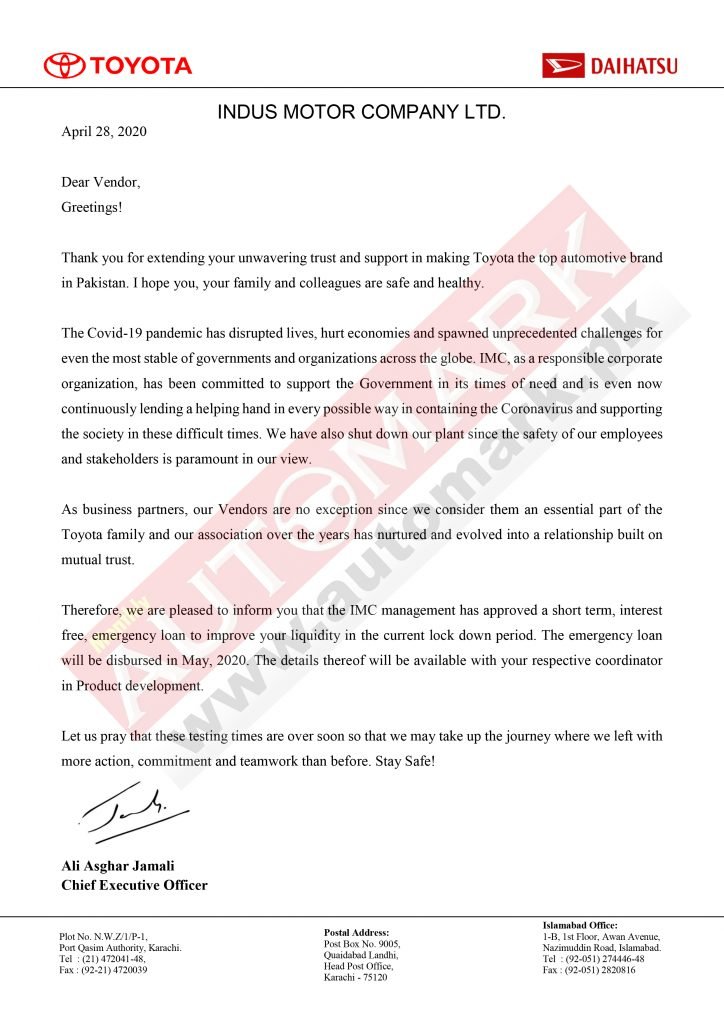
Indus Motors has suspended operations at its plant in Karachi near Port Qasim as employees could not commute to the sites after the Sindh government instructed for complete lockdown and public transportation operators to suspend business.
Indus Motor Company also released a memo stating that they fully support the government’s efforts to stop the spread of CONVID 19. Hence, their production plants have been closed until further notice. They also said that the halt will lead to a delay in the delivery of new vehicles to the customers, for which they apologized.
Indus Motors just introduced Toyota’s new model of Yaris last week and the variants are ready for display and test drive at all dealerships across the country, which have also been delayed.


Honda Atlas Cars (Pakistan) Limited also has stopped operations at vehicle assembly facilities for all models of cars as well as two motorcycle plants until 6th April. Punjab government also announced for lockdown of the whole Punjab province for 2 weeks.
Leading passenger vehicle assembler Pak Suzuki, the market leader in Pakistan stopped output at their Port Qasim, Karachi plant.

FAW, first Chinese vehicle assembler of passenger car, light and heavy commercial vehicle also halt production of all vehicles at their facilities in Karachi.

Similarly Korean assemblers KIA shutdown their newly stablish plant at Port Qasim while Hyuandi Nishat stopped production of recently launch Hyuandi light commercial pickup Porter H-100. Japanese truck assembler in Pakistan Hinopak also halt it’s all truck assembling. Chinese assembler Jwforland, Regal Automobile, United Motors, Master Motors, Changan Motors and Dysin Automobile said it has halted its auto plant in the Pakistan for the safety of employees and will restart after official lockdown from government is over.

Likewise, all trye manufactures including Service Industries Limited, Panther Tyres Limited, General Tyre and other brands also shutdown their manufacture plants.
It is worth to mention here that all parts suppliers of the OEM’s also shutdown their parts manufacturing facilities across the country after announcements of lockdown and OEM shutdown intimation.

Japanese carmakers’ production in Central and South America has also been effected.
Nissan said it will suspend its vehicle manufacturing in Mexico from Wednesday to April 14, while Toyota will halt its plant in Brazil from Tuesday to April 3 and has stopped production at its factory in Argentina from Friday to March 31.

Mitsubishi Motors Corp., meanwhile, stopped operations at its factory on the northern Philippine island of Luzon from March 17 and will continue the measure until April 12th in line with the Philippine government’s measure restricting residents from going outdoors.
Toyota and other Japanese automakers have resumed operations in China, where the coronavirus epidemic started, but have been shutting operations at its factories in the United States and Europe in line with governments’ requests for residents to stay indoors to prevent the spread of the coronavirus.

Chinese automaker Geely unveils anti-coronavirus SUV Icon

The compact SUV comes with an air filtration system capable of preventing viruses such as Covid-19 from entering the cabin, claims the company.
To combat the coronavirus epidemic which has resulted in 95,000 infected patients and over 3,000 deaths globally till date, the Chinese automaker Geely Auto has unveiled its new compact SUV Icon which comes equipped with an air filtration system capable of preventing bacteria and viruses such as Covid-19 from entering the cabin, claims the company.

“In response to the new Coronavirus epidemic, Geely Auto developed in record time a new Intelligent Air Purification System (IAPS) that is N95 certified. This highly efficient air purification system works in tandem with the Icon’s air conditioner to isolate and eliminate harmful elements in the cabin air including bacteria and viruses,” said the company in a press release.

The Icon SUV was launched online on February 24 and reportedly has received 30,000 pre-orders before the official launch, as per the parent company of Volvo and Lotus brands.
Geely had pledged to spend $53m on combating the virus. The N95 standard has the ability to block at least 95% of very small (0.3 microns) particles. However, coronavirus particles often measure less than this, so its effectiveness still needs to be gauged.

The Icon SUV is based on a concept that the Chinese company showed at the 2018 Beijing Motor Show, and is offered in petrol and hybrid setups.

Toyota Yaris launch may face delay in Pakistan

Due to the coronavirus outbreak, the launch of Toyota Yaris by Indus Motor Company (IMC) which was set to be 27th March 2020 in Lahore is now rescheduled in Karachi at Indus assembly plant at Port Qasim on 24th March 2020.

However, with the ongoing situation, Toyota Yaris launch plans may be postponed due to corona virus. A new date has not been announced yet.

According to Automark sources “No firm decision has been taken about the launch as the situation is changing daily.”  However, market sources say that the company might do a soft launch.

The company at the start of March did a line-off ceremony of Toyota Yaris in the Karachi plant at Port Qasim and the car was only displayed to the dealers.

Also Read : Indus Motor Company finally reveals the awaited model ‘Toyota Yaris’ in Pakistan

According to market sources, the corona outbreak has to have an adverse effect on the automotive market in Pakistan and vendors are facing a shortage of vehicle spare parts. Like most of the world, corona has hit Pakistan and the question is whether the industry is able to sustain these delays and shortages?

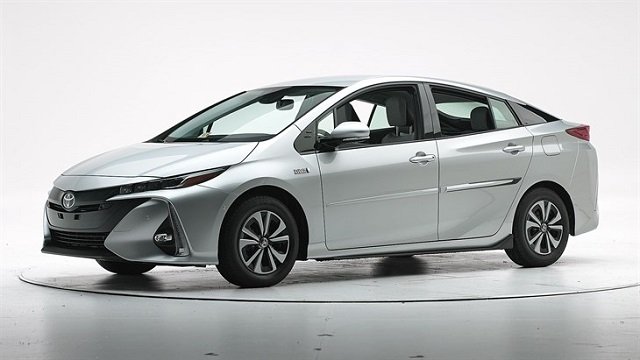
Toyota Yaris has been in replacement of the discontinued models namely XLI and GLI which were the most popular models of Toyota since their introduction back in 2000-2001 and they gave Toyota about 65% of their sales.

The features of the car are yet to be released. However, the car enthusiasts say that the length, width, and height of the car would be as 4425mm, 1730mm, 1475mm. Whereas the wheelbases would be 2250mm.

The engine of the car is in line 4 cylinders, 16-valve DOHC with it-i. The engine capacity is 1496cc. The highest power output is 6000rpm and the torque us 4200 rpm. The speed is 170km/h, fuel consumption 5.8/100 km and the tank capacity is 42 liters.

The price of Toyota Yaris is expected to be set around a bracket of 23-24 lacs.  The Yaris is a popular model that has been popular in many countries. It was first introduced in Thailand with the name Yaris Ativ.

The delay and the closing of plants have already left the industry at a loss. If the coronavirus lasts longer, the effects will be larger than one can imagine now.

Toyota Yaris 2020

Coronavirus is shutting car plants in Europe just as factories in China reopen

Fiat Chrysler is temporarily closing four plants in Italy as the novel coronavirus takes its toll on the world’s eighth biggest economy.

The move follows a decision by the Italian government to impose sweeping restrictions on travel and public gatherings as it tries to contain the worst outbreak of the coronavirus, or Covid-19, outside China.

The Italian-American automaker said in a statement Wednesday that plants will be closed and production rates reduced “to support the nationwide campaign addressing the Covid-19 crisis.”

The closure of plants in Europe illustrates how the impact on the auto industry from coronavirus is going global. The pandemic has already resulted in extended factory closures and a steep drop in vehicle sales in China.

A spokesperson for Fiat Chrysler said the plants affected in Italy will be closed for the rest of the week to “minimize the risk” of contagion among employees. They are expected to reopen on March 16.

To limit contact among workers, the company said it will increase space between employees at their workstations. This will require a change to manufacturing processes and lead to lower daily production rates.

Other measures to contain the spread of the virus include enabling some employees to work from home and controlling numbers at company cafeterias.

Italy on Monday imposed widespread restrictions on travel and public life across the country, including closing schools, movie theaters, museums and gyms, and limiting opening hours for bars, restaurants and shops.

Economists say the measures are likely to push the country’s already fragile economy into a sharp downturn that will put Italian hotels, travel companies and restaurants under intense pressure.

Another threat to carmakers

Global automakers have been battling supply chain disruptions after a coronavirus lockdown in China idled parts suppliers and forced some carmakers to temporarily halt production in the country.

Volkswagen, the world’s largest carmaker, said Wednesday that almost all its locations in China are producing again. Nissan was able to restart three of its plants in China last month. But two others — one located near ground zero for the virus in Hubei province and the other in neighboring Henan — are only expected to reopen later this week.

A steep drop in demand in China has threatened to push the industry deeper into recession. Passenger vehicle sales in China, the world’s largest market for cars, fell 92% in the first half of February.

The emergence of a large number of coronavirus cases in Europe threatens another key sales and production hub for global carmakers.

Europe’s automotive industry is highly integrated, with supply chains that cross multiple countries. Germany is home to Volkswagen, as well as BMW and Daimler. Renault and Peugeot, which is merging with Fiat Chrysler, are based in France.

If France and Germany are forced to follow Italy in implementing sweeping restrictions to contain the spread of coronavirus, car manufacturers will be in for much more pain.

A spokesperson for Volkswagen said that its factories outside China are working “without any significant restrictions.” But the company, which owns Lamborghini, said it’s watching the situation in Italy “very closely.”

Source: This article was originally published on “news-daily.com