Several bike manufacturers have increased their prices this year due to a decline in sales and prevailing economic conditions. Devaluation of Rupee has also been cited as one of the causes behind the increase in prices however, the currency has remained stable during the past six months.
The latest bike maker to hike their prices is Suzuki Motorcycles, who have announced an increase in the prices of multiple models. You can see the updated prices below:
Model
New Price
Suzuki GD110S
Rs. 172,000
Suzuki GS150
Rs. 182,000
Suzuki GS150SE
Rs. 199,000
Suzuki GR150
Rs. 273,000
It is pertinent to point out that these prices are ex-factory but include the freight charges.
Interestingly, the motorbikes by Suzuki are priced higher than the bikes made by Honda and Yamaha. The major features for Suzuki’s bikes were the lease facilities and zero markups offered by the company. There have been cases where they were sold below the invoice prices.
However, an increase in the prices might hurt the company’s sales considering that Yamaha has revamped its bike lineup for 2019.
Moreover, motorbike prices has been increasing rapidly throughout the year, even though the Dollar to Rupee rate has been stable for quite some time. the company’s approach to repeatedly increasing prices may prove to do more harm than good.
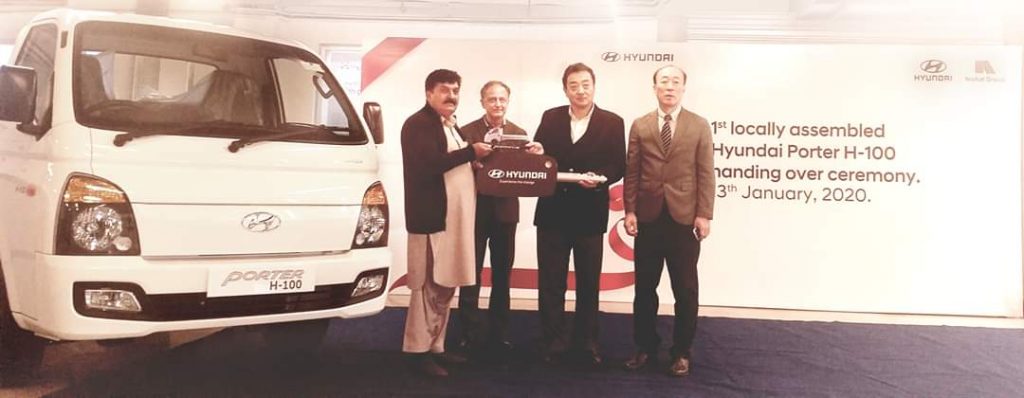
Hyundai Nishat Motors Private limited (HNMPL) has started the booking of their ‘Hyundai H-100 Porter’ truck and the introductory price is starting from Rs. 2,449,000. A launching ceremony, booking opening and the price announcement was held on 2nd of December 2019 in Lahore. The ceremony invited large number of dealers, various bankers, vendors and valued customers.
Pakistan’s famous light commercial truck/pickup ‘Shehzore’, has the same engine as that of Hyundai H-100 previously which has now been discontinued and people are waiting for this pickup since a long time. The pickup has 1.0 ton towing weight capacity, 2.6 L Euro II diesel engines with 5-speed manual transmission power. The Porter H-100 has various applications; it can be used as a flat deck van, an ambulance, a security van, a refrigerator van, and a delivery van. Also, Hyundai H-100 Porter will be the first locally assembled pickup that offers a four- year or 100,000 km warranty. This news is a relief for the rapidly, falling automotive industry of Pakistan.
The offer has never been given by any other local assembler in Pakistan because of which the consumers have been anticipating the pickup to be launched for a long time. These offers make the Hyundai H-100 Porter a tough competition to tackle.
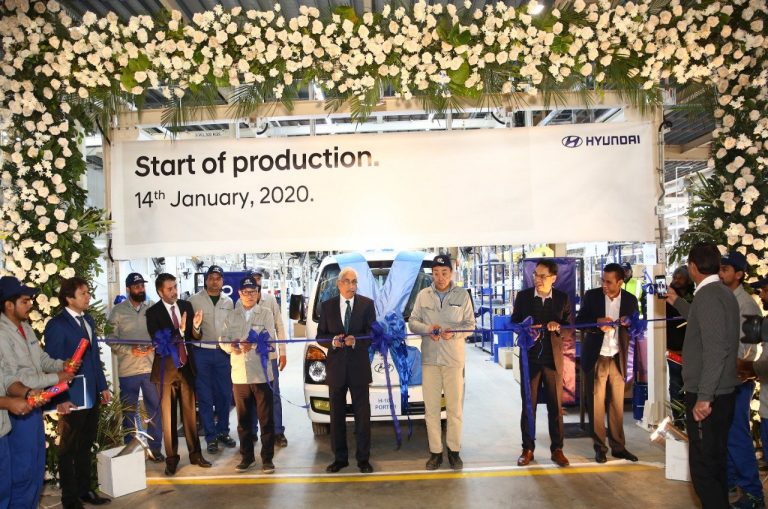
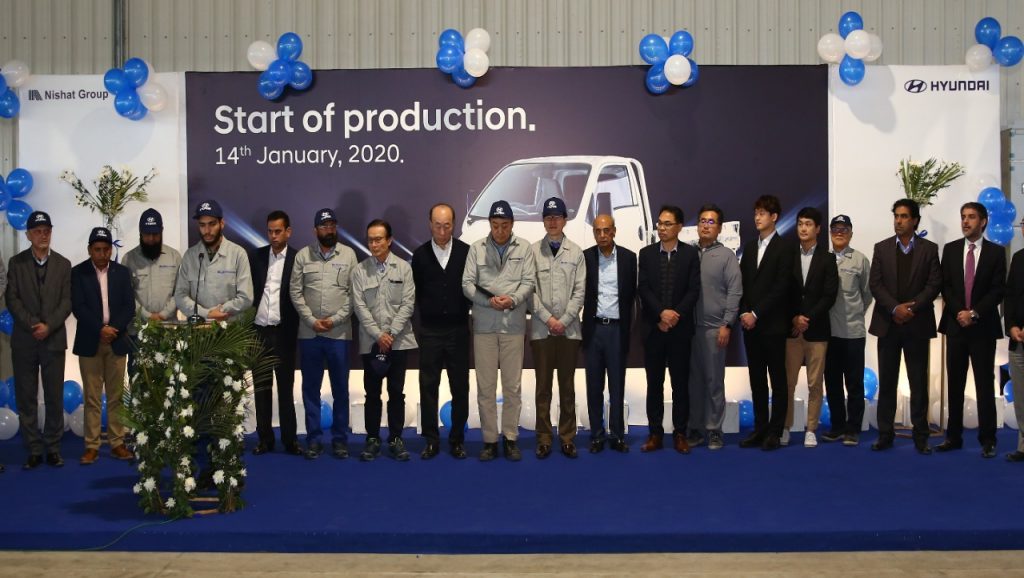
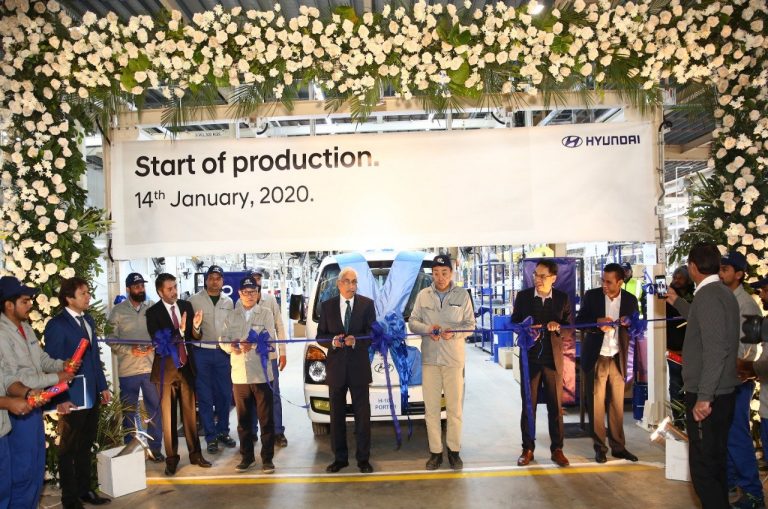
Hyundai Nishat Motors Private limited (HNMPL) announced a local assembling vehicle plant in October 2019 during its launch program. According to the announcement, the plant was to be operational by January 2020. The launch ceremony was done for their digital showroom and Hyundai Ioniq Hybrid car in Karachi on last month. The inaugurated facility included the company’s trademark 3S dealership, along with a digital showroom.
Locally assemble Huyndai Porter H-100 in its manufacturing facility in Faisalabad which would give the Hyundai H-100 Porter a 20% indigenization. Talking with media at the occasion of Inauguration ceremony of showroom in Karachi, Tatsuya Sato of HNMPL says that a total investment of $150 million has been made in the Faisalabad facility which will have an annual production capacity of 15,000 units. It is a CKD operation in which the parts would be imported and locally assembled in the production plant. Also, the facility will open up 250 employment opportunities for the locals. Lastly, he added that the company aims to increase localization by 45% over the next 5 years.
With the rupee depreciating as dollar raises the indigenization can help make the market more sustainable. Speaking on this the COO said that that this parity is also hitting current assemblers regardless of attaining 65% localization. “Higher indigenization in vehicles can stabilize on which we are focusing more.”
As per Automark sources, the HNMPL is also eyeing the Prime Minister ‘Kamyab Jawan Kamyaab Pakistan’ campaign by the National Youth Development program. The program offers 6 schemes through which the youth can get more opportunities to excel in their desired programs.
HNMPL is a joint venture between Nishat Group (Pakistan), Sojitz Corporation (Japan), and Millat Tractors Limited (Pakistan), and is partnering with Hyundai Motors (Korea) to become a leader in the automobile market in Pakistan.
Companies like HNMPL are focusing on the startup scheme through which the young people will be encouraged to try their hands at business by investing in the commercial vehicle business. Opportunities like these are lucrative for both the industrialist and the youth. If successful, this would be a boost to the industrialists who are moving rapidly towards indigenization.
The ground breaking ceremony of the Hyundai-Nishat vehicle assembly plant at Faisalabad’s M-3 Industrial City took place in last December 2017. The local production of vehicles is expected to begin within two years. Hyundai-Nishat Motors signed an investment agreement with the Ministry of Industries and Production under the Automotive Development Policy 2016 – 21 in early December 2017 to set up a Green Field project to undertake assembly and sale of passenger cars and one-ton commercial vehicles.
The groundbreaking was performed by the Prime Minister of Pakistan Mr. Shahid Khaqan Abbasi. The venture sees an investment of US $230 Million as the plant will initially produce 7,000 vehicles by 2020 and will enhance its production to 30,000 units by year 2023. Hyundai-Nishat intends to launch a range of vehicles from hatchbacks, sedans & SUVs to commercial vehicles. Three vehicles were displayed during the event, namely Hyundai Tucson, Hyundai H-1 van and Hyundai H-100 pickup (The latest version of Hyundai Commercial Pickup known as Shehzore in Pakistan).
South Korea’s Hyundai Motors said on Tuesday it has signed a preliminary deal to build a new factory in Indonesia, which would be its first car plant in Southeast Asia and a crack at Japanese rivals that dominate the market.
The deal comes as Hyundai and affiliate Kia Motors struggle with a prolonged sales downturn in China, where they suspended two factories this year.
Hyundai Motor said it will invest about $1.55 billion in the Indonesia auto manufacturing plant from now until 2030, including product development and operation costs.
The facility, to be built in the city of Bekasi, east of Jakarta, will start production in late 2021, with an annual capacity of 150,000 vehicles and a plan to grow that to 250,000 vehicles a year, Hyundai said.
Hyundai plans to make small sport utility vehicles (SUVs) and multi-purpose vehicles (MPVs), while electric vehicles (EVs) tailored to Southeast Asian market are under consideration.
Hyundai said it is building the production facilities to avoid import tariffs ranging from 5% to 80% in the ASEAN region. The plant will cater to Indonesia, the region’s largest automobile market, and other countries belonging to the Association of Southeast Asian Nations (ASEAN), it said.
The plant will allow the automaker to secure future growth to help it “combat slowing demand in the global automotive market”, Hyundai said in its statement.
The deal was signed at an event attended by Indonesian President Joko Widodo and Hyundai Motor Executive Vice Chairman Euisun Chung. Widodo is in South Korea for a meeting of ASEAN leaders hosted by South Korean President Moon Jae-in.
Moon has been pushing a “New Southern Policy” aiming to deepen ties with Southeast Asia as Seoul seeks to curb its reliance on traditional trading partners like China and the United States.
Hyundai is far behind Japanese rivals in Southeast Asia, with its sales reaching 122,883 vehicles versus Toyota’s 854,032 from January to September this year, according to research firm LMC Automotive.
LMC Automotive forecast a 4% year-on-year decline in total vehicle sales in the ASEAN region in the fourth quarter, partly because the slowdowns in the Thai and Indonesian economies show no signs of abating.
Hyundai said key ASEAN countries including Indonesia, Thailand, Malaysia, Vietnam and Singapore are expected to see combined vehicle sales grow to 4.49 million units in 2026, from 3.16 million in 2017.
First time with a new 1.0 liter TURBO engine with 122 PS that offers driving performance superior to a 1.5 liter engine, torque equivalent to 1.8 liter engine, and fuel efficiency to a maximum 23.8 kilometers/liter. – Exterior design combines sportiness and elegance with a more spacious cabin than other city cars. – Value-added functions and features for comfort and comes with a lower price for every variant. – Takes the sporty look to the next level with an RS variant available for the first time. – Experience the all-new Honda City at the 36th Thailand International Motor Expo 2019 and at Honda showrooms nationwide starting from 24 December, 2019. BANGKOK, Nov, 25 2019 – (JCN Newswire) -Honda Automobile (Thailand) Co., Ltd. officially launched the world premiere of the 5th generation all-new Honda City in Thailand, the next level of a city car that offers an unprecedented and unparalleled experience that goes beyond any possibilities. The new model’s exterior design offers an image of uncompromising sportiness and elegance, while the cabin is spacious and luxurious beyond its class.
The all-new Honda City takes driving performance to the next level with a new 1.0 liter VTEC TURBO engine that delivers 122 PS for the ultimate in performance combined with superior fuel efficiency, and it’s also fully equipped with advanced technologies for comfort and safety. An RS variant of the all-new Honda City is available for the first time, offering a sportier look with a complete RS package, the latest generation of Honda CONNECT technology that provides connectivity between a driver and car, and a new exterior color “Ignite Red.” Interested customers can experience the all-new Honda City at the 36th Thailand International Motor Expo 2019 which takes place from 29 November until 10 December. The all-new Honda City will be available at Honda showrooms nationwide starting from 24 December, 2019. As an exclusive offer, customers who reserve an all-new Honda City between 25 November and 31 December, 2019, and take delivery of the car within 31 January, 2020, will receive a Fitbit Smart Tracker Charge 3 in a graphite/black color, worth 6,490 THB.
Mr. Masayuki Igarashi, Chief Officer for Regional Operations (Asia & Oceania), Honda Motor Co., Ltd., and President and CEO, Asian Honda Motor Co., Ltd., said, “Honda City, one of our most important models, was developed and launched as a regional model back in 1996. It has consistently received overwhelming feedback from the 1st through the 4th generation, with accumulated sales of four million units in 60 countries worldwide. The Asia & Oceania region is an important market for Honda City, with more than 100,000 units sold in the region in 2019 (January to September 2019), which accounts for almost 70% of Honda City sales worldwide. We also consider Thailand as a key market for Honda City due to the country’s strong market potential and because it is Honda’s largest production base in the region. As Thailand is the leading market for City, today Thai people will be the first to witness the world premiere of the 5th generation all-new Honda City, which we expect to create an unprecedented phenomenon as it exceeds the expectations of customers and sets a new standard for Thailand’s automotive market once again.”
The all-new Honda City’s exterior delivers a more premium yet sportier look with sharp character lines that will really attract attention, as well as projector headlights with LED Daytime Running Lights (DRL), LED Tail Lights, Chrome Front Grille, Shark Fin Antenna, and newly-designed 15-inch alloy wheels.
The interior design contributes to its unprecedented ergonomics along with a more spacious cabin that creates an ergonomic environment with seating that provides optimal comfort for the driver and all passengers. The all-new Honda City’s luxury and elegance is enhanced by a black interior or leather seats with a two-tone ivory/black interior (SV variant only), a Piano Black console, and chrome inside door handles. It responds to all driving styles with premium functions such as a Multi-information Display (MID) with illumination, 8-inch Advanced Touch Display Audio with Apple CarPlay and Siri Voice Control, Multi-function Steering Wheel with HFT, Bluetooth connectivity, and an automatic Air-conditioning system.
For the first time, the all-new Honda City is available in a RS variant that gives it a sportier and more premium look. The RS variant comes with a complete set of sporty aeroparts including a Gloss Black front grille with RS logo emblem, sporty front bumper and grille, LED Headlights with LED Daytime Running Lights (DRL), LED Fog Lights, Sporty Black Power-retractable Side Door Mirror with Turning Light, Gloss Black Trunk Spoiler with an “RS” logo, and new sporty-design 16-inch Alloy Wheels. The cabin is fully equipped to reflect a complete look of sportiness with newly-designed suede leather seats with red stitching, a Multi-information Display with red illumination, and an eye-catching new Ignite Red exterior color exclusively available for the RS variant.
The all-new Honda City takes performance to the next level with a new 1.0 liter DOHC 3-cylinder, 12-valve, VTEC TURBO engine. The turbocharger further enhances combustion efficiency, and the engine delivers a maximum 122 PS at 5,500 rpm and maximum torque of 173 Newton-meters at 2,000 to 4,500 rpm. The new engine provides driving performance superior to the 1.5 liter engine in the previous generation and powerful torque equivalent to a 1.8 liter engine. The engine is mated to a continuously variable transmission (CVT) to ensure ultimate fuel efficiency of 23.8 kilometers/liter. The 7-speed paddle shift offers exciting driving yet a comfortable drive with the cruise control system. The all-new Honda City is more environmentally friendly as it meets the EURO 5 standard and has a CO2 emission rate of only 99 grams/kilometer. This engine is compatible with E20 fuel. To enhance confidence in all driving conditions, the all-new Honda City’s advanced safety technologies include a G-CON (G-Force Control) body structure, six airbags, Anti-lock Braking System (ABS), Electronic Brake Distribution (EBD), Vehicle Stability Assist (VSA), Hill Start Assist (HSA), and Multi-angle Rearview Camera. The all-new Honda City is available in four variants: – RS 739,000 THB – SV 665,000 THB – V 609,000 THB – S 579,500 THB
It comes in six colors including new Ignite Red Metallic exclusively for the RS variant, Platinum White Pearl exclusively for the RS and SV variants, and Crystal Black Pearl, Lunar Silver Metallic, Modern Steel Metallic, and Taffeta White for the V and S variants. Customers who reserve an all-new Honda City from 25 November until 31 December, 2019, and take delivery of the car within 31 January, 2020, will receive a Fitbit Smart Tracker Charge 3 in a graphite/black color, worth 6,490 THB.
To complete the all-new Honda City’s sportier look in your style, Honda offers a Modulo accessories set under the concept “Stage Up Booster” that includes a Trunk Spoiler (Wing Type) at 8,150 THB, Sport Pedals at 1,300 THB, Side Step Garnish LED at 4,400 THB, 15-inch Sport Alloy Wheels at 3,600 THB(price per wheel not including tires), LED Fog Lights at 5,500 THB, and a Drive Recorder at 3,850 THB. The Modulo Accessories are also available in three packages: – Modulo Aero Package, priced at 15,500 THB, which includes a set of two front under spoilers, a set of two side under spoilers, and a set of two rear under spoilers. – Modulo Aero RS Package, priced at 17,900 THB, which includes a set of two front under spoilers, a set of two side under spoilers, and a set of two rear under spoilers. – Modulo Aero Sport Package, priced at 23,500 THB, which includes a set of two front under spoilers, a set of two side under spoilers, a set of two rear under spoilers, and a trunk spoiler (wing type).
Hyundai Nishat Motors Private limited (HNMPL) has not yet
announced the prices of their ‘Hyundai H-100 Porter’, however, as per Automark
sources the launching ceremony, booking opening and the price announcement is
expected to be on 2nd of December 2019 in Lahore. The ceremony invites have
been sent to large number of dealers, various bankers, vendors and valued customers.
Pakistan’s famous light commercial truck/pickup ‘Shehzore’, has the same engine as that of Hyundai H-100 previously which has now been discontinued and people are waiting for this pickup since a long time. The pickup has 1.0 ton towing weight capacity, 2.6L Euro II diesel engines with 5-speed manual transmission power. The Porter H-100 has various applications; it can be used as a flat deck van, an ambulance, a security van, a refrigerator van, and a delivery van. Also, Hyundai H-100 Porter will be the first locally assembled pickup that offers a four- year or 100,000 km warranty. This news is a relief for the rapidly, falling automotive industry of Pakistan.
The offer has never been given by any other local assembler
in Pakistan because of which the consumers have been anticipating the pickup to
be launched for a long time. These offers make the Hyundai H-100 Porter a tough
competition to tackle.
Hyundai Nishat Motors Private limited (HNMPL) announced a
local assembling vehicle plant in October 2019 during its launch program.
According to the announcement, the plant was to be operational by January 2020.
The launch ceremony was done for their digital showroom and Hyundai Ioniq
Hybrid car in Karachi on last month. The inaugurated facility included the
company’s trademark 3S dealership, along with a digital showroom.
Locally assemble Huyndai Porter H-100 in its manufacturing
facility in Faisalabad which would give the Hyundai H-100 Porter a 20% indigenization.
Talking with media at the occasion of Inauguration ceremony of showroom in
Karachi, Tatsuya Sato of HNMPL says that a total investment of $150 million has
been made in the Faisalabad facility which will have an annual production
capacity of 15,000 units. It is a CKD operation in which the parts would be
imported and locally assembled in the production plant. Also, the facility will
open up 250 employment opportunities for the locals. Lastly, he added that the
company aims to increase localization by 45% over the next 5 years.
With the rupee depreciating as dollar raises the
indigenization can help make the market more sustainable. Speaking on this the
COO said that that this parity is also hitting current assemblers regardless of
attaining 65% localization. “Higher indigenization in vehicles can stabilize on
which we are focusing more.”
As per Automark sources, the HNMPL is also eyeing the Prime
Minister ‘Kamyab Jawan Kamyaab Pakistan’ campaign by the National Youth
Development program. The program offers 6 schemes through which the youth can get
more opportunities to excel in their desired programs.
HNMPL is a joint venture between Nishat Group (Pakistan),
Sojitz Corporation (Japan), and Millat Tractors Limited (Pakistan), and is
partnering with Hyundai Motors (Korea) to become a leader in the automobile
market in Pakistan.
Companies like HNMPL are focusing on the startup scheme
through which the young people will be encouraged to try their hands at
business by investing in the commercial vehicle business. Opportunities like
these are lucrative for both the industrialist and the youth. If successful,
this would be a boost to the industrialists who are moving rapidly towards
indigenization.
The ground breaking ceremony of the Hyundai-Nishat vehicle
assembly plant at Faisalabad’s M-3 Industrial City took place in last December
2017. The local production of vehicles is expected to begin within two years.
Hyundai-Nishat Motors signed an investment agreement with the Ministry of
Industries and Production under the Automotive Development Policy 2016 – 21 in
early December 2017 to set up a Green Field project to undertake assembly and
sale of passenger cars and one-ton commercial vehicles.
The groundbreaking was performed by the Prime Minister of Pakistan Mr. Shahid Khaqan Abbasi. The venture sees an investment of US $230 Million as the plant will initially produce 7,000 vehicles by 2020 and will enhance its production to 30,000 units by year 2023. Hyundai-Nishat intends to launch a range of vehicles from hatchbacks, sedans & SUVs to commercial vehicles. Three vehicles were displayed during the event, namely Hyundai Tucson, Hyundai H-1 van and Hyundai H-100 pickup (The latest version of Hyundai Commercial Pickup known as Shehzore in Pakistan).
A panel of 11 experts have named the all-new 2020 Toyota Corolla and its first-ever hybrid variant as the 2020 Green Car of the Year. It may surprise you to learn this is only the second time a Toyota model wins the award since 2007, when the Toyota Camry Hybrid had earned the honor (though many Toyota models did finish as runners-up).
“The new Corolla and Corolla Hybrid represent significant achievements for Toyota and clearly deserve the 2020 Green Car of the Year honor,” said Green Car Journal editor and publisher Ron Cogan.
“Corolla sells in huge numbers worldwide. This means the impressive fuel efficiency of both gasoline and hybrid Corollas promises to bring substantial, cumulative and meaningful reductions in carbon emissions and fuel use now and in future years.”
The all-new 2020 Toyota Corolla and Corolla Hybrid were launched earlier this year and have already been changing the subcompact car landscape. The Corolla Hybrid is now the most affordable hybrid vehicle you can buy with a Toyota badge, and with its estimated 53 city mpg rating, it’s one of the most fuel-efficient hybrid vehicles you can buy too.
It’s not a stretch to say that the Corolla’s stylish new design and new, fuel-efficient powertrain have been responsible for keeping it ahead of the industry. Toyota says that sales of the total Corolla lineup are “holding steady” even though the subcompact segment is currently down more than 15 percent compared to 2019.
“This award is one we’ve been eyeing for a while now, so it’s great to get this recognition and stamp of approval,” said Bill Fay, senior VP of automotive operations at Toyota Motor North America. “It really is a testament to the desire and effort of Toyota team members to help reduce our environmental impact, while delivering quality and choice to our customers.”
In total, BMW ordered more than €10 Billion ($11 Billion) worth of cells by 2031.
In the case of CATL, BMW Group increases the previously announced (in mid-2018) order of €4 billion to €7.3 billion.
€4.5 billion will fall directly on BMW Group, while the remaining €2.8 billion will be used by the Chinese joint venture BMW Brilliance Automotive Ltd. (BBA) joint venture in Shenyang.
The original CATL order volume of four billion euros announced in mid-2018 will now be increased to 7.3 billion euros (contract duration from 2020 to 2031), with 4.5 billion euros for the BMW Group and 2.8 billion euros for the Chinese production site of the BMW Brilliance Automotive Ltd. (BBA) joint venture in Shenyang. The BMW Group is the first customer of the CATL battery cell plant currently under construction in Erfurt, Germany. “We strongly supported and played an active part in establishing CATL in Germany,” said Dr. Andreas Wendt, member of the Board of Management of BMW AG responsible for Purchasing and Supplier Network.
In the case of Samsung SDI (the main supplier for BMW so far), the supply contract was extended from 2021 to 2031. The deal is worth €2.9 billion.
“The BMW Group has also signed a long-term supply contract for its fifth-generation electric drive trains with its second battery cell supplier, Samsung SDI. The contract, with value of 2.9 billion euros, extends from 2021 to 2031. “In this way, we are securing our long-term battery cell needs. Every cell generation is awarded in global competition to the leading manufacturer from both a technology and a business perspective. This ensures we always have access to the best possible cell technology,” Wendt announced at a supplier event today in Seoul, South Korea.”
BMW intends to use CATL and Samsung SDI batteries in the upcoming fifth-generation electric drive trains, from 2021 on.
Additionally, BMW intends to directly source cobalt and lithium, which will then be made available for CATL and Samsung SDI.
“The BMW Group will source the cobalt needed as a key raw material for cell production directly from mines in Australia and Morocco and make it available to CATL and Samsung SDI. The same applies to lithium, which the BMW Group will also source directly from mines, including from Australia. This gives the company full transparency over where both raw materials come from. Compliance with environmental standards and respect for human rights have the highest priority. The BMW Group’s fifth-generation electric drive trains from 2021 on will also be produced entirely without using rare earths. “This means we will no longer be dependent on their availability,” explained Wendt.”
The battery cells from the supplier are used to assemble the modules and packs at several BMW plants:
Dingolfing, Germany
Spartanburg, USA
Shenyang, China, at the BMW Brilliance Automotive Ltd. (BBA) plant
Thailand, in partnership with the Dräxlmaier Group, one of its long-term automotive suppliers.
Together with the all-new R&D facility in Munich, and additional partnership deals with Northvolt and Umicore, BMW has in place a strong foundation for mass-electrification.
“The BMW Group possesses extensive in-house expertise throughout the entire value chain for battery cell technology. In-house battery production takes place at BMW Group Plants Dingolfing (Germany) and Spartanburg (USA), and at the BBA plant in Shenyang (China). The BMW Group has also localised battery production in Thailand and is working with the Dräxlmaier Group in this area.
On 14 November, the company opened its Battery Cell Competence Centre in Munich. The aim of the competence centre is to advance battery cell technology and introduce it into production processes. The company invested a total of 200 million euros in the location, which is set to create up to 200 jobs. The production of battery cell prototypes makes it possible to analyse and fully understand cell value creation processes. “Whether we then produce the cells ourselves at a later date, will largely depend on how the supplier market develops,” according to Wendt.
The BMW Group has formed a joint technology consortium with Swedish battery manufacturer Northvolt and Umicore, a Belgian developer of battery materials, for the purpose of developing the cell technology crucial to electromobility. The cooperation will focus on creating a complete, sustainable value chain for battery cells in Europe, extending from development and production all the way to recycling. Recycling of battery components plays a decisive role in closing the materials cycle as far as possible and maximising reuse of raw materials as demand for battery cells grows.”
The plan for 2023 is to offer 25 plug-in electric models, out of which more than half will be BEVs.
Advisor to the Prime Minister on Climate Change, Amin Aslam talking to the media on Thursday said that Pakistan is planning to save 2 billion dollars in fuel costs by shifting to electric vehicles
The advisor said that the cabinet has given formal approval for the country’s first electric vehicle policy. He added that by incorporating electric vehicles into the consumer market the country will save million in fuel exports and also bring down the adverse effects being caused to the environment due to carbon emissions.
The advisor revealed that electric Rickshaw and Motorcycle factories are to be set up in the country under the new policy. Yesterday, It was revealed that the federal government has signed a Memorandum of Understanding (MoU) with private ride-hailing service to introduce electric vehicles in the country.
The MoU was signed by Minister of Science and Technology Fawad Hussain Chaudhary and CEO of bus hailing service in Islamabad on Tuesday, according to Radio Pakistan.
Under the MoU, the company will introduce electric battery-powered buses and also spend 12 billion rupees to expand its transport bus service in the country.
The federal cabinet meeting, held on November 4, had given approval to the draft policy of electric motor vehicles.
The cabinet gave approval to the country’s electric motor vehicle policy. PM Khan ordered that the commerce and industry and production ministries will provide guidance to the federal government for the implementation of the policy
The government is set to launch electric buses in the country to combat air pollution.
As per details, the federal government has signed a Memorandum of Understanding (MoU) with private ride-hailing service to introduce electric vehicles in the country.
The MoU was signed by Minister of Science and Technology Fawad Hussain Chaudhary and CEO of bus hailing service in Islamabad on Tuesday, according to Radio Pakistan.
Under the MoU, the company will introduce electric battery-powered buses and also spend 12 billion rupees to expand its transport bus service in the country.
The federal cabinet meeting, held on November 4, had given approval to the draft policy of electric motor vehicles.
Minister for Science and Technology Fawad Chaudhary stated that the government is planning to earn approximately Rs. 10 billion through the use of green technology in the coming few years. He praised the Airlift team for their idea stating:
“These youngsters have pursued this entrepreneurship idea and have managed to raise funding for it. I always tell young people to focus more on entrepreneurship than seeking jobs.”
Currently, Airlift is offering its services in Lahore and Karachi whereas other metropolitan cities will also be targeted soon as part of their expansion plan.
Self-driving cars, or autonomous vehicles (AVs), connected and autonomous vehicles (CAVs), driverless cars, robo-cars or robotic cars, appear to be the upcoming thing. They will have tremendous economic importance because of the size of the potential market.
The car market is one of the largest in the world. On an annual basis, the world’s car manufacturers produce 105 million vehicles, with China, Japan and Germany being the largest producers. Some 105 million vehicles — 80 million cars and 25 million commercial vehicles — in a single year means that each year, 105 million new vehicles hit the world’s streets. That amounts to nearly 290,000 on a daily basis. This is a market that has an annual turnover of $1.6 trillion.
In the past five years, the number of cars produced annually has remained more or less static, while forecasts for the coming years show modest growth. Not so with autonomous vehicles. Forecasts for the future are dramatic. Over the next decade, Internet-connected car technologies and AVs are set to create another revolution in the automotive sector. In 2016, some 40% of people surveyed in the US stated that they were willing to use fully automated vehicles, presumably because they consider AVs to be safer than conventional cars. The global market for autonomous driving hardware components is expected to increase form $400 million in 2015 to $40 billion in 2030.
An increase of a hundredfold
The dramatic increase in the sale of hi-tech components means a dramatic increase in the production of automated vehicles. Generally speaking, an AV is a conventional vehicle with a chassis, four wheels and a motor but with hi-tech wizardry that will enable it to drive itself — that is, to navigate without a driver sitting at the wheel starting and stopping the car, steering it backward and forward, going to the left or right, etc.
The computerized technologies will navigate the AV safely. They will know when to stop or steer the car to prevent an accident such as running someone over, colliding with another car or crashing into a wall.
Self-driving cars combine a variety of sensors to perceive their surroundings, such as radar, LiDAR, sonar, GPS, odometry and inertial measurement units. Advanced control systems interpret sensory information to identify appropriate navigation paths, as well as obstacles and relevant signage.
The main technologies incorporated in these systems are artificial visual technologies. This stands to reason because the main task of these technologies is to perceive obstacles and take the necessary steps to avoid them. In short, artificial visual system sensors can see obstacles and report them to a central computerized “brain” that will know what to do.
The increase in the development and sale of these technologies, both the hardware and software, herald a rapid increase in self-driving vehicles. Demand for such vehicles is expected to be strong. Their advantages are manifold and will benefit the individual and the community, as well as the infrastructure.
They will benefit the individual because they will make getting from one place to another much safer. In the foreseeable future, when automatic vehicles are as common as conventional vehicles today, driving as we know it may well be reserved for sporting activities. Daily activities such as getting to work, going shopping or taking the children to school will be done by an AV.
Automatic cars are also beneficial for the community. With automatic cars, accidents will decrease greatly. Fewer accidents means fewer casualties, fewer invalids and lower mortality. From a communal perspective, fewer accidents means fewer injured parties, hence less pressure on hospitals and other medical facilities. Fewer accidents means fewer people maimed for life, thereby rendering less need for social services and welfare.
Automated vehicles will also be eco-friendly. AVs will be cleaner and less harmful to the environment. Long-distance trucks at the forefront of adopting and implementing the new technologies. Long-distance driving is tedious and consequently dangerous. Automatic trucks will have a beneficial bearing on the road infrastructure.
The challenge for the designers of driverless cars is to produce control systems capable of analyzing sensory data in order to provide accurate detection of other vehicles and the road ahead, as well as stationary objects.
The fact that the production of AVs is set to increase dramatically is very good news for Israel, as it is the world’s largest producer of automatic vehicle technologies. Countless start-ups in Israel are developing innovative technologies for AVs, and many hi-tech companies have already developed such technologies and are selling their products in the global markets.