As an IMF mission opens the fourth review of Pakistan’s US$7 billion Extended Fund Facility, the country’s car industry sits at the centre of the bargain. Behind every tax slab and tariff line is one question: has Pakistan done what it committed to, and who pays where it has not? For a sector built over three decades behind high walls, the answer will decide who invests, who exports and who exits.
Note: the terms you will see CKD is a car assembled locally from imported kits; CBU is a fully built imported car. GST is sales tax. FED and SED are federal and special excise duties, extra taxes on specific goods. RD is regulatory duty, an extra import charge. ICE is a petrol or diesel car, HEV a hybrid, EV an electric car. FY 2030–31 means July 2030 to June 2031.
Commitments: done and not done
The macro commitments are largely met. Pakistan beat its primary-surplus condition, adjusted gas and electricity prices on time, kept central-bank lending to government at zero, met reserve and net-asset floors, and cut spending ceilings by PRs136 billion.
The structural commitments tell a different story. The FBR collected PRs9.306 trillion against a PRs9.917 trillion target, about 0.5% of GDP short. Power-sector arrears reached PRs420 billion against a PRs400 billion ceiling. Health and education spending missed its condition by PRs370 billion, the Sovereign Wealth Fund amendment stalled in parliament, and sugar-market liberalisation was not adopted. A PRs853 billion statistical discrepancy, meaning gaps in the national accounts, still worries the Fund
Note: how to read Figure 1
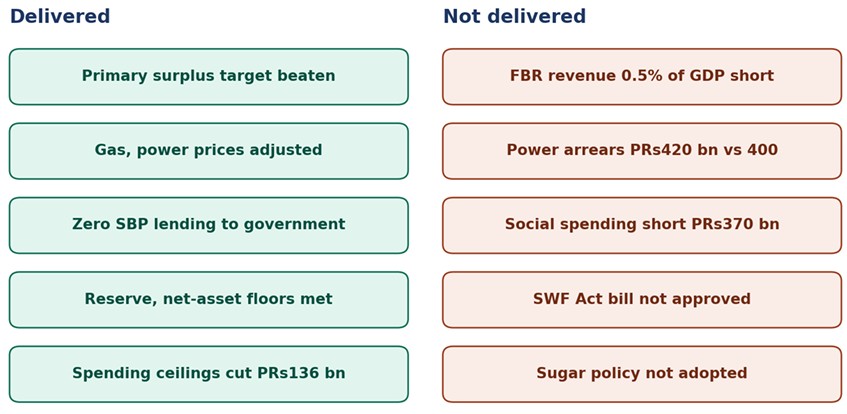
Teal boxes are promises kept and coral boxes are promises missed. The left column is mostly about balancing the budget, which Pakistan achieved. The right column is mostly about reforming institutions and collecting more tax, which it has not yet done. A “primary surplus” is government income minus spending before interest payments.
These gaps explain why vehicles, a visible and documentable asset, sit in the FBR’s sights. A revenue-short tax authority and an open-market IMF produce a double squeeze: more tax on luxury, less protection for everyone. The draft Auto Policy 2026–31 targets a weighted-average tariff of 5.99% by 2031 and a 15–20% cap on finished imports. Every concession is offset elsewhere, so the FBR loses nothing.
Note: what “revenue neutral” means
If the government cuts tax on one thing, such as EVs, it must raise it on another, such as luxury cars. The IMF will not accept a net loss for the FBR
Note: how to read Figure 2
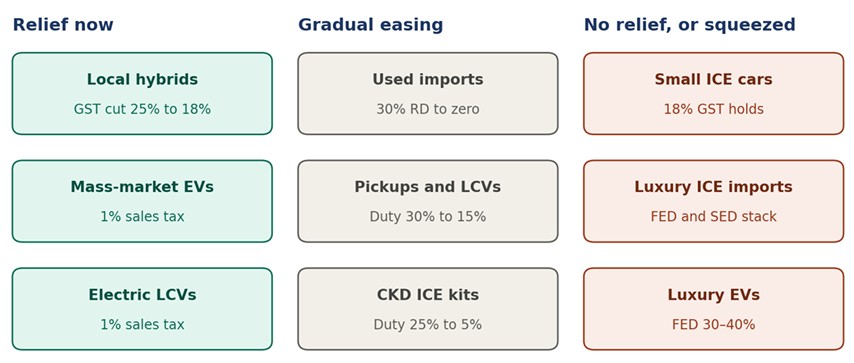
Teal means relief now, gray means slow easing over several years, and coral means no relief or a heavier burden. It shows direction, not exact tax bills. The full year-by-year rates are in the research report.
Small ICE cars. The IMF rejected a proposed cut in sales tax from 18% to 12.5% on 800cc–1000cc cars, so commuter prices will track inflation, with a 1–1.5% climate levy on top. Local assemblers must also reach 40 45% domestic value addition by 2031, even as duties on non-localised kits fall from 25% to 5%. Why it matters: this is the mass market, and buyers of Alto-class cars should not expect price relief from the policy.
Hybrids. The clear winners. S.R.O. 1525(I)/2026 cut sales tax on locally assembled hybrids up to 2000cc from 25% to 18%, and the Corolla Cross and Santa Fe are riding it. Expect a 2.5–5% excise duty to phase in later, the price of cheaper kits. Why it matters: hybrids need no charging network, so they are the easiest “greener” choice for buyers today.
Electric vehicles. Locally assembled EV kits pay 1% and carry no excise duty, which is why Chinese and local joint ventures, including BYD with Hubco, are racing to build lines. The draft lifts their sales tax to 18% by FY 2030–31. Luxury EVs above US$75,000 lose their tax-free pass and face a 30–40% excise duty.
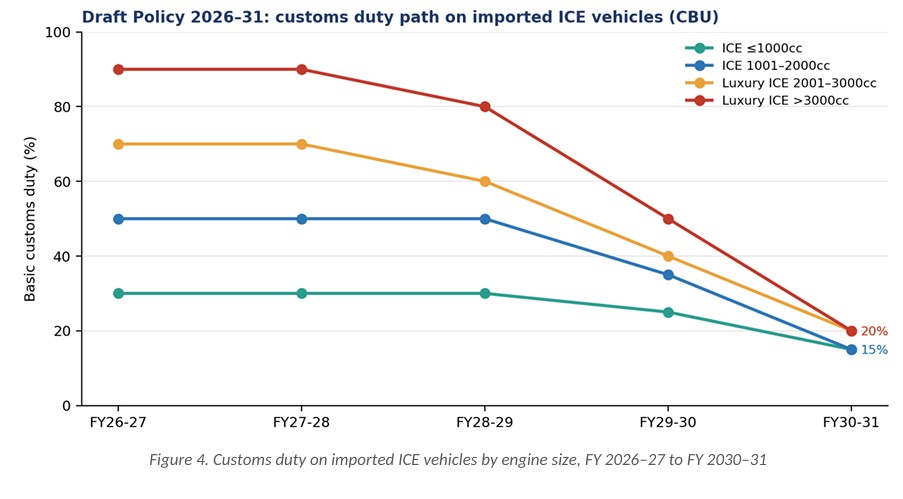
Luxury ICE. Large engines carry the burden. Imported cars above 2000cc face customs duties of 70–90% today, falling to 20% by FY 2030–31, with excise and special excise duties stacked on top.
Pickups and LCVs. Dual-cabin 4x4s used for personal transport are now treated as luxury passenger vehicles. Electric LCVs under 150 kWh get the 1% rate, and fleet buyers are already shifting.
Used imports. An extra 30% regulatory duty under S.R.O. 1065(I)/2026 glides to zero by FY 2030–31. Landed costs of Vitz, Aqua and similar cars have jumped, dealers are turning into brokers, and baggage-scheme loopholes are closing. Why it matters: used Japanese cars are the middle-class alternative to new local cars, and their prices fall only slowly, with the biggest relief around 2029–30.
Note: how to read Figure 4 The lines stay flat for about three years, then fall sharply in the last two. Protection is held for now and removed late. Larger engines start higher but converge toward 15–20%.
Parts makers. About 1,200 vendors claim a 34% structural cost disadvantage and want a 40% duty floor on localised parts. The SBP refused a 365-day export-realisation window, meaning exporters must still bring their dollars home within 180 days. So the pivot is tractor parts, where firms like Millat use over 90% local content, aimed at East, Southern and West Africa. It starts from exports of US$20–30 million, against US$10–12 billion in Thailand and over US$20 billion in India.
Who is arguing what PAMA and PAAPAM warn of de-industrialisation across 1,200 parts factories, 2.5 million jobs and US$5 billion of investment. The IMF replies that competitiveness must come from efficiency and market-driven exchange rates, not tariff insulation. Used-car importers welcome open markets but say inspections, letters of credit and the baggage-scheme clampdown choke their trade.
The Japan question The draft asks OEMs to export 12% of production value by 2029–30. Toyota’s local unit faces a US$265 million disputed liability, frozen by a court, and Japan has raised Specific Trade Concerns at the WTO. Pakistan is outside the MPIA appeal arrangement, so a panel loss could be appealed into a void.
Note: in plain terms only governments can bring cases at the WTO, so Japan speaks for Toyota and Suzuki. The MPIA is a fast-track appeal system that Japan has joined and Pakistan has not. A ruling against Pakistan could therefore be stalled for years.
The outlook
Dedicated technical sessions with the IMF are expected in early-to-mid October. The rule is revenue neutrality: any relief for industry must be offset by excise duties or levies.
The bigger risk is speed. India and Thailand protected their industries for 20 to 44 years before opening, while Pakistan is being offered five.
Bottom line The direction is fixed (open markets, higher tax on luxury, favour for local hybrids and EVs), but the pace is still being negotiated. October is the month to watch.
Note: on the numbers Figures come from reported review outcomes and a draft policy still under negotiation. Sources differ on some points, such as the used-car duty (30% or 40%) and when the 1% EV tax ends (June 2027 or FY 2027–28). Treat every rate as provisional.
Author’s note This article draws on my research report, Pakistan’s Automotive Sector under Structural Adaptation. It reflects reported review outcomes and draft policy positions still under negotiation. None of the figures should be read as final sovereign commitments. — Ali Abbas, Automotive Industry Analyst
This exclusive article has been published in Automark’s October-2026 printed and digital edition.
Written by Ali Abbas, Automotive Industry Analyst