
A New Industrial Experiment for Pakistan
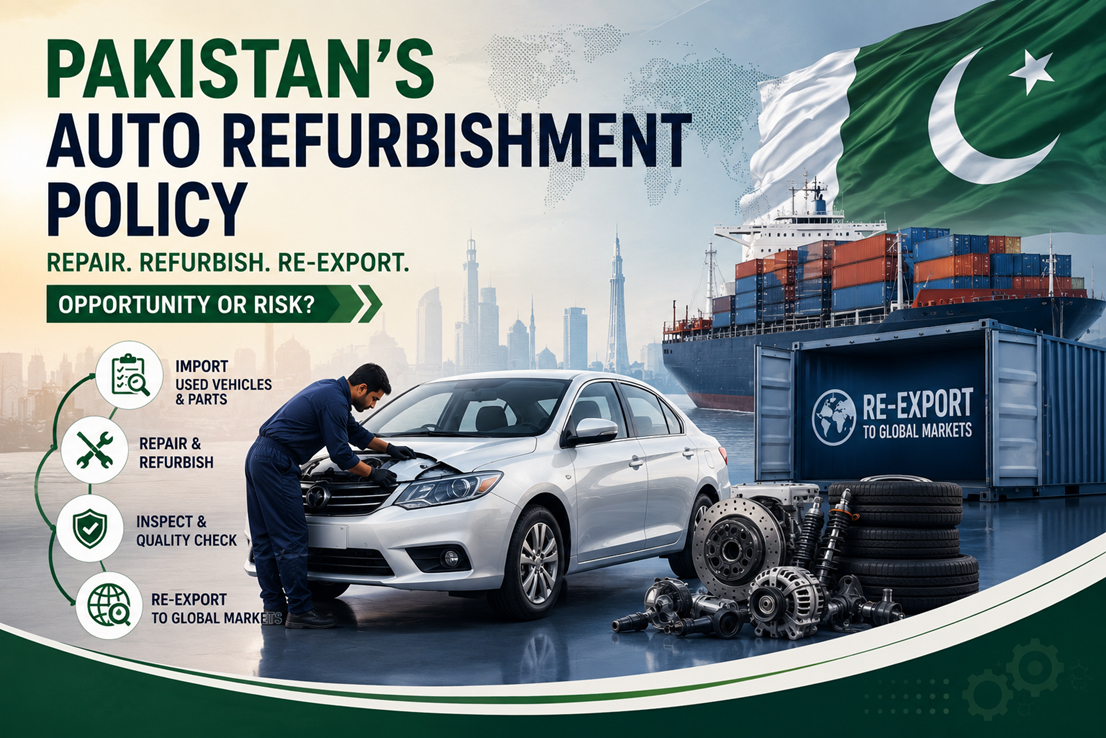
Pakistan’s automotive industry is entering a new phase as the Federal Government approves a pilot project allowing the temporary import of used vehicles and auto parts for repair, refurbishment, and re-export.
The idea behind the initiative is simple but ambitious: vehicles and components will be imported under controlled conditions, refurbished to international standards, and then exported back to overseas markets instead of being released into local circulation. The government believes this approach can help generate industrial activity, improve technical capabilities, create employment opportunities, and strengthen export-oriented business within the automotive sector.
At first glance, the concept appears promising and strategically important for Pakistan’s industrial future. However, the real challenge may not be the policy itself, but the ability to implement it professionally, transparently, and in its true letter and spirit. Pakistan has previously introduced several industrial and export promotion schemes with positive intentions, yet many struggled due to weak monitoring systems, poor enforcement, policy misuse, and lack of accountability. Because of that history, industry stakeholders are approaching this new initiative with both interest and caution.
Understanding the Proposed Model
Under the approved framework, imported vehicles and auto parts will not be permitted for local sale. Instead, they will undergo repair, refurbishment, inspection, quality testing, and controlled industrial processing before being re-exported to international markets.
The policy aims to support industrial growth, automotive engineering activity, technical skill development, and export enhancement while creating new employment opportunities across workshops, logistics, engineering services, and quality inspection operations.
Learning from the Jebel Ali Model
The concept itself is not new internationally. A successful example already exists at Jebel Ali Free Zone, where vehicle refurbishment and re-export operations have developed into a major economic activity.
In Dubai, imported vehicles are repaired, restored, inspected, upgraded, and exported to multiple regions around the world. The success of this ecosystem is largely driven by strict customs monitoring, digitized import-export tracking systems, transparent documentation procedures, strong compliance standards, and effective logistics management. Every imported vehicle is carefully monitored from arrival until final export.
Pakistan, however, operates in a different environment where enforcement gaps and market leakages have historically weakened similar industrial initiatives. This is why many experts believe that execution will determine whether this policy becomes an industrial success story or another missed opportunity.
Pakistan’s Past Experience Raises Concerns
One of the biggest concerns surrounding the initiative is Pakistan’s past experience with export-oriented schemes. In previous projects, imported materials intended for industrial processing and re-export reportedly entered the local market instead of being utilized according to policy objectives.
A notable example was the establishment of an export processing unit in Karachi, where raw materials were imported for manufacturing and export purposes. However, concerns were later raised that some imported materials became available in the domestic market rather than being fully processed for export.
Because of these past experiences, skepticism naturally exists within the automotive industry. Many stakeholders are questioning whether imported vehicles under this new policy will genuinely be refurbished and re-exported, or whether some may eventually find their way into the local market through unofficial channels.
These concerns are serious and cannot be ignored if the government wants to build confidence and credibility around the project.
Spare Parts Availability — An Existing Challenge
Another major issue is the current shortage of imported spare parts in Pakistan. Even today, authorized dealerships and workshops face difficulties obtaining sufficient parts for existing locally assembled and imported vehicle models.
The market is already struggling with delayed imports, foreign exchange limitations, supply chain disruptions, limited inventory availability, increased prices of genuine parts, and long customer waiting periods. In many cases, customers are unable to receive timely repairs simply because required components are unavailable.
This situation raises an important question: if the industry is already unable to fulfill the current demand for spare parts efficiently, how will it manage the additional demand created by refurbishment and re-export operations?
Refurbishment work requires a continuous and reliable supply of mechanical components, electrical systems, body parts, suspension items, tires, paint materials, and other consumables. Without a separate and carefully managed supply chain mechanism, the new initiative could place additional pressure on an already strained automotive parts ecosystem.
The Importance of Quality Audits
Another critical factor for success will be the implementation of strong quality audit and inspection systems. International refurbishment markets operate on strict quality standards because overseas buyers expect vehicles to meet high levels of reliability, functionality, safety, and appearance.
The audit helps companies ensure that vehicle quality, functionality, appearance, and overall manufacturing standards meet customer expectations and company requirements.
Professional refurbishment operations globally rely on detailed evaluations covering mechanical performance, safety compliance, cosmetic finishing, electrical functionality, paint quality, documentation traceability, and operational reliability. Without internationally recognized quality systems, Pakistan may struggle to establish credibility in export markets.
Key Risks That Must Be Controlled
For this project to succeed, the government will need to introduce extremely strong monitoring and compliance mechanisms.
1. Complete Digital Tracking
Every imported vehicle and component should be digitally traceable from arrival to export.
2. Strict Customs Monitoring
Authorities must ensure that imported vehicles cannot be registered or sold locally.
3. Dedicated Bonded Facilities
Refurbishment activities should only be allowed within approved bonded zones under continuous monitoring.
4. Independent Audits
Third-party operational and inventory audits should be mandatory.
5. Spare Parts Supply Planning
A separate import and allocation mechanism may be required to avoid disrupting the existing spare parts market.
6. Heavy Penalties for Violations
Any leakage into the local market must result in strict legal and financial consequences.
Opportunity Still Exists — If Execution Improves
Despite these concerns, the opportunity still exists. If managed professionally, Pakistan could gradually develop expertise in automotive refurbishment, engineering services, inspection systems, logistics operations, and export-oriented industrial activity.
The policy has the potential to create employment, support industrial growth, and strengthen Pakistan’s position within regional automotive trade networks.
However, success will depend entirely on governance, transparency, operational discipline, and the government’s ability to enforce the policy without compromise.
Key Takeaway:
Pakistan’s refurbishment and re-export policy presents both opportunity and risk.
The concept itself is modern, globally recognized, and economically promising. International examples such as Jebel Ali clearly demonstrate that automotive refurbishment can become a successful industrial and export sector.
However, Pakistan’s own history of weak implementation, regulatory loopholes, and local market leakages makes industry concerns understandable.
The biggest challenge is not introducing the policy — it is ensuring that the scheme is implemented honestly, transparently, and with uncompromising regulatory discipline.
If the government can establish strict controls, strong audits, reliable tracking systems, and proper spare parts planning, this initiative could become a meaningful step toward industrial growth and export-oriented automotive development in Pakistan.Bottom of Form
This exclusive article has been published in Automark’s June-2026 printed edition. Written by @asif-mehmood
#Automark