.
Pakistan’s automotive industry is entering one of the most interesting phases of its history. A market that was traditionally driven by fuel economy, affordability, and resale value is now experiencing a major transformation.
For decades, the Pakistani customer had one simple question:
“Which vehicle gives me the lowest running cost and maximum reliability?”
Today, that question is evolving:
“Which technology gives me the best ownership experience?”
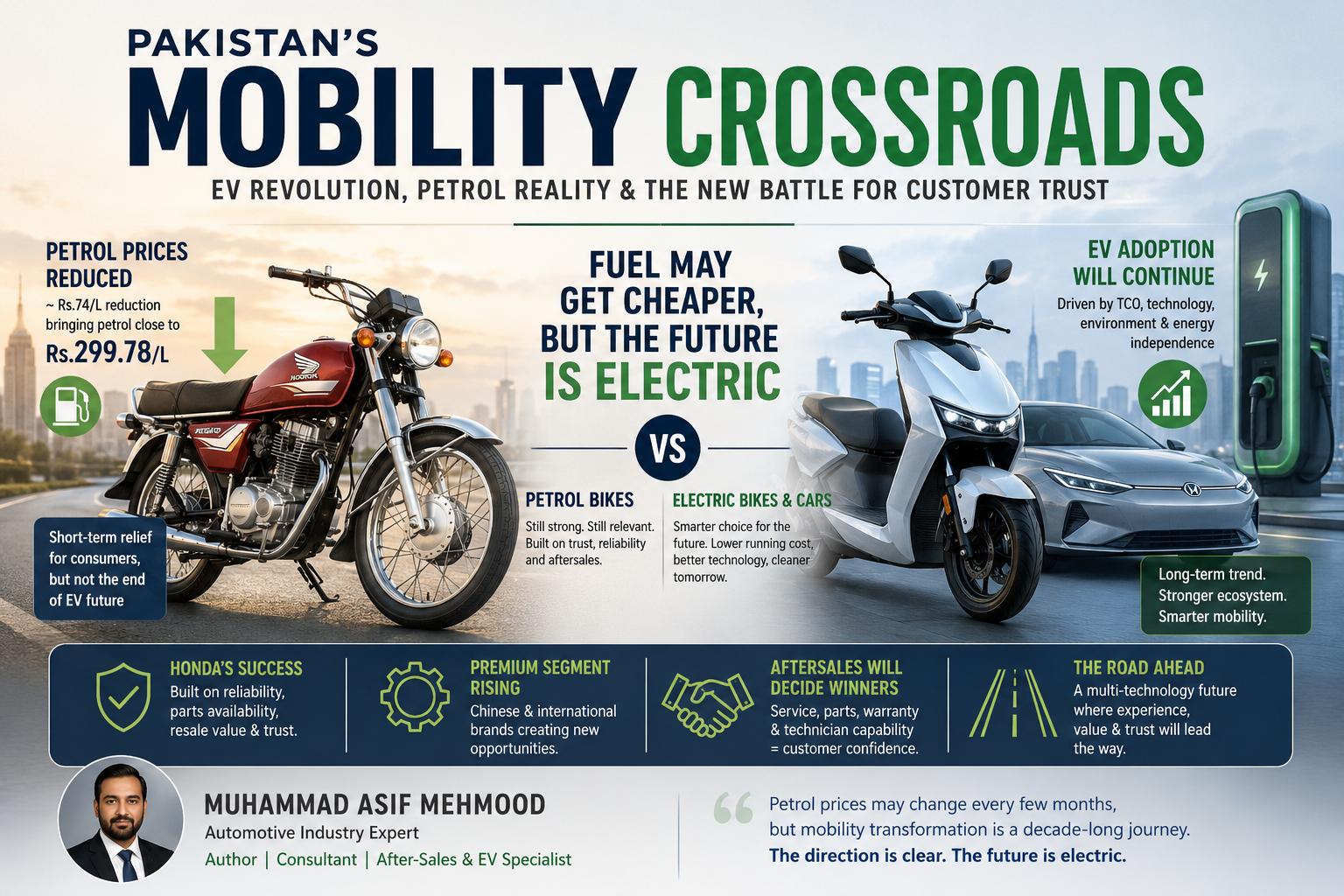
The recent reduction in petrol prices has created a fresh debate across the automotive sector. After reaching historically high levels, petrol prices have seen a significant reduction, bringing relief to consumers. This development has raised an important question:
Will cheaper petrol slow down Pakistan’s electric vehicle revolution, or is EV adoption now moving beyond fuel prices?
The answer lies in understanding the changing mindset of the Pakistani customer.
Petrol Price Was an Accelerator, Not the Foundation of EV Growth
There is no doubt that rising fuel prices accelerated EV interest in Pakistan.
When petrol prices moved toward unprecedented levels, consumers started calculating their monthly transportation expenses more seriously. For daily commuters, especially motorcycle users travelling 40–50 km per day, fuel cost became a major financial burden.
This created an opportunity for electric motorcycles.
The customer thinking became:
“Petrol is expensive, I should shift to EV.”
However, EV adoption was never only about petrol prices.
Globally, electric mobility is being driven by:
- Lower maintenance cost
- Advanced technology
- Energy independence
- Environmental responsibility
- Reduced dependency on imported fuel
- Better driving experience
Fuel prices may influence purchasing decisions temporarily, but they cannot stop a global mobility transformation.
The Real Impact on Electric Motorcycles
The two-wheeler segment will experience the biggest short-term impact from petrol price reduction because Pakistan’s motorcycle market is highly price-sensitive.
A large percentage of customers buy motorcycles for daily transportation, and affordability remains the strongest factor.
Consider a simple comparison:
A petrol motorcycle averaging 40 km/litre:
At Rs.400/litre petrol:
Fuel cost ≈ Rs.10/km
At Rs.300/litre petrol:
Fuel cost ≈ Rs.7.5/km
An electric motorcycle may operate approximately around:
Rs.1–2/km
The saving has reduced, but it has not disappeared.
The future challenge for EV companies will not only be selling electric motorcycles.
It will be building customer confidence through:
- Battery warranty
- Battery replacement strategy
- Spare parts availability
- Technician training
- Reliable aftersales support
The next successful EV brands will not only sell vehicles — they will sell trust.
Electric Cars: A Different Market Story
The impact of petrol price reduction on electric cars will be much smaller.
A customer purchasing a vehicle worth millions of rupees does not evaluate only fuel prices. The decision includes:
- Technology
- Performance
- Comfort
- Ownership cost
- Brand confidence
- Future value
Electric cars offer advantages beyond fuel savings:
- Instant torque
- Quiet driving experience
- Lower maintenance requirements
- Advanced features
- Reduced dependence on fuel imports
The EV car market is therefore moving toward a technology-driven decision rather than a fuel-saving decision.
The New Challenge: Changing Customer Mindset
The first phase of EV adoption was:
“Petrol is expensive, buy EV.”
The next phase must become:
“EV is the smarter mobility choice.”
This requires the industry to educate customers about Total Cost of Ownership (TCO).
Vehicle ownership is not only the purchase price.
Customers spend on:
- Fuel
- Engine oil
- Filters
- Repairs
- Maintenance
- Downtime
EVs change this entire ownership equation.
Honda’s Success: The Power of Trust and Ecosystem
While EVs are creating a new future, Pakistan’s petrol motorcycle market continues to demonstrate an important lesson.
For decades, Atlas Honda has maintained unmatched dominance in the motorcycle market.
The reason is not only product quality.
Honda created an ecosystem.
Reliability
The Pakistani customer values durability.
A motorcycle is not just transportation; for many families, it is a long-term asset.
Honda created a simple customer belief:
“Buy once, worry less.”
Spare Parts Availability
One of Honda’s biggest strengths is its nationwide ecosystem.
Customers know they can find:
- Parts
- Mechanics
- Repair support
- Technical knowledge
This created confidence that competitors struggled to match.
Resale Value
In Pakistan, resale value strongly influences purchase decisions.
Customers often think:
“After using this motorcycle, how easily can I sell it?”
Honda’s resale advantage became a powerful competitive barrier.
Why Many Competitors Failed Against Honda
Several companies entered the motorcycle market with attractive products and competitive pricing.
However, many struggled because they focused mainly on the product.
A motorcycle business is not only manufacturing.
It is an ecosystem business.
The common challenges were:
- Limited dealership network
- Weak aftersales support
- Parts availability issues
- Lower resale confidence
- Lack of long-term customer relationship
The lesson is clear:
A good product can attract customers.
A strong ecosystem keeps them.
The Rise of Premium Petrol Motorcycles
Despite EV growth, another interesting trend is developing in Pakistan — the premium petrol motorcycle segment.
A new generation of customers is looking beyond fuel average.
They want:
- Styling
- Performance
- Technology
- Better riding experience
- Road presence
This is creating opportunities for premium Chinese and international brands.
Higher-end motorcycles may not achieve mass volumes like 70cc or 125cc motorcycles, but they are creating a new enthusiast market.
The introduction of premium brands, including models from Thailand-based manufacturers such as GPX, shows that Pakistan’s motorcycle customer base is becoming more diverse.
Can Premium Petrol Bikes Succeed in Pakistan?
The opportunity exists, but success will depend on one thing:
Customer trust.
Premium customers demand:
- Professional dealerships
- Genuine spare parts
- Trained technicians
- Warranty support
- Brand commitment
Without aftersales strength, even an excellent motorcycle struggles.
The Future: Multiple Technologies Will Coexist
Pakistan’s future mobility landscape will not belong to only EVs or only petrol vehicles.
It will be a mixed market.
Entry-level transportation:
Electric motorcycles will continue growing.
Premium motorcycle segment:
High-quality petrol motorcycles will continue attracting enthusiasts.
Commercial and fleet segment:
EV adoption will accelerate because operating cost matters most.
The Next Battle: Experience vs Economy
The motorcycle and automotive industry is moving from:
“Which vehicle gives better mileage?”
towards:
“Which vehicle gives better value?”
Honda succeeded because it mastered reliability and ownership confidence.
The next generation of successful companies will succeed by combining:
Product + Technology + Design + Aftersales Experience
Pakistan’s mobility future is not about petrol versus electricity.
It is about who can deliver the best customer experience.
Petrol prices may rise and fall, but customer expectations will continue to rise.
The companies that understand this change will define the next decade of Pakistan’s automotive industry.
This exclusive article has been written by @asif-mehmood, Published in Automark’s July-2026 printed edition.