Dear Readers, Pakistan is entering a new era of transportation. Electric vehicles (EVs) are becoming an important part of the global automobile market, and Pakistan is also moving towards cleaner and more affordable transport solutions. Rising fuel costs, dependence on imported oil, air pollution, and the need for sustainable mobility are encouraging the country to explore alternatives to traditional petrol and diesel vehicles.
The Government of Pakistan has introduced the New Energy Vehicle (NEV) Policy 2025–30, which aims to make 30% of new vehicle sales electric by 2030. The policy covers different categories, including motorcycles, rickshaws, passenger cars, light commercial vehicles, buses, and trucks. It also sets a target of developing 3,000 charging stations across the country during the policy period. These targets create a need for investment in charging infrastructure and open the door to new business opportunities for private investors.
However, promoting electric vehicles alone will not be enough. People and businesses must have access to reliable, safe, and affordable charging facilities. Without a proper charging network, customers may hesitate to purchase electric vehicles, especially if they regularly travel long distances or depend on vehicles for their business operations.
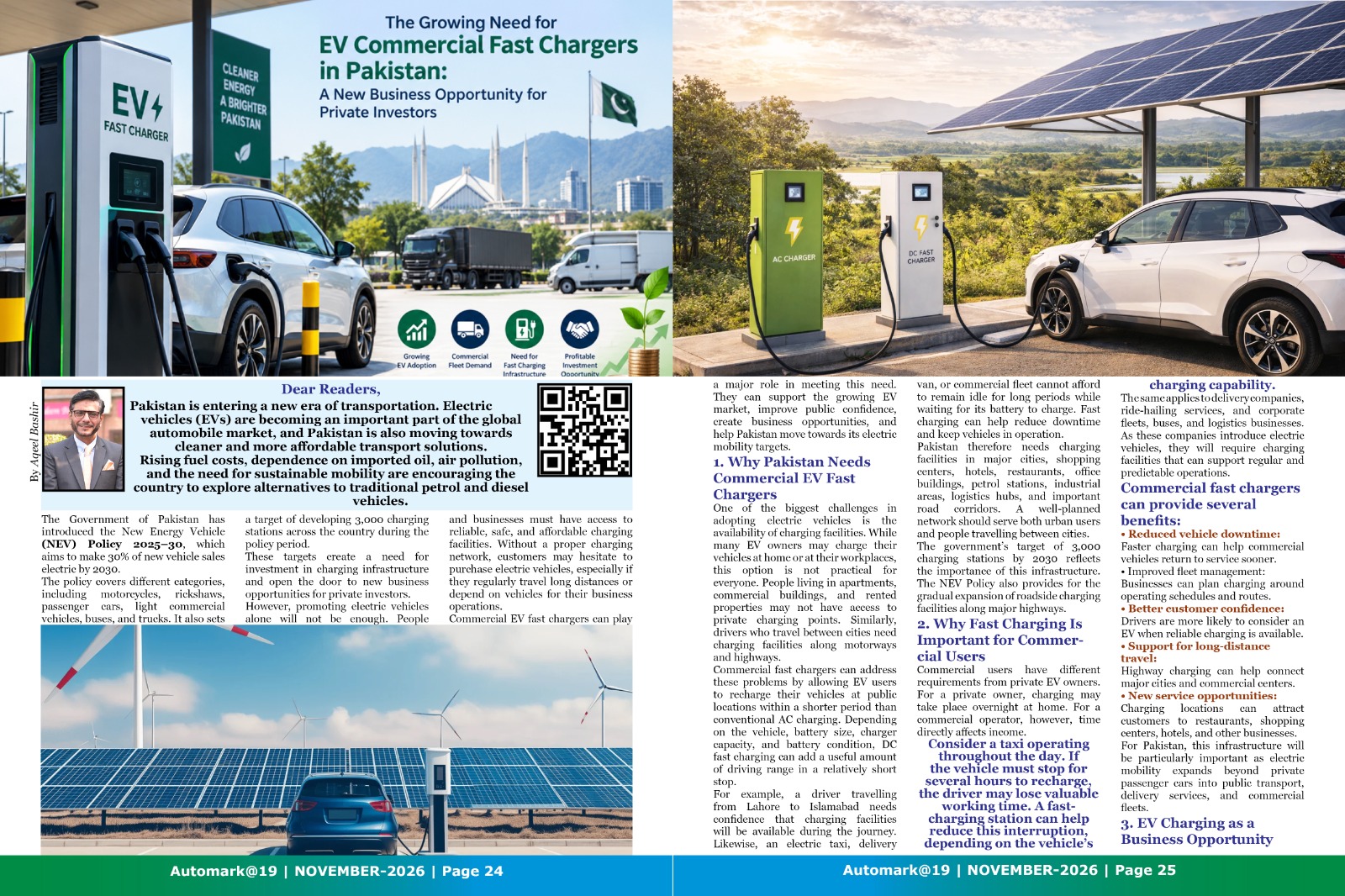
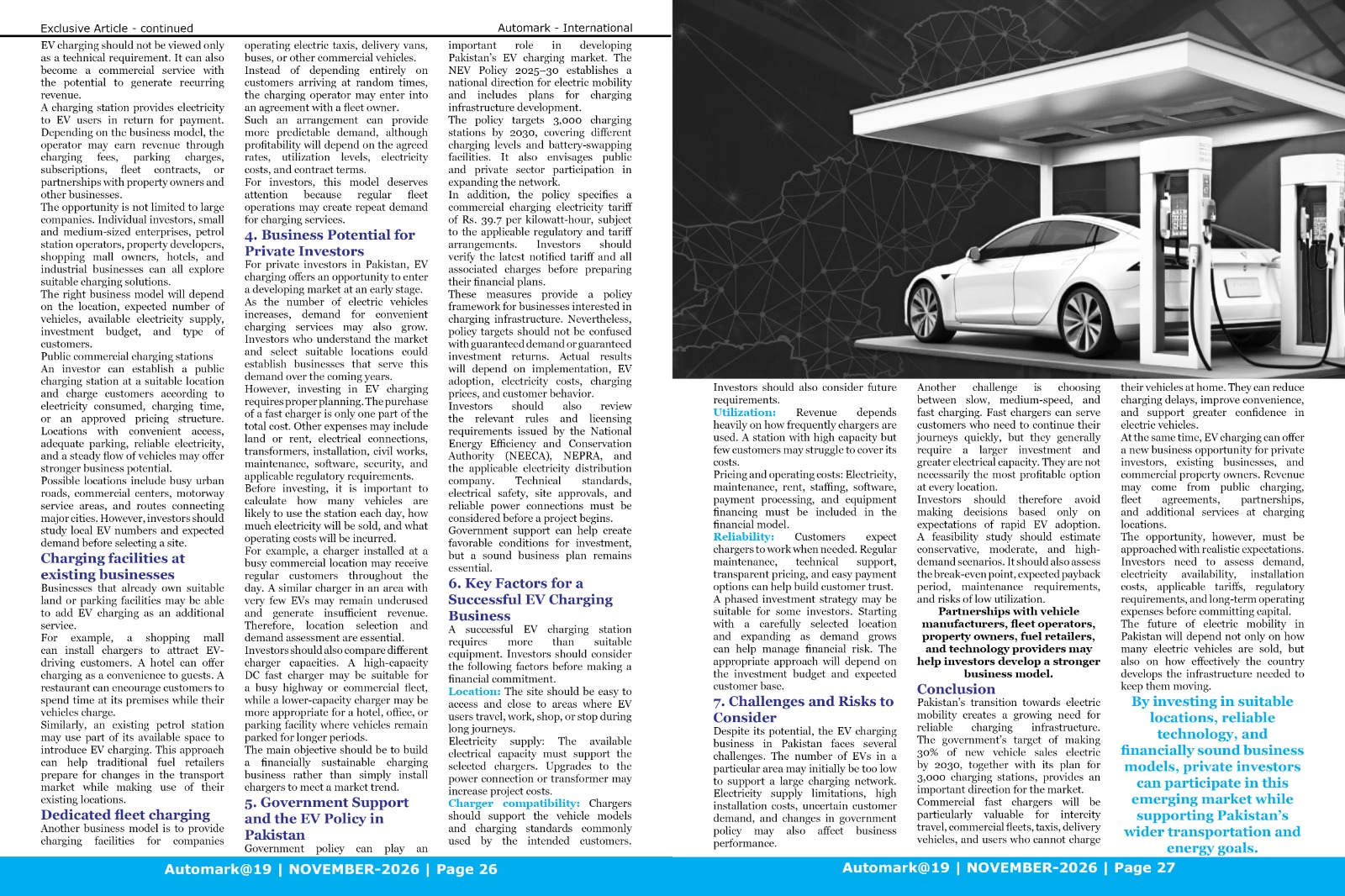
Commercial EV fast chargers can play a major role in meeting this need. They can support the growing EV market, improve public confidence, create business opportunities, and help Pakistan move towards its electric mobility targets.
1. Why Pakistan Needs Commercial EV Fast Chargers
One of the biggest challenges in adopting electric vehicles is the availability of charging facilities. While many EV owners may charge their vehicles at home or at their workplaces, this option is not practical for everyone. People living in apartments, commercial buildings, and rented properties may not have access to private charging points. Similarly, drivers who travel between cities need charging facilities along motorways and highways.
Commercial fast chargers can address these problems by allowing EV users to recharge their vehicles at public locations within a shorter period than conventional AC charging. Depending on the vehicle, battery size, charger capacity, and battery condition, DC fast charging can add a useful amount of driving range in a relatively short stop.
For example, a driver travelling from Lahore to Islamabad needs confidence that charging facilities will be available during the journey. Likewise, an electric taxi, delivery van, or commercial fleet cannot afford to remain idle for long periods while waiting for its battery to charge. Fast charging can help reduce downtime and keep vehicles in operation.
Pakistan therefore needs charging facilities in major cities, shopping centers, hotels, restaurants, office buildings, petrol stations, industrial areas, logistics hubs, and important road corridors. A well-planned network should serve both urban users and people travelling between cities.
The government’s target of 3,000 charging stations by 2030 reflects the importance of this infrastructure. The NEV Policy also provides for the gradual expansion of roadside charging facilities along major highways.
2. Why Fast Charging Is Important for Commercial Users
Commercial users have different requirements from private EV owners. For a private owner, charging may take place overnight at home. For a commercial operator, however, time directly affects income.
Consider a taxi operating throughout the day. If the vehicle must stop for several hours to recharge, the driver may lose valuable working time. A fast-charging station can help reduce this interruption, depending on the vehicle’s charging capability.
The same applies to delivery companies, ride-hailing services, and corporate fleets, buses, and logistics businesses. As these companies introduce electric vehicles, they will require charging facilities that can support regular and predictable operations.
Commercial fast chargers can provide several benefits:
- Reduced vehicle downtime: Faster charging can help commercial vehicles return to service sooner.
- Improved fleet management: Businesses can plan charging around operating schedules and routes.
- Better customer confidence: Drivers are more likely to consider an EV when reliable charging is available.
- Support for long-distance travel: Highway charging can help connect major cities and commercial centers.
- New service opportunities: Charging locations can attract customers to restaurants, shopping centers, hotels, and other businesses.
For Pakistan, this infrastructure will be particularly important as electric mobility expands beyond private passenger cars into public transport, delivery services, and commercial fleets.
3. EV Charging as a Business Opportunity
EV charging should not be viewed only as a technical requirement. It can also become a commercial service with the potential to generate recurring revenue.
A charging station provides electricity to EV users in return for payment. Depending on the business model, the operator may earn revenue through charging fees, parking charges, subscriptions, fleet contracts, or partnerships with property owners and other businesses.
The opportunity is not limited to large companies. Individual investors, small and medium-sized enterprises, petrol station operators, property developers, shopping mall owners, hotels, and industrial businesses can all explore suitable charging solutions.
The right business model will depend on the location, expected number of vehicles, available electricity supply, investment budget, and type of customers.
Public commercial charging stations
An investor can establish a public charging station at a suitable location and charge customers according to electricity consumed, charging time, or an approved pricing structure. Locations with convenient access, adequate parking, reliable electricity, and a steady flow of vehicles may offer stronger business potential.
Possible locations include busy urban roads, commercial centers, motorway service areas, and routes connecting major cities. However, investors should study local EV numbers and expected demand before selecting a site.
Charging facilities at existing businesses
Businesses that already own suitable land or parking facilities may be able to add EV charging as an additional service.
For example, a shopping mall can install chargers to attract EV-driving customers. A hotel can offer charging as a convenience to guests. A restaurant can encourage customers to spend time at its premises while their vehicles charge.
Similarly, an existing petrol station may use part of its available space to introduce EV charging. This approach can help traditional fuel retailers prepare for changes in the transport market while making use of their existing locations.
Dedicated fleet charging
Another business model is to provide charging facilities for companies operating electric taxis, delivery vans, buses, or other commercial vehicles.
Instead of depending entirely on customers arriving at random times, the charging operator may enter into an agreement with a fleet owner. Such an arrangement can provide more predictable demand, although profitability will depend on the agreed rates, utilization levels, electricity costs, and contract terms.
For investors, this model deserves attention because regular fleet operations may create repeat demand for charging services.
4. Business Potential for Private Investors
For private investors in Pakistan, EV charging offers an opportunity to enter a developing market at an early stage. As the number of electric vehicles increases, demand for convenient charging services may also grow. Investors who understand the market and select suitable locations could establish businesses that serve this demand over the coming years.
However, investing in EV charging requires proper planning. The purchase of a fast charger is only one part of the total cost. Other expenses may include land or rent, electrical connections, transformers, installation, civil works, maintenance, software, security, and applicable regulatory requirements.
Before investing, it is important to calculate how many vehicles are likely to use the station each day, how much electricity will be sold, and what operating costs will be incurred.
For example, a charger installed at a busy commercial location may receive regular customers throughout the day. A similar charger in an area with very few EVs may remain underused and generate insufficient revenue. Therefore, location selection and demand assessment are essential.
Investors should also compare different charger capacities. A high-capacity DC fast charger may be suitable for a busy highway or commercial fleet, while a lower-capacity charger may be more appropriate for a hotel, office, or parking facility where vehicles remain parked for longer periods.
The main objective should be to build a financially sustainable charging business rather than simply install chargers to meet a market trend.
5. Government Support and the EV Policy in Pakistan
Government policy can play an important role in developing Pakistan’s EV charging market. The NEV Policy 2025–30 establishes a national direction for electric mobility and includes plans for charging infrastructure development.
The policy targets 3,000 charging stations by 2030, covering different charging levels and battery-swapping facilities. It also envisages public and private sector participation in expanding the network. In addition, the policy specifies a commercial charging electricity tariff of Rs. 39.7 per kilowatt-hour, subject to the applicable regulatory and tariff arrangements. Investors should verify the latest notified tariff and all associated charges before preparing their financial plans.
These measures provide a policy framework for businesses interested in charging infrastructure. Nevertheless, policy targets should not be confused with guaranteed demand or guaranteed investment returns. Actual results will depend on implementation, EV adoption, electricity costs, charging prices, and customer behavior.
Investors should also review the relevant rules and licensing requirements issued by the National Energy Efficiency and Conservation Authority (NEECA), NEPRA, and the applicable electricity distribution company. Technical standards, electrical safety, site approvals, and reliable power connections must be considered before a project begins.
Government support can help create favorable conditions for investment, but a sound business plan remains essential.
6. Key Factors for a Successful EV Charging Business
A successful EV charging station requires more than suitable equipment. Investors should consider the following factors before making a financial commitment.
Location: The site should be easy to access and close to areas where EV users travel, work, shop, or stop during long journeys.
Electricity supply: The available electrical capacity must support the selected chargers. Upgrades to the power connection or transformer may increase project costs.
Charger compatibility: Chargers should support the vehicle models and charging standards commonly used by the intended customers. Investors should also consider future requirements.
Utilization: Revenue depends heavily on how frequently chargers are used. A station with high capacity but few customers may struggle to cover its costs.
Pricing and operating costs: Electricity, maintenance, rent, staffing, software, payment processing, and equipment financing must be included in the financial model.
Reliability: Customers expect chargers to work when needed. Regular maintenance, technical support, transparent pricing, and easy payment options can help build customer trust.
A phased investment strategy may be suitable for some investors. Starting with a carefully selected location and expanding as demand grows can help manage financial risk. The appropriate approach will depend on the investment budget and expected customer base.
7. Challenges and Risks to Consider
Despite its potential, the EV charging business in Pakistan faces several challenges. The number of EVs in a particular area may initially be too low to support a large charging network. Electricity supply limitations, high installation costs, uncertain customer demand, and changes in government policy may also affect business performance.
Another challenge is choosing between slow, medium-speed, and fast charging. Fast chargers can serve customers who need to continue their journeys quickly, but they generally require a larger investment and greater electrical capacity. They are not necessarily the most profitable option at every location.
Investors should therefore avoid making decisions based only on expectations of rapid EV adoption. A feasibility study should estimate conservative, moderate, and high-demand scenarios. It should also assess the break-even point, expected payback period, maintenance requirements, and risks of low utilization.
Partnerships with vehicle manufacturers, fleet operators, property owners, fuel retailers, and technology providers may help investors develop a stronger business model.
Conclusion
Pakistan’s transition towards electric mobility creates a growing need for reliable charging infrastructure. The government’s target of making 30% of new vehicle sales electric by 2030, together with its plan for 3,000 charging stations, provides an important direction for the market.
Commercial fast chargers will be particularly valuable for intercity travel, commercial fleets, taxis, delivery vehicles, and users who cannot charge their vehicles at home. They can reduce charging delays, improve convenience, and support greater confidence in electric vehicles.
At the same time, EV charging can offer a new business opportunity for private investors, existing businesses, and commercial property owners. Revenue may come from public charging, fleet agreements, partnerships, and additional services at charging locations.
The opportunity, however, must be approached with realistic expectations. Investors need to assess demand, electricity availability, installation costs, applicable tariffs, regulatory requirements, and long-term operating expenses before committing capital.
The future of electric mobility in Pakistan will depend not only on how many electric vehicles are sold, but also on how effectively the country develops the infrastructure needed to keep them moving. By investing in suitable locations, reliable technology, and financially sound business models, private investors can participate in this emerging market while supporting Pakistan’s wider transportation and energy goals.
This exclusive article has been published in Automark’s October-2026 printed and digital edition. Written by @Aqeel Bashir.