Home Blog Page 36

This 3-Wheel Electric Scooter Runs on Solar Power and Will Easily Get You Out of Traffic Jams

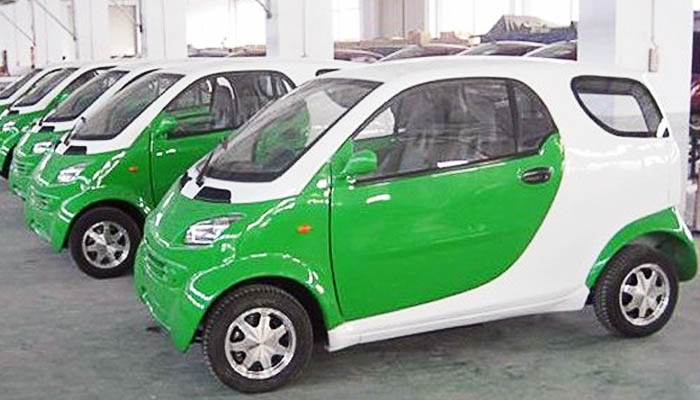
This is the BICAR, a three-wheel electric scooter that runs on solar power and designed for sharing using a shared mobility program. It was developed by a research team at the Zurich University of Applied Science, led by Adrian Burri and Hans-Jörg Dennig. The fully electric-powered scooter goes up to 28mph (45 km/h).

The BICAR’s energy self-sufficiency is guaranteed with solar power and includes a back-up system with swappable batteries and newly-created Battery Swap Stations. Riders can use a mobile app to “geo-localize” a BICAR or a Battery Swap Station, make a reservation, lock/unlock the BICAR and use their mobile phone and software as an information board and navigation tool while driving, according to the team.

BICAR-sharing for short and medium distance traveling within a city is ideal for businesses that are in search of a sustainable, space-saving, and cost-efficient solution. Parking is super-easy and its size also makes for navigating traffic jams seamless and less stressful.

Toyota start building the Suzuki ACross for Europe – a new hybrid SUV based on the Toyota RAV4

Toyota has started production of the Suzuki ACross – a new SUV for Suzuki based on the Toyota RAV4 – which is heading for Europe.

As car makers look for more and more ways to co-operate and save cash, it was no surprise to learn last year that Toyota is going to build cars for Suzuki.

The plan was to build a new Suzuki SUV to sit above the SX-4 using the hybrid Toyota RAV4 as the basis, and although we don’t yet know whether the new Suzuki SUV – which looks set to be the Suzuki ACross – will be more than just new badges and grille, production has now started.

According to Just Auto, production of the RAV4-based Suzuki is now underway at Toyota’s Plant in Japan, and the completed cars are destined to be sold in Europe, and will help Suzuki cut its average CO2 thanks to the RAV4’s hybrid powertrain.

But it’s not just a Suzuki based on the RAV4 that’s in the offing, but a Toyota Corolla Estate Suzuki-fied too.

When the plans were announced last year, Toyota said the plan was to build the Corolla Estate for Suzuki in the UK – at Toyota’s Burnaston Plant where the Corolla is already built – with it too destined for sale in the UK and Europe. So expect to learn soon that its production will start before the year is out.

The Suzuki ACross is expected to go on sale later this year, although it may be early in 2021 before the ‘Suzuki Corolla’ arrives.

Toyota and Suzuki resume car production in Pakistan

Pak Suzuki Motors and IMC have reopened their car production plants in Karachi from the 15th of June 2020 which were closed since 23rd March 2020.

According to a notification sent to the Pakistan Stock Exchange (PSX), by PSMC said:

 “The management of the company, according to relaxation/ approval given by the Government has decided to resume its production and operation from today.”

The company was closed for 84 days and has had zero sales in the month of April. With ease of restriction from government their production plants have final reopened. Their offices opened after eid but even then only Head of Departments and essential staff attended the office. The rest of the staff has been doing their work from home.

Also Read : Car assemblers struggle to resume operations in Karachi

Indus Motor Company (IMC) opened their offices after Eid with permission from Sindh government. However according to Automark sources they closed their offices from 8th of June for disinfection of the office. The company later released a public notice which stated that the company was closed down to ensure safety of the staff and will reopen on 11th of June.  However, IMC could not reopen on given time.

According to sources, in that time of closure the company performed corona test of over 5000 people including the employees and related support manpower. Those employees who tested positive were advice for quarantined meanwhile the negative ones got back to work. IMC has a dedicated team that ensures that all the SOPs are being followed during work at plant and offices.

The production plant has become operational but only in single shift. However a week the second shift might become operational too. However the company has rescheduled the production of Yaris in June which were set on higher units.

The ongoing situation of the spread of COVID- 19 in Pakistan might cause another halt in the vehicle production in Pakistan. Hopefully, things will return to normal in the upcoming days. The auto industry has already faced severe losses in 2020 and anymore will push them over the edge. 

New Toyota Wigo launched in Philippines, starts at P568,000

Over a week ago, we reported that Toyota Motor Philippines (TMP) would be launching the facelifted Wigo on June 15, 2020. Well, today’s the day, and the Japanese car manufacturer has introduced the car online with a P568,000 starting price. Check out the full price list below:

2020 Toyota Wigo

  1. Toyota Wigo E MT – P568,000
  2. Toyota Wigo G MT – P623,000
  3. Toyota Wigo G AT – P658,000
  4. Toyota Wigo TRD S – P700,000

The humble city car comes equipped with a 1.0-liter three-cylinder gasoline engine capable of 65hp at 6,000rpm and up to 89Nm of torque at 4,400rpm—exactly the same figures as the pre-refresh version. The mill can come mated to either a four-speed automatic or a five-speed manual transmission.

The big changes are outside, where the vehicle flaunts a more aggressive face, among other design tweaks. The interior has been improved as well, and now features redesigned seats. Higher-end variants get a new rear camera and power side mirrors.

If you opt for higher variants, you can also get a touchscreen infotainment system, a digital A/C panel, push-start ignition, and keyless entry. The Toyota Racing Development (TRD) version features an Android Auto- and Apple CarPlay-compatible infotainment setup, as well as a handful of visual exterior upgrades. The latter includes different lighting units, TRD side skirts, a two-tone rear spoiler, and TRD badges and decals.

“The New Wigo remains an iconic car that offers the same familiar feeling of practicality and reliability, but made more advanced, more convenient, safer, and more fun with its sleek and sporty TRD Styling,” TMP president Atsuhiro Okamoto said during the launch.
If you’re looking for a reliable starter car, the refreshed Toyota Wigo might be well worth looking into. Are you satisfied with the improvements Toyota has given the vehicle?

Why the Auto Industry is suffering and the way forward in Pakistan

Due to the ongoing Covid-19 pandemic, large scale manufacturing has also shut down ever since social distancing and quarantine laws have been set into place. As a result, the auto industry in Pakistan is suffering with closed offices and dealerships, stagnant production lines and mostly importantly, no demand. With investors being cautious with their social distance and also their capital, auto manufacturers faced the unprecedented occasionof virtually zero sales in the month of April 2020 compared to previous months on a year-on-year basis as reported in various media.

While the pandemic has undoubtedly caused investor panic, forced companies to delay their vehicle purchase orders and cut down on households’ appetite for local and imported cars, a lot of folk don’t realise that sales figures from the auto industry had already started falling in the red zone well before the pandemic.

For the investors, which is perhaps the biggest demand-influencing segment of customers, confidence was already low due to a number of ongoing reasons, the biggest one being, the PTI govt’s policy on sale and purchase of vehicles and the costs associated with registration and transfer of vehicles, in addition to legislation that prohibited sale of vehicles on “open-letter” and enforced transfer of ownership within a certain time frame.

For investors and house hold buyers, another major factor was the hike in prices of locally assembled and import vehicles owing to depreciation of dollar-rupee exchange rate as well as increase in import duties and inflation, which almost immediately skyrocketed the prices of new and used vehicles in Pakistan. The prices of locally assembled vehicles have since peaked, reaching its highest. It is worth taking note here that the dollar-rupee exchange rate, the SBP’s interest rate as well as inflation have since fallen.

An often-ignored factor that most companies in Pakistan fail to take into consideration is millennial spending habits. While a lot of wiser and older folk may disagree on the change in young peoples’ spending preferences influencing overall demand for vehicles in Pakistan, one cannot fully make a concrete case in the favour of or against this factor in the absence of data but a visible change in young people’s attitude towards vehicle ownership, their knowledge of the environmental impact of it and their readiness to adapt to car-sharing and vehicle-pooling platforms can at least be observed at large thanks to disruptive technologies emerging from the IT sector.

While the way forward for the auto industry in Pakistan is a hard one to predict for most analysts as we live in unprecedented times, but those with their eye on global data know one thing for sure: overall global demand was on its way down way before the covid-19 pandemic so it is going to take a lot more than just reopening business to get numbers back up. In Pakistan, it would not only take effort from vehicle manufacturers and dealers, but also from the government in terms of policy that allows the local industry to become less import-dependent and sustainable in the long-run, by keeping stable fiscal and monetary policy that ensures steady exchange and interest rates, a business friendly framework that allows for ease of business to attract foreign investment, and mostly importantly enabling a significant increase in the quality of labour by facilitating the TVET framework and integrating it into the mainstream education framework of Pakistan.

It is worth mentioning here that the government has been trying to come up with an EV Policy for the production and sale of electric vehicles locally, which for the moment seems on a secondary priority level for the government with the situation at hand, and as insiders reveal, owing to strict opposition from existing industry stakeholders including manufacturers. The plan also seems ambitious as we not only lack the technical and labour capability to make electric vehicles and specifically rechargeable batteries, it is also problematic knowing that none of the stakeholders, especially the Ministry of Climate Change ever considered the biggest fact in going electric, something that countries with electric vehicles adopted beforehand: making the source of the energy renewable, either fully or partially with most countries having set timelines for making their entire electric grid “smart” and fossil-fuel free. As we know, most of our energy in Pakistan comes either from coal or other fossil fuels, with our electricity grid network not exactly being modern, let alone the ongoing shortage of electric power that Pakistanis experience in all areas of Pakistan especially in hotter months.

On the contrary, one could argue that the oil market crash causing some of the lowest oil barrel prices in recent history could prop up the demand for vehicles globally, it is widely acknowledged by the global businesses, the scientific community and government entities that oil is nonetheless a finite energy resource which is fast running out, regardless of what prices OPEC agrees to set. And in Pakistan, owing to the exchange rate concerns, consumers can never fully benefit from the effects of the global oil crash ironically.

Another major factor that would influence the way forward for the local industry as mentioned earlier is, how local auto makers adapt their strategy to influence their biggest target market, i.e. the millennials and gen z. They would have to get used to their spending preferences and comprise on the quantity of their sales to the quality of their sales by building trust and ease at the end-user level. Companies need to realise that millennials and young people no longer just care about the product but also the value associated with it, including the user experience, cost of up-keep and the overall impact on the environment. It would mean not only making the sale but technologically enabling ease of the after-sales relationship and cutting down costs to keep the customer within their service network and providing a safe, seam-less user experience without the hassle of traditional ownership issues.

By Muhammad Inam Shahid
*The writer would appreciate your views and insights at [email protected]

Electrical Vehicles (2-3 wheelers & Heavy Commercial Vehicles

SUMMARY FOR THE ECC OF THE CABINET

Industries and Production (I&P) Divisionnotified a committee for EV Policy Formulation on 5th Sept 2019 in view of notification of Cabinet Division dated 27th  August 2019, wherein it was stated that policy electric vehicle falls under the domain of Ministry of Industries and Production. Copy of Cabinet Division’s notification is enclosed at Annex-A for reference.

2. Initially, Ministry of Climate Change (MoCC) made a presentation Honourable Prime Minister by Ministry of Climate Change (MoCC) on 17 May 2019 for introduction of electric vehicles in Pakistan. The Cabinet advised further stakeholder consultation on EV Policy. EDB/MoIP continued consultations with potential investors and the subject was discussed as agenda item of various meetings of Auto Industry Development Committee (AIDC), which is a cabinet approved body comprising of public and private sector members, mandated to recommend measures for growth of automotive sector. AIDC recommended phase-wise introduction of electrical vehicles starting with 2-3 wheeler motorcycles and rickshaws followed by heavy commercial vehicles (HCVs) including trucks and buses. AIDC further proposed promotion of  both; electric vehicle and hybrid technologies in four wheelers (Cars and Sports Utility Vehicles, SUVs) beyond Automotive Development Policy (ADP 2016-21) i.e.  July 2021 onwards to maintain its sanctity.

3. Federal Government formulated a high level Inter-Ministerial Committee under the Chairmanship of the then Advisor to Prime Minister on Industries and Productionin pursuance of MoIP’s Notification No 2(48)/2020 dated April 1, 2020to discuss the subject policy at length before submission to ECC of the Cabinet. The notification was later amended to include Minister for Industries and Production as the Chair and Secretary Ministry of Commerce as a member. Copies of relevant notifications are enclosed at annex- B.

4          Proposals related to EV manufacturing and introduction in local market were discussed at length in first meeting of  inter-ministerial committee held under Chairmanship of the then Advisor to the PM on Industries and Production on April 06,2020. Minutes of meeting are enclosed as annex-C for review. The second meeting of said inter-ministerial committee was held on June 03, 2020 under chairmanship of Minister for Industries and Production. As decided in the first meeting, the comparison of policy documents prepared by Ministry of Climate Change and Ministry of Industries and Production was discussed in detail. The policy recommendations to the extent of 2-3 wheelers and HCVs were finalized in the meeting. The copy of presentation including decisions taken by inter-ministerial committee is enclosed as annex- D.

5. The EV Policy by EDB/ I&P Division has been prepared with objectives of technology acquisition, encourage auto and related industry to adopt EV manufacturing, mitigate negative aspects of climate change through reduction in emissions from transport sector, employment generation through new investments, reduction of oil import bill, usage of excessive electricity etc. while giving due consideration to infrastructure development, which will provide cost effective solution to the commuters in the form of E-vehicles. The major recommendations of the policy including 2-3 wheelers, HCVS and general proposals are as under:

2-3 Wheelers

  1. General Sales Tax (GST) at sales stage to fixed for 2-3 wheelers @ 1% for five years i.e. the policy period. Sales Tax at import stage to be waived off (0%) to avoid refunds.
  • EV Specific Parts of 2-3 wheelers to be imported at 1 % Customs Duty (CD) for five years. Lists of major EV Specific Parts are enclosed as annex E.
  • Exemption of 2-3 wheelers from Registration and Annual Token Tax. Reduction of toll tax to 50% for EVs.
  • Existing  manufacturing regime for 2-3 wheelers with respect to non EV parts & components to remain intact to safeguard already achieved localization
  • Benefits of EV policy to be extended to both; existing and new manufacturers.
  • Import of new EVs (2-3 wheelers) in CBU condition at concessionary rate of duty (50 % of the prevailing rate of custom duty)  to be linked with establishment of manufacturing facilities i.e. 100 units per variant with maximum of 2000 units allowed to be imported under concessionary regime

Heavy Commercial Vehicles (HCVs)–Electric

  • 1 % Customs Duty on import of CBUs (Electric Buses, Trucks & Prime Movers)
  • Import of entire CKD allowed at 1 % Customs duty to the local manufacturers
  • General Sales Tax @ 1 % at sales and waived off (0%) at import stage.
  • Exemption of registration fee, annual renewal fee, permits and reduction of toll tax to 50 percent for HCVs.

General Proposals for 2-3 wheelers & HCVs

  • Localization of parts and components to be reviewed after 2 years  announcement of policy 
  • Duty and Tax Free  import of plant and machinery to be allowed to both; existing and new entrants in both 2-3 wheelers & HCVs
  • Five year income tax exemption for auto part manufacturers for setting up  manufacturing facility for EV related equipment
  • Inputs for EV vendors to be exempted from duties and taxes for 5 years (applies to in-house manufacturing by OEMs also)
  • The funding facility of State Bank of Pakistan to encourage green investments will encompass EV manufacturers, EV parts, components and module manufacturers, EV infrastructure development including charging stations
  • Five years income tax exemption for manufacturers of  EV equipment and infrastructure development
  • Import of chargers with the CKD to attract 1 % Customs Duty and 1 % Sales Tax whereas import of charging stations for electric vehicle under HS Code 8504.4030 already allowed at 0 % Customs Duty to continue

6. Ministry of Climate Change, Ministry of Science and Technology, Ministry of Commerce, Ministry of Planning, Development and Special  Initiatives, Advisor to PM on Institutional Reforms and Austerity Measures, SAPM on Petroleum and Deputy Chairman Planning Commission  have already endorsed the proposals contained in para-5 ante during the inter-ministerial meetings.

7. Approval of the ECC is solicited to the proposals at para-5, above.

8. The Minister for Industries and ProductionDivision has seen and authorized the submission of this Policy to the ECC.

                                                                                                                                    (AFZAL LATIF)

Secretary

June, 2020

AuVitronics export auto parts to Toyota Vietnam

Pakistani auto part manufacturer AuVitronics has become a part of Toyota’s international supply chain

The auto industry in Pakistan has entered into a new era with AuVitronics Limited, a House of Habib company geared up to export the ‘Absorber FR Bumper’ to Toyota Motor Vietnam Co. Ltd. (TMV), joining the league of part suppliers in the Toyota global supply chain.

AuVitronics will export absorber FR bumpers to Toyota Vietnam, the Indus Motor Company said in a statement.
IMC, operating as Toyota Indus, is a Pakistani automobile manufacturer which is a subsidiary of Japanese multinational automaker Toyota. These parts are made of Expanded Polypropylene (EPP) which will be installed in Corolla cars in the future.

“IMC has been striving for the development of the auto sector for last thirty consecutive years. We have fulfilled our commitment to the country and promoted the auto and engineering industry in Pakistan and today we are achieving new successes,” said CEO, IMC, Ali Asghar Jamali.

He added that now as part of the global supply chain of Toyota, they will further develop the industrial base of the country since IMC has already helped local vendors to have around 30 technical assistance agreements with foreign companies. He also added that the consistency in policies can only make long term export objective a reality. Government should nurture the industry and induct growth oriented interventions and generate revenue from higher volumes rather than increasing tax rates.

Meanwhile, AuVitronics Limited CEO Syed Abbas-ul-Hussaini said, “It is a great pleasure for Pakistan to become part of the global supply of Toyota and it is the beginning of a new era for the local auto industry as it has opened new export markets for the sector”.
“It has opened ways to international markets for the [Pakistani] automobile sector,” Hussaini added.

Car assemblers struggle to resume operations in Karachi

All leading vehicles assemblers in the Pakistan Auto Industry closed down their operations in March 2020 due to the government imposed lockdown to control Covid 19 spread in the masses.

After being closed for two months the dealers, vendors and assemblers had a meeting with Government of Sindh at Commissioner Karachi’s office. A decision was reached, after much persuasion by the auto industry, the plants and offices were to be opened after Eid holidays with strict compliance to the SOPs.

However according to sources two Japanese car assemblers are struggling to keep their operations running. Their offices have again been shut down for disinfection and the date to reopen is delayed every day.

However, the regional offices of the companies remained open and the staff which is essential for HODs was instructed to be at the office meanwhile the management staff has been told to work from home.

Covid- 19 has severely affected the Auto industry; the whole month of April had zero sales and production. Some assemblers still have nil sales too. The overall car production and sales during 10MFY20 plunged by 52 per cent year-on-year each to 88,628 and 86,330 units.

Even now if the assemblers fail to resume operations things could go worse for the already failing Auto Industry.

New Toyota Initiative Embraces Hydrogen Fuel Cells

A new joint venture takes a promising approach

For several years, Toyota has touted hydrogen fuel cells as a way to power cars. The sporty Toyota Mirai has been at the forefront of the automaker’s ambitions — though auto industry experts have differed as to how realistic Toyota’s plans are for this technology.

A newly-announced joint venture suggests Toyota is increasing their commitment to this technology — and they’re not alone in it. A report from Automotive News (via Bloomberg) notes that Toyota has teamed with a quintet of Chinese companies on an initiative to develop fuel cells.

Toyota’s partners in this new venture, United Fuel Cell System R&D, are Beijing SinoHytec Co., Dongfeng Motor Corp., Guangzhou Automobile Group Co., Beijing Automobile Group Co. and China FAW Corp. Toyota will own 65%; its initial investment will be close to $46 million.

What’s most significant here is the potential for hydrogen to end up powering a host of cars across China — which could then spur global demand. As the article notes:
China has the muscle to change the landscape should it make hydrogen-powered vehicles a national priority. The world’s biggest car market is set to embrace hydrogen fuel-cell vehicles in the same way that it did EVs, Wan Gang, who’s been called the father of China’s electric-car movement, said last year.

Writing at Jalopnik, Erik Shilling explores this move in the context of some other recent announcements from Toyota. Hydrogen fuel cells currently require a lot of energy to make, Shilling notes — but the technology “is more scalable than battery-electric technology.” All of which means that this joint venture could have a substantial impact on the future of transportation.

Dealers urge Sindh Government to introduce online motor registration system

The Excise, Taxation, and Narcotics control department of Punjab has enabled dealers to register and to give license plates to new car owners in exchange for a small fee.

Meanwhile, the Sindh government is a decade behind in making any government system computerized. The manual systems seem to live on even in the 21st century in Sindh Government, creating problems for industries and citizens.

Sindh Excise and Taxation – Narcotics Control department collected Rs.5416.907 million Motor Vehicle Tax in the current financial year July 20019 to April-May 2020. According to the information given by the Provincial Minister of Excise and Taxation – Narcotics Control and Parliamentary Affairs, Mukesh Kumar Chawla, in a meeting that took place last Saturday.

Even then a new vehicle or motorcycle/three wheelers buyer faces a huge dilemma when he goes to register his vehicle in the Exercise and Taxation department ‘Motor Registration Wing’. He has to wait hours on end in the space outside the wing and then deal with hassles of registering the car manually. Even then there is a chance that he might not license plate for his car in upcoming few years.

On the other hand, Excise Taxation and Anti-Narcotics department of Punjab has introduced the Dealer Vehicle Registration System (DVRS). In this system, the dealers who have been in the auto industry for more than three years will be given license under the Punjab Motor Vehicle transaction Licensees Act 2015. This license will enable those dealers to access to Motor Transport Information Management System (MTMIS) Centralized System.

The licensed dealers will take the registration fee and a fixed convenience/service charge from the customer, register the vehicle in the MTMIS system, and issue customers the license plates on the spot. The cars which are locally assembled can be registered imported cars and commercial vehicles will have to follow the manual method.

The dealers who will be given the license will have to deposit dues of the government, entre data of car and car owner in the MTMIS system, and deliver the registration documents to the department after posting challan to concerned MRA.

The dealer will also be responsible for maintaining a record for five years and make it available for an audit anytime needed. There should be no violations of laws, which could be giving anyone the authority to use the system and withhold information that should have been conveyed to the concerned party.

“The Government should also seriously consider to implementing online motorcycle registration system at Sindh Excise and Taxation department as like province of Punjab has already done.” said Chairman Association of Pakistan Motorcycle Assembler (APMA), Mohammad Sabir Sheikh, while talking to Automark representative. He further said that “having a system like DVRS could make our lives much easier. We appeal Sindh government to take this step and make the system better.”

With this system, the Punjab government has dealt with unregistered cars, and the Sindh government could do the same.

There wouldn’t be a problem of non-issuance of number plates with dealers given the right to issue license plates.

Non-issuance of number plates has become a case in Sindh High Court. A petition was filed concerning non-issuance of number plates by the excise department and harassment the car owners faced at the hands of traffic police because of that.

The Taxation and Narcotics Control Department, on hearing of the petition on 11 March 2020, was ordered by Sindh High Court (SHC) to give license plates to all the car owners who registered their cars but failed to get their plates.

It should be noted that the excise department has issued no number plates in the past two years. Over 200,000 to 300,000 vehicles owners are waiting to get their license plates according to the petitioner’s counsel, Advocate Asim Iqbal.

Introduction of Dealer Vehicle Registration System (DVRS) will not only benefit the dealers, buyers but also the excise department, which at present is lacking in doing its job.