Dear Readers, For the current month’s theme for Automark magazine is PAPS 2026 Auto Show. Pakistan’s Automotive Potential and Future Direction has been chosen as the main theme of the month because a Pakistan Auto Show is about more than just cars, parts, and technology. This event offers us a chance to examine the entire automotive industry and see where Pakistan stands in terms of its position, what has been achieved throughout the years, the existing challenges, and the upcoming opportunities. The future cannot be judged merely on the grounds of the volume of production and the number of companies in attendance at a show. The future of an industry depends upon the creation of local value, technology advancement, competitiveness of the products, supply chain reliability, and success in international market penetration.
Pakistan Auto Show (PAPS) 2026, held every year by Pakistan Association of Automotive Parts & Accessories Manufacturers (PAAPAM), yet again proved the increasing power, variety, and future possibilities of Pakistan’s automotive industry. Over time, PAPS has developed into the largest automotive expo in the country, where automakers, manufacturers of automotive parts, technology firms, investors, policymakers, and others in the industry gather in one place. It once again gathered the whole automotive industry in one place. The expo has emerged as an important venue for Pakistan’s automotive industry where automakers, automotive part makers, engineering firms, technology firms, investors, and many more gather.
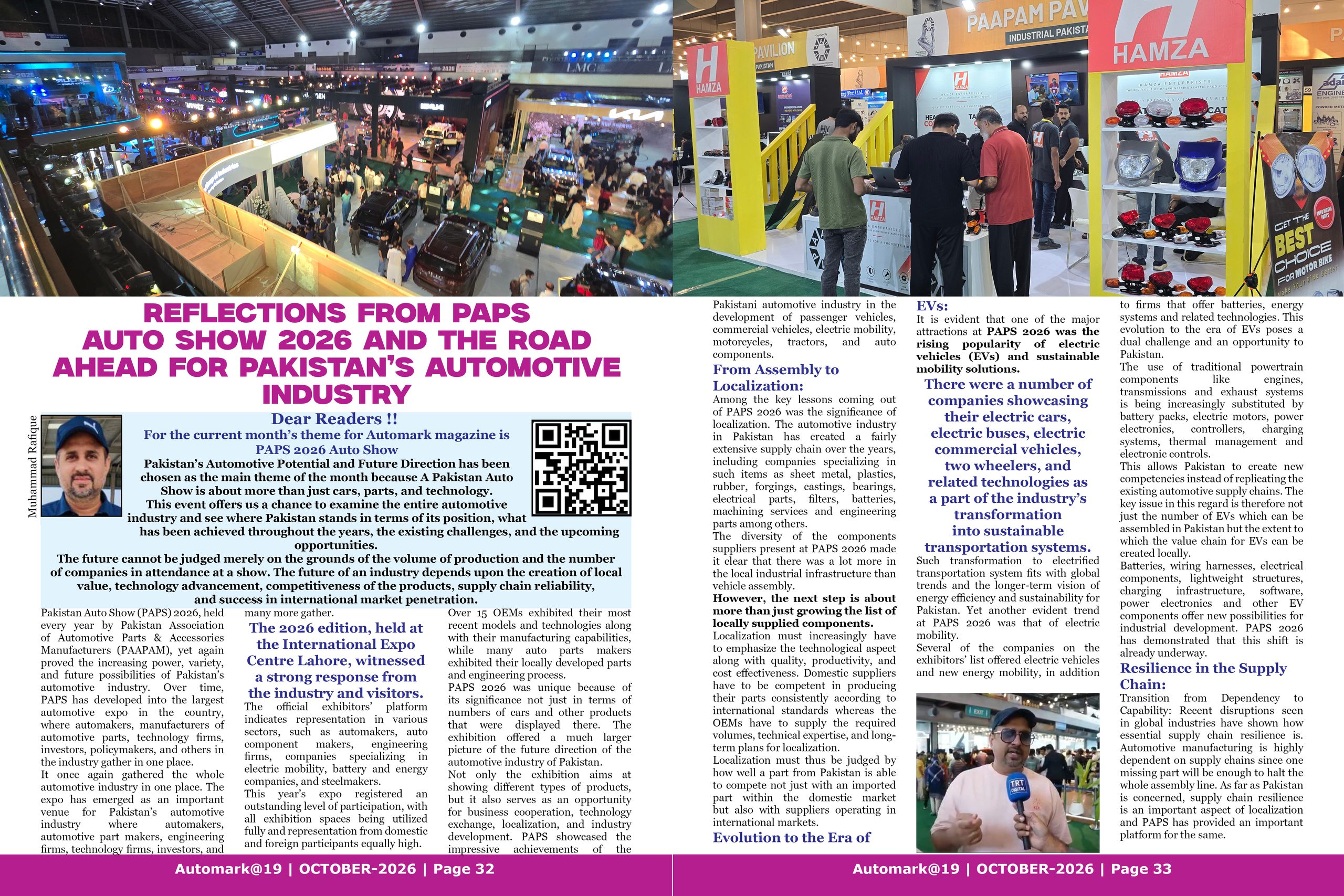
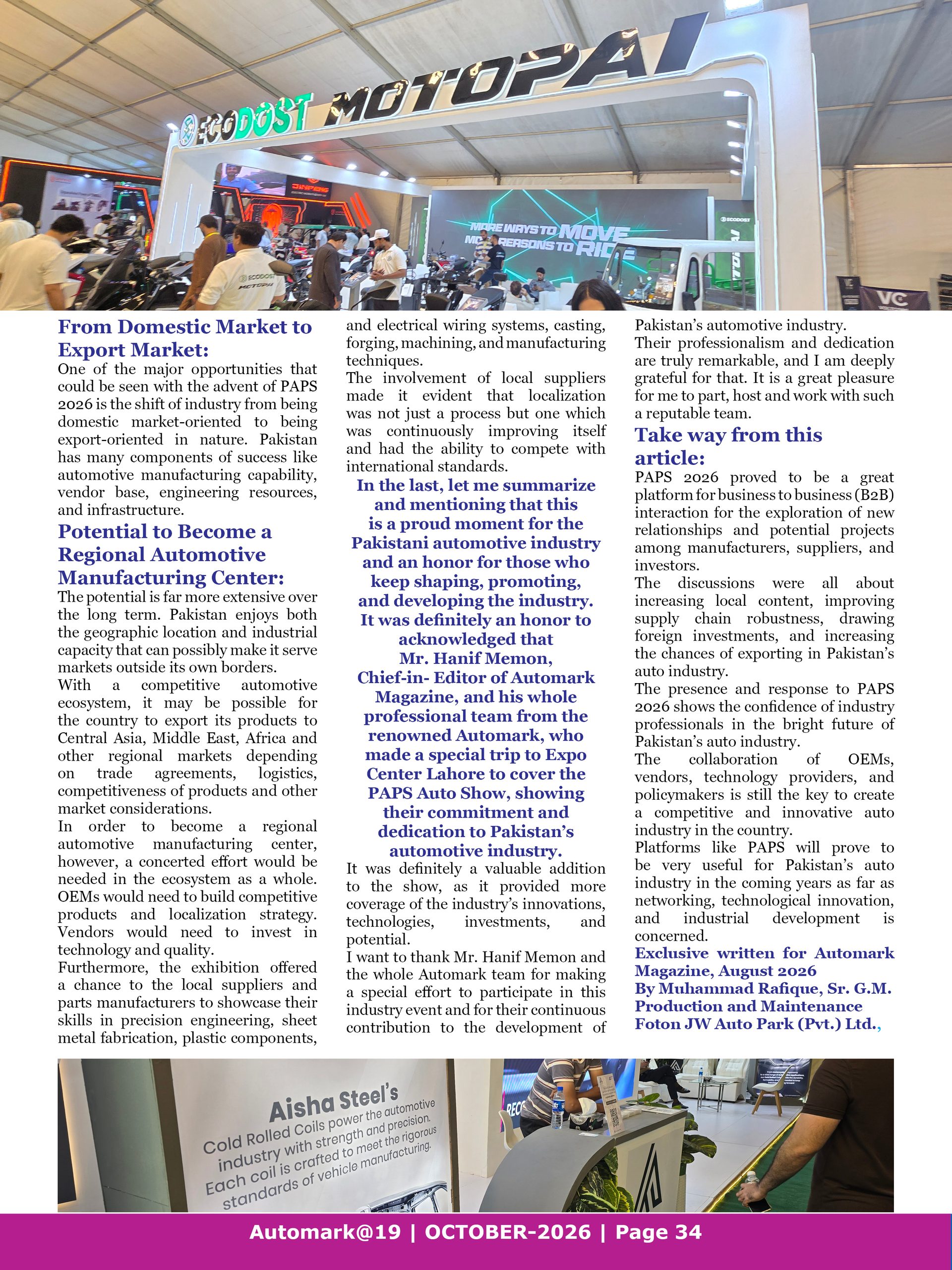
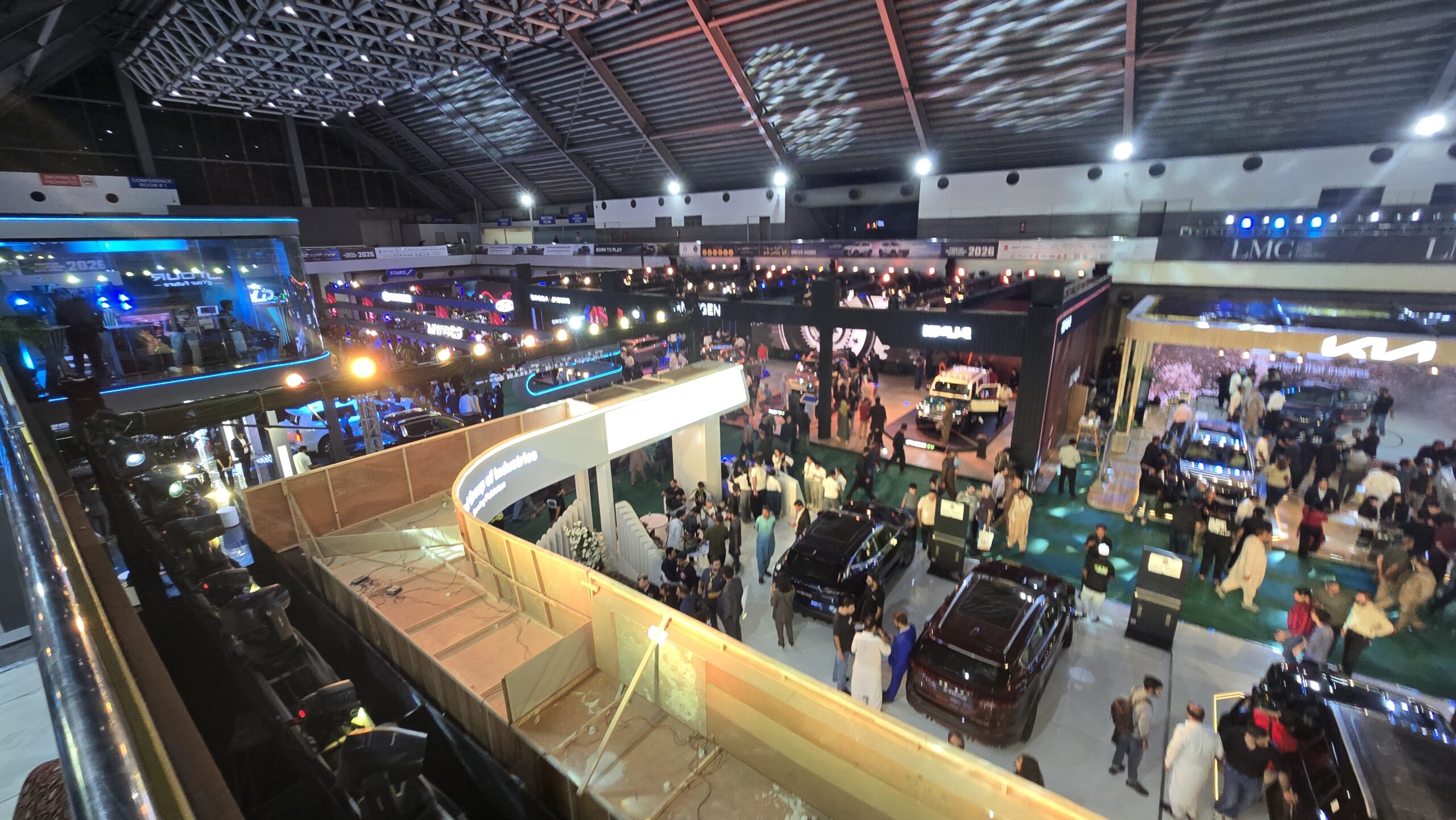
The 2026 edition, held at the International Expo Centre Lahore, witnessed a strong response from the industry and visitors. The official exhibitors’ platform indicates representation in various sectors, such as automakers, auto component makers, engineering firms, companies specializing in electric mobility, battery and energy companies, and steelmakers. This year’s expo registered an outstanding level of participation, with all exhibition spaces being utilized fully and representation from domestic and foreign participants equally high. Over 15 OEMs exhibited their most recent models and technologies along with their manufacturing capabilities, while many auto parts makers exhibited their locally developed parts and engineering process.
PAPS 2026 was unique because of its significance not just in terms of numbers of cars and other products that were displayed there. The exhibition offered a much larger picture of the future direction of the automotive industry of Pakistan. Not only the exhibition aims at showing different types of products, but it also serves as an opportunity for business cooperation, technology exchange, localization, and industry development. PAPS showcased the impressive achievements of the Pakistani automotive industry in the development of passenger vehicles, commercial vehicles, electric mobility, motorcycles, tractors, and auto components.
From Assembly to Localization: Among the key lessons coming out of PAPS 2026 was the significance of localization. The automotive industry in Pakistan has created a fairly extensive supply chain over the years, including companies specializing in such items as sheet metal, plastics, rubber, forgings, castings, bearings, electrical parts, filters, batteries, machining services and engineering parts among others. The diversity of the components suppliers present at PAPS 2026 made it clear that there was a lot more in the local industrial infrastructure than vehicle assembly. However, the next step is about more than just growing the list of locally supplied components. Localization must increasingly have to emphasize the technological aspect along with quality, productivity, and cost effectiveness. Domestic suppliers have to be competent in producing their parts consistently according to international standards whereas the OEMs have to supply the required volumes, technical expertise, and long-term plans for localization. Localization must thus be judged by how well a part from Pakistan is able to compete not just with an imported part within the domestic market but also with suppliers operating in international markets.
Evolution to the Era of EVs: It is evident that one of the major attractions at PAPS 2026 was the rising popularity of electric vehicles (EVs) and sustainable mobility solutions. There were a number of companies showcasing their electric cars, electric buses, electric commercial vehicles, two wheelers, and related technologies as a part of the industry’s transformation into sustainable transportation systems. Such transformation to electrified transportation system fits with global trends and the longer-term vision of energy efficiency and sustainability for Pakistan. Yet another evident trend at PAPS 2026 was that of electric mobility. Several of the companies on the exhibitors’ list offered electric vehicles and new energy mobility, in addition to firms that offer batteries, energy systems and related technologies. This evolution to the era of EVs poses a dual challenge and an opportunity to Pakistan. The use of traditional powertrain components like engines, transmissions and exhaust systems is being increasingly substituted by battery packs, electric motors, power electronics, controllers, charging systems, thermal management and electronic controls. This allows Pakistan to create new competencies instead of replicating the existing automotive supply chains. The key issue in this regard is therefore not just the number of EVs which can be assembled in Pakistan but the extent to which the value chain for EVs can be created locally. Batteries, wiring harnesses, electrical components, lightweight structures, charging infrastructure, software, power electronics and other EV components offer new possibilities for industrial development. PAPS 2026 has demonstrated that this shift is already underway.
Resilience in the Supply Chain: Transition from Dependency to Capability: Recent disruptions seen in global industries have shown how essential supply chain resilience is. Automotive manufacturing is highly dependent on supply chains since one missing part will be enough to halt the whole assembly line. As far as Pakistan is concerned, supply chain resilience is an important aspect of localization and PAPS has provided an important platform for the same.
From Domestic Market to Export Market: One of the major opportunities that could be seen with the advent of PAPS 2026 is the shift of industry from being domestic market-oriented to being export-oriented in nature. Pakistan has many components of success like automotive manufacturing capability, vendor base, engineering resources, and infrastructure.
Potential to Become a Regional Automotive Manufacturing Center: The potential is far more extensive over the long term. Pakistan enjoys both the geographic location and industrial capacity that can possibly make it serve markets outside its own borders. With a competitive automotive ecosystem, it may be possible for the country to export its products to Central Asia, Middle East, Africa and other regional markets depending on trade agreements, logistics, competitiveness of products and other market considerations. In order to become a regional automotive manufacturing center, however, a concerted effort would be needed in the ecosystem as a whole. OEMs would need to build competitive products and localization strategy. Vendors would need to invest in technology and quality. Furthermore, the exhibition offered a chance to the local suppliers and parts manufacturers to showcase their skills in precision engineering, sheet metal fabrication, plastic components, and electrical wiring systems, casting, forging, machining, and manufacturing techniques. The involvement of local suppliers made it evident that localization was not just a process but one which was continuously improving itself and had the ability to compete with international standards.
In the last, let me summarize and mentioning that this is a proud moment for the Pakistani automotive industry and an honor for those who keep shaping, promoting, and developing the industry. It was definitely an honor to acknowledged that Mr. Hanif Memon, Chief Editor of Automark Magazine, and his whole professional team from the renowned Automark, who made a special trip to Lahore to cover the PAPS Auto Show, showing their commitment and dedication to Pakistan’s automotive industry. It was definitely a valuable addition to the show, as it provided more coverage of the industry’s innovations, technologies, investments, and potential. I want to thank Mr. Hanif Memon and the whole Automark team for making a special effort to participate in this industry event and for their continuous contribution to the development of Pakistan’s automotive industry. Their professionalism and dedication are truly remarkable, and I am deeply grateful for that. It is a great pleasure for me to part, host and work with such a reputable team.
Take way from this article:
PAPS 2026 proved to be a great platform for business to business (B2B) interaction for the exploration of new relationships and potential projects among manufacturers, suppliers, and investors. The discussions were all about increasing local content, improving supply chain robustness, drawing foreign investments, and increasing the chances of exporting in Pakistan’s auto industry. The presence and response to PAPS 2026 shows the confidence of industry professionals in the bright future of Pakistan’s auto industry. The collaboration of OEMs, vendors, technology providers, and policymakers is still the key to create a competitive and innovative auto industry in the country. Platforms like PAPS will prove to be very useful for Pakistan’s auto industry in the coming years as far as networking, technological innovation, and industrial development is concerned.
This exclusive article has been published in Automark’s October-2026 printed and digital edition. Written by @muhammad-rafique