
Learning from the Past – Earning from the Present – Growing from the Future – Episode: 13
Summary of the Last Article
Range Extended Electric Vehicles (REEV), a special type of EV that bridges the gap between battery electric vehicles (BEVs) and Hybrid Electric Vehicle (HEVs). They have a larger battery than hybrids, allowing to drive solely on electricity being Pure Electric Vehicle include a gasoline engine as a generator to recharge, not to drive the wheels. REEV car took benefits of EV while week infrastructure of Pakistan’s country sides.
REEVs are gaining traction in Pakistan to combat range anxiety, with Deepal S05, Forthing Friday REEV and Nora EV, with prices ranging from PKR 70 Lakh to 1 Crore+.
A Plug-in Hybrid Electric Vehicle (PHEV) is a car that combines a gasoline engine with an electric motor and a larger battery, which can be charged by plugging into an external power source. They offer electric-only driving for short trips and automatic switching to efficient hybrid mode for long distances.
Now Read On….
Today we will write in detail about BEV mean Pure Electric Vehicle.
What is BEV?
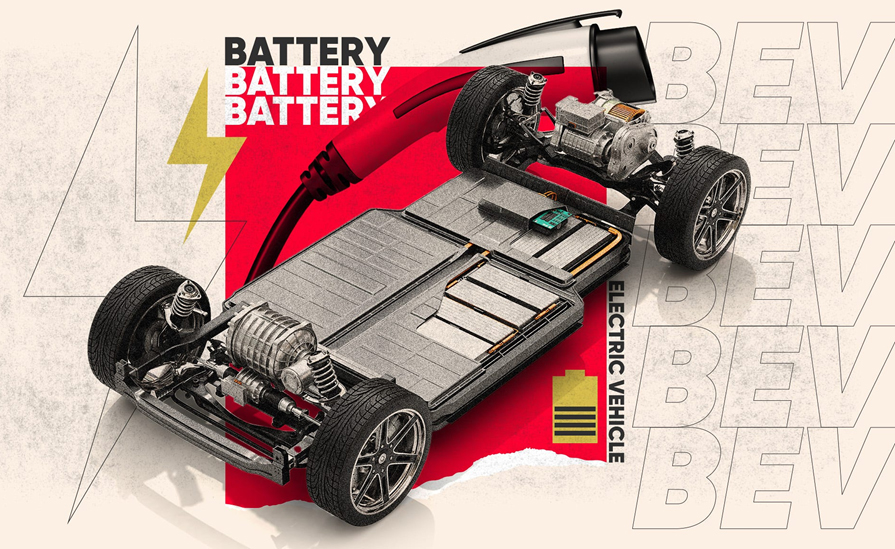
BEV stands for Battery Electric Vehicle. It refers to a car that runs exclusively on electricity stored in a rechargeable battery pack and relies on an electric motor instead of a traditional gas-powered engine.
Electric Vehicle (EV) is propelled by one or more electric motors instead of an internal combustion engine. It runs on electricity stored in rechargeable battery packs and is “refueled” by plugging into an electrical outlet or charging station.
Core Performance & Design
- Instant Torque & Acceleration: Unlike gas engines that must build up revs, electric motors deliver 100% of their torque immediately, providing instant acceleration.
- Regenerative Braking: When the driver takes their foot off the accelerator, the motor acts as a generator, slowing the vehicle down and converting that kinetic energy into electricity to recharge the battery.
- Fewer Moving Parts: Because electric motors contain only a few moving parts compared to complex internal combustion engines, they require significantly less maintenance (e.g., no oil changes or spark plug replacements).
- Spacious Layout (Frunks): Without the bulk of a gas engine under the hood, EVs are often designed with extra storage space in the front, commonly referred to as a “frunk”.
Environmental & Economic Benefits
- Zero Emissions: Battery Electric Vehicles (BEVs) produce zero tailpipe emissions, helping to drastically reduce localized air pollution and lower your carbon footprint.
- Lower Running Costs: Charging an EV with electricity is generally much cheaper than continuously filling up a tank with petrol or diesel, and maintenance costs are lower over the vehicle’s lifespan.
Smart Technology & Convenience
- Over-the-Air (OTA) Updates: Modern EVs act like large smartphones, receiving software updates via the cloud that can improve vehicle performance, unlock new features, or patch bugs without visiting a dealership.
- One-Pedal Driving: By utilizing aggressive regenerative braking, drivers can accelerate, decelerate, and come to a complete stop using only the accelerator pedal.
- Cabin Preconditioning: You can use a companion smartphone app to heat or cool the car’s interior while it is still plugged into the charger, saving battery range for your actual drive.
Local Context (Pakistan):
- EVs: Excellent for intra-city commutes in major urban centers like Lahore, Islamabad, and Karachi, especially if you have a home solar setup. However, public charging infrastructure is still growing, making inter-city travel on motorways somewhat challenging.
When to Choose Which
Choose a BEV if you have reliable home charging, primarily commute short distances, and want near-zero maintenance. Choose an HEV if you live in an apartment, frequently take long road trips, or prefer standard gasoline fueling without relying on charging infrastructure.
Battery Electric Vehicles (BEVs)
BEVs run entirely on electricity stored in a battery pack. They are plugged in to charge and do not have a gasoline engine.
- Best For: Daily urban commuters with access to a home or workplace charger.
- Pros: Lower running and maintenance costs, zero tailpipe emissions, and a smoother, quieter ride.
- Cons: Higher upfront cost and “range anxiety” if public charging infrastructure is sparse.
EV Models and Prices in Pakistan
Electric vehicle (EV) options in Pakistan are expanding rapidly, featuring everything from budget-friendly mini cars to luxury crossovers. Prices generally span from PKR 15 Lac for entry-level models to over PKR 5 Crore for high-end imports.
- Budget/Mini EVs: Alektra Metro (PKR 10 – 13 Lac), Honri Ve (PKR 35.99 – 43.99 Lac), and Dongfeng Box (PKR 55 – 68 Lac).
- Mid-Range & Crossovers: BYD Atto 2 (PKR 72.90 Lac), BYD Atto 3 (PKR 89.90 Lac), and MG ZS EV (PKR 76 Lac – 1.50 Crore).
- Luxury EVs: Audi e-tron (starting at PKR 1.36 Crore), Porsche Taycan, and BMW iX.
Global EV Sales Volume & Growth
- 2022: Approximately 10.5 million vehicles sold globally.
- 2023: Sales grew by roughly 31%, reaching about 13.8 million units.
- 2024: Total electrified sales climbed to ~17.5 million, a 28% jump from 2023.
- 2025: Market reached an all-time high with approximately 20.7 million EVs sold worldwide.
- 2026 (Q1): Global sales reached 4.0 million units. While 2026 figures temporarily softened by roughly 3% year-over-year globally in Q1, Europe saw a 24% surge in demand, and emerging markets (like Australia, New Zealand, and ASEAN countries) are experiencing triple-digit growth as gas prices rise.
Market Share & Regional Comparison
- China: The undisputed volume leader. EV sales share breached the 50% mark for the first time in 2025.
- Europe: Continues to surge due to strict CO₂ emission targets. By Q4 2025, European BEV market share hit a record 24%, and demand continued to grow in 2026.
- United States: Experienced aggressive growth to hit a peak of 10.5% market share in late 2025. However, the removal of certain tax credits caused a market readjustment, and sales slowed down in early 2026.
Pakistan’s EV Sales & Growth
Electric four-wheeler (car) sales volume in Pakistan remains relatively low compared to conventional vehicles, capturing a fraction of the total market, though monthly EV sales surged by 61% and 322% for two-wheelers due to high fuel costs and government incentives.
- Current Volume: Traditional Internal Combustion Engine (ICE) vehicles continue to dominate the passenger car market, recording 109,655 units sold during the first nine months of the FY26 (a 45% increase). Monthly electric car sales, while showing explosive percentage growth, still represent smaller absolute volumes (e.g., rising to 53 units in March).
- Growth Trends: In a single month, conventional car sales dipped by 9% MoM, whereas electric vehicle sales jumped by 61% MoM.
- Market Expansion: Localized options are expanding, with popular EVs like the Honri Ve assembled locally and major global players like BYD entering the market with models like the Atto 3 and Seal.
Two-Wheeler Growth & Volume
- Current Volume: The electric two-wheeler segment is expanding at a much faster rate, quickly capturing over 10% of monthly vehicle sales in the country.
- Growth Trends: Sales for electric two-wheelers surged by 322% year-on-year by mid-Q2 2026, with year-to-date registrations reaching 90,416 units.
Q & A Before Buying EV
Electric Vehicle (EV) in Pakistan is highly practical for daily urban commuting, allowing you to bypass volatile petrol prices while enjoying lower maintenance costs. The most critical questions to ask before buying an EV.
1. Do you have a dedicated parking space with a power outlet?
Charging at home is the most convenient and cheapest way to power your EV. Relying entirely on public charging stations will cost significantly more.
If you live in an apartment, make sure your housing society or union allows you to install a dedicated wall box. Ideally, having a home solar setup will reduce your running costs to almost zero.
2. Can the vehicle charge on the CCS2 standard?
The Combined Charging System 2 (CCS2) is the de-facto standard being deployed across Pakistan’s charging networks.
If you are buying an imported vehicle or a grey import, ensure it comes with a CCS2 adapter, otherwise, you will struggle to use commercial fast-chargers.
3. What is the vehicle’s real-world range?
Ranges are typically calculated under ideal European/Chinese conditions. Real-world range in Pakistan drops due to heavy stop-and-go city traffic and constant air-conditioning usage during the summer.
Check the WLTP or CLTC rating of the car and expect roughly (15 \div 20\%\) less range in actual Lahore or Karachi city driving.
4. Who will service the car and honor the warranty?
EVs are essentially computers on wheels. They don’t require oil changes, But inverters, software, and high-voltage battery packs require certified technicians.
5. What are the tax incentives and registration costs?
The government promotes EV adoption through the NEV Policy, offering significantly lower token taxes and just a 1% import/registration tax on EVs.
With non-filer restrictions being enforced, make sure your tax status is updated before buying to avoid massive penalties at the time of registration.
6. Do you travel inter-city frequently?
Pakistan’s EV charging infrastructure along major highways (like the M-2 Motorway) is expanding, traveling from Lahore to Karachi or into the northern areas still requires careful route planning.
If an EV is your only family car and you take frequent road trips, consider a REEV (Range Extended Electric Vehicle), which offers electric driving for driving and a petrol engine for Battery Charging.
7. How does charging cost?
Charging your EV at home or your workplace is vastly cheaper, but commercial fast-charging networks charge a premium.
NEPRA sets off-peak subsidized residential rates (around Rs. 24/kWh), whereas commercial fast-charging can range between Rs. 100 to Rs. 130/kWh.
3. Costs & Incentives
- Are PHEVs more expensive than traditional cars? Yes, PHEVs generally have a higher upfront cost due to the dual powertrain (battery + engine).
- What incentives are available? Check for federal, state, or local tax credits or rebates for purchasing a PHEV, which can help offset the higher purchase price.
- Are there insurance perks? Some insurers offer discounts for driving electric vehicles (including PHEVs), recognizing their efficiency and technology.
4. Maintenance & Reliability
- How does maintenance differ? PHEVs typically need less maintenance than traditional cars (e.g., less brake wear due to regenerative braking). However, they still require engine maintenance (oil changes, etc.), although often less frequently.
- How long does the battery last? Most manufacturers offer 8-year/100,000-mile warranties on high-voltage batteries, giving significant peace of mind.
5. Potential Drawbacks
- Reduced Cargo Space: The battery pack can occupy space, reducing trunk or cabin space in some models.
- Winter Performance: Cold weather can reduce the electric-only range significantly.
- Complex Technology: With both a gasoline engine and electric motor, there are more components that could potentially need repair over the long term.
Runing Cost Saving EV Vs ICE
Electric Vehicles (EVs) save on running costs primarily through drastically cheaper “fuel” (electricity versus gasoline/diesel) and significantly lower ongoing maintenance.
1. Fuel (Electricity vs. Petrol)
- Energy Cost: Charging an EV is generally (50% – 70%) cheaper per kilometer than refueling an internal combustion engine (ICE) car.
- Home Charging: Charging during off-peak hours at home offers the biggest savings, dropping the cost-per-mile to a fraction of gas prices.
- Efficiency: Electric motors convert over (85%) of their energy into movement, compared to gas engines which only convert about (20% – 30%).
2. Maintenance
- Fewer Moving Parts: An EV has significantly fewer moving parts than an ICE vehicle. There are no spark plugs, pistons, valves, or mufflers.
- No Fluid Changes: EVs do not require routine engine oil changes, transmission fluid flushes, or coolant replacements.
- Less Brake Wear: Thanks to regenerative braking (where the motor slows the car and generates power to recharge the battery), brake pads and rotors last much longer than on traditional cars.
3. Total Cost of Ownership (TCO)
While EVs are often cheaper to operate, total savings depend on where you live and how you drive. Be mindful of the following trade-offs
- Tires: EVs are heavier than gas cars due to the battery, which can cause tires to wear out slightly faster if you do not opt for durable, EV-specific tires.
- Depreciation: Fast-paced technology upgrades mean that some EVs may depreciate a bit faster than standard cars, which is why leasing is often a popular way to stay protected from older tech.
Last Wording
Talking about EVs, this chapter will be incomplete without mentioning Two Wheelers and Three Wheelers. It seems these both vehicles will pay a major role in the development and adoption of EVs in Pakistan, so we will write next article on Two-Wheeler Electric Vehicles. Stay connect with Automark and say with us “Grow Automotive than Grow Pakistan”.
Exclusive written for Automark Magazine, June 2026
By Mumtaz Hussain