Home Blog Page 106

Registration of Auto vendors with EDB

Registration of Auto vendors with EDB

Up to 2003-2004, when deletion programs were active in Pakistan, there was a compulsory process that all the parts manufacturers had to register themselves with the EDB. But from July 2004 to July 2014 (one decade) this practice was abolished.

“It is a good idea that the Engineering Development Board is again taking the issue of vendors’ registration with the EDB,” chairman Association of Pakistan Motorcycle Assemblers (APMA), Mohammad Sabir Shaikh said.

In Pakistan, a number of parts vendors have become entrepreneurs having staff of less than five persons but are not registered with the Sales Tax due to low volume of production and lack of knowledge and education, he said.

The EDB should avoid putting any pressure on such entrepreneurs that force them to pack up their businesses. However, they are genuine manufactures of many parts and supplying to small units through big vendors, Sabir said.

If the EDB wants to ensure registration of two three wheelers’ vendors with the EDB – the Board must include APMA chairman and vice chairman from Karachi and Lahore in a committee who will visit vendors for verifications otherwise the move to register vendors with the EDB would prove something negative. 

All the 2/3/4 wheelers are required to operate under the criteria defined in SRO 656(I)/2006 and procure their inputs through sources as defined in SRO 656(I)/2006 i.e. i) import through the system as per lists approved by EDB, ii) Manufacturing of parts through in-house facilities and iii) procurement from Sales Tax registered vendors having in-house facilities for the manufacturing of parts.

While submission of initial list and submission of reconciled records at the end of the year, it has been observed that certain vendors having no existence or traders operating under the garb of vendors are reported by the OEMs which has opened the window for pass through of parts and also encouraged the supply of sub-standard parts to OEMs specially of 2/3 wheelers.

This mechanism has also discouraged the localization of parts in the country besides causing revenue loss to the national exchequer.

It is also a fact that all the vendors reported by the OEMs in the list are not approved by EDB under SRO 655(I)/2006 because they do not use the concessionary regime of the SRO 655. It is also to inform that all the vendors are also not member of PAAPAM and as such it becomes difficult for EDB to ascertain their gentility without assessing manufacturing facilities these vendors possess, as they are not operating under the concessionary regime of SRO 655(I)/2006.

In order to have a complete data of the local vendors supplying parts to the OEMs, irrespective of their registration/ membership with EDB/ PAAPAM, it is proposed that all the vendors supplying parts to any of the OEMs should be required to register with EDB and made liable to provide status of their manufacturing facilities to be verified by EDB to ensure the procurement sources. This measure would create ample space for further localization and growth of industry.

The above issue will also be discussed at length in the 20th AIDC meeting to be held on August 18, 2014.


Federal Ministries, government departments need attitude change

Federal government’s departments including the Federal Board of Revenue (FBR) need to change their attitude otherwise the situation pertaining to routine matters will remain the same.

After June 2006, the industry continues to operate under tremendous pressure coupled with step motherly treatment of federal government departments and ministries. Till today, bureaucratic hurdles and officials’ lethargic attitude still exist.

In the last 10 years, same people in the bureaucracy have been sitting on their seats who have seen three different governments in their tenure.

Like past the Federal Board of Revenue has recently issued sales tax audit notices to every motorcycle assemblers and their vendors. “Are these part of the policies which have been adopted in the last 10 years or there is some kind of pressure from the EDB,” chairman Association of Pakistan Motorcycle Assemblers (APMA), Mohammad Sabir Shaikh said. The language of the notices clear reflects the secret hand of the EDB in formulating the notices, he added.

The turnover of three to four big auto sector assemblers of cars and motorcycles is bigger than 500 small assemblers and vendors. But the government, like past practice, has always created problems for small units leaving big assemblers to operate freely.

According to sales tax notices, the FBR demands sales tax records under section 37 and 38 (2) of the sales tax act 1990 for the period 1.07.2011 to 30.6.2013.

The FBR informed the field commissioners to examine the assemblers and vendors of motorcycles in their areas that are they following SRO 656/2006 dated 22.6.2006 and check have they procured the parts and components from the importers and traders instead of original manufacturers.

It is also notable that the genuine manufacturers supplying parts to the OEMs are making parts by themselves or importing these parts from China as the cost of production of auto parts in China is much lower than Pakistan.

Assemblers have been asked to submit following documents for sales tax audit.

1)Purchase register and sales register.

2)Purchase invoices and bill of entries of imports.

3)Monthly sales tax returns and cash payment receipts to NBP.

4)Compliance of SRO 656/2006. These documents are provided to the EDB.

5)Utility bills

Chairman APMA Mohammad Sabir Shaikh said that for the last one decade the small assemblers have been facing these kind of problems.

He urged the Prime Minister Nawaz Sharif, Finance Minister Ishaq Dar and FBR chairman to stop these kinds of bottlenecks as the industry has already been surviving under stiff business and political environment.

The government should refrain from creating hardships and support the industry in order to pull out the assemblers from hot water, he said.

He urged the government to appoint CEO of the EDB immediately and try to fill this post by taking a competent person from the private sector or the industry.

Sabir said that the industry and the vendors were highly hopeful after taking over of PML-N government in 2013 but so far the political crisis appears to have deepened which has put on hold the future investment plans by the local industry.

He said there is a need to end the monopoly of big assemblers and vendors who enjoy upper hand in all the policy making in every government. As a result, the voice of small units remains unheard.

The political heat engulfing Islamabad mainly and other parts of the country since August 14 because of sit in by Pakistan Tehreek-e-Insaf and Pakistan Awami Tehreek is one of the main problems of people who are looking forward for change in government that can bring good industrial and government policies besides resolution of their genuine problems.


The rise and fall of Dewans

In June 2006, Dewan Mushtaq Group’s (DMG) sales were over $665 million. It was under a long term debt of $175 million on the books and posted a net profit of $5.8 million. A year later it announced its first net loss ever recorded. And a year later it was Pakistan’s largest bank defaulter.

New entrant in the market

It is a good sign that some new entrants are trying to enter the local auto market after taking over of PML-N government.

These new entrants are in constant touch with the Engineering Development Board (EDB) discussing their investment proposals.

Pakistani car assemblers still unhappy over falling used cars imports

The assemblers of cars are still unsatisfied over sharp drop in import of used cars (from 660cc to 3,000cc) vehicles saying that the import continues despite government’s decision of restricting the arrival through various measures.

According to Pakistan Bureau of Statistics (PBS), import of cars plunged by 44 per cent in 2013-2014 to $177 million as compared to $313.5 million in 2012-2013. But these figures do not impress the local car industry.

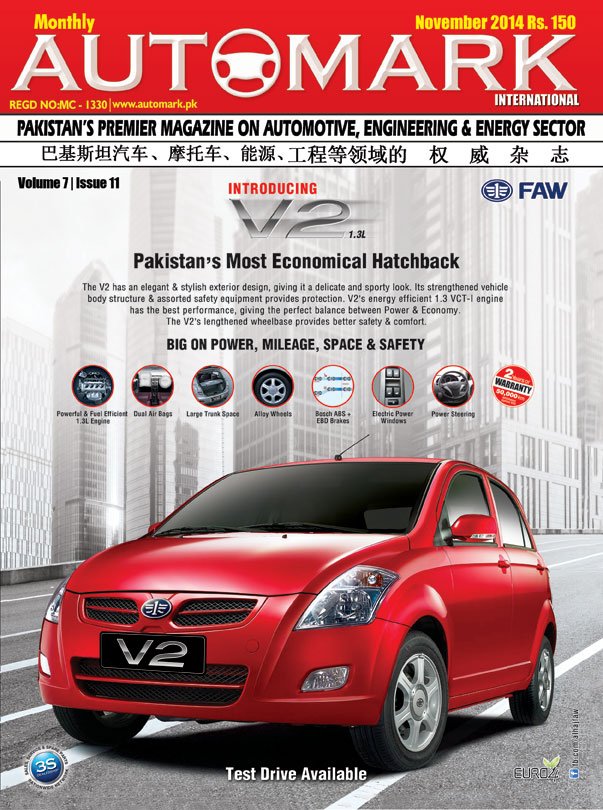
Monthly Automark July 2014

Monthly Automark July 2014


Motorcycle assembling , marketing and aftermarket business in Pakistan

License: 

What is motorcycle manufacturing license in Pakistan?

Establishment of factory for motorcycle assembly, engine assembly, painting and testing of final product in one designated place.

A) Approval from Ministry of Industries and Production through its related department – Engineering Development Board (EDB) — for starting production activities.

B) Getting a license from Pakistan Standards and Quality Control Authority (PSQCA) for the use of the Pakistan Standard Mark.

C) Registration of trade mark/brand name of the products with the IPO/trade market registry, government of Pakistan.

D) Before getting licenses A, B, and C, one needs to get registration with Federal Board of Revenue (FBR) for sales tax and income tax as a manufacturer, importer and distributor/retailer. And if the manufacturer is interested to export, registration is also required for exporter.

After meeting all the above formalities, the manufacturer has to approach the provincial excise and taxation departments for registration of their manufactured products. 

Imports: 

For importing bike in CBU condition, any importer or trader or individual can import by paying 65 per cent customs duty and other levies. 

If an assembler wants to imports parts for bike assembling then he has to follow some SROs like SRO 656/ 2006 and SRO 693/ 2006.

If the same assembler tries to import parts on highly discounted rates of duty then he has to follow SRO 655/2006.

Any importer/assembler has to make direct imports for the assembly /manufacture of the said vehicle in compliance to the conditions of the SRO 656/2006.  Regarding this, the EDB is responsible for monitoring the imports and production of the assemblers on regular basis. If assembler violates the conditions of SRO the EDB can cancel or suspend the production certificate and importable quota lists.

Marketing:

Pakistan has been producing around 1.6 million bikes per annum for the last five years in which 80 per cent are 70cc bike like Honda CDI 70cc. 

The remaining 20 per cent is 100cc, 125cc and 150cc.

Because of the fact that 70cc bikes hold the major market share a stiff competition exists among the assemblers. Due to intense competition the profit margin of assemblers has almost become negligible. To get profit people try to cover up high cost of production and impact of exchange rate parity by indulging themselves in under invoicing, misdeclaration using commercial channels of imports, etc. In some cases even they evade sales tax. 

To improve the marketing and profit of assemblers, they have to make efforts country wide to register their parts and bike sale dealers into the sales tax net. 

A brand new concept has to be introduced in Pakistan to educate bike dealers for sales, service, spare parts, aftermarket and guideline to the consumers for getting bike through financing schemes at one shop. 

If we implement the organized system at the dealership network nationwide – it will improve the quality of the product and profit will also increase.

Currently, dealers all over the country have become bankrupt followed by  circular debt between assemblers, vendors and dealers. As a result, they are doing their business in deep crisis and rising competition.

A decade back, countrywide bike dealers used to belong from business families but in the last few years a mushroom growth of bike mechanics and people retired from public and private sector organizations have become authorized bike dealers. Due to their lack of experience and market expertise, the marketing system of bike selling has collapsed.

Japanese excel in marketing techniques especially Pak Suzuki Motor Company Limited which can be of great help for the new authorized dealers of Chinese bike assemblers. 

Chinese assemblers must realize that instead of boosting their production they must improve their quality of bikes and ensure after market facilities to the bike buyers. By doing this, their profit and business will improve and will get more revenues through low production volumes instead of higher volumes.

It has been in practice for many years that Chinese bike dealers leave the customers on their own instead of ensuring frequent service and maintenance of bikes. Chinese bike dealers should introduce the culture of 3S and 5S showrooms by providing sales, service and spare parts facility at one place.

Heavy Bikes:

In all over Pakistan, rich and elite class have become fond of heavy bikes and after every five to 10 years new generations make their entry in this category.

Import of used bikes have shown tremendous growth in the last two to three years in which 250-1,300cc bikes are being imported of branded companies like Honda, Yamaha, Suzuki, Kawasaki and some European and American brands.

Rising interest of young generations towards heavy used bikes propelled imports thus pushing the two leading bike assemblers to introduce brand new bikes to cash the situation. 

Figures released by Pakistan Bureau of Statistics (PBS) showed 374 per cent jump in bike imports to $4.6 million in July-April 2013-2014 as compared to $971,000 in same period last fiscal year. 

The trend of imports of heavy bikes has been showing positive growth as imports in 2012-2013 jumped by 90 per cent o $1.5 million as compared to $785,000 in 2011-2012.

Atlas Honda introduced brand new imported 150cc and 500cc bikes at Rs660,000 and Rs1.25m respectively. Pak Suzuki Motor Company’s imported Inazuma 250cc, Intruder 800cc and Hayabusa 1,300cc bikes, which were priced Rs675,000, Rs1.5m and Rs2.4m respectively in four to five months back, now carry price tags of Rs 725,000, Rs 1.6 million and Rs 2.5 million. Out of two leading assemblers, one of them had also raised prices despite rupee appreciation against the dollar.

The heavy bikes are more popular in some big cities of Punjab as compared to Karachi where sale volume is slow.

Due to rising number of imports, many people have opened service outlets in Punjab and in Karachi dealing only in heavy bikes. Arriving under various government’s schemes, the prices of bikes of two to three years old start from Rs 500,000 to Rs 2.5 to Rs three million which is certainly not a problem for young lot of elite class of the country.

In total imports the share of used bikes is higher than the brand new heavy bikes. A Japanese bike assembler had sold over 60 units of heavy bikes in the country in the last eight months.

The government is also getting good revenue from the import of heavy bikes and even in some cases cumulative taxes and duties cross Rs one million per bike.

Assemblers are not importing these heavy bikes for any future local assembly in Pakistan due to their very limited customers and exorbitant prices.

There is no harm in cutting import duties on heavy bikes as these are not currently being assembled and there is remote possibility of assembling of these in short and long term due to their very heavy prices. The government should consider reducing import duties on heavy bikes.

This exclusive review published in Monthly AutoMark Magazine’s June-2014 edition, written by Mohammad Sabir Shaikh www.automark.pk

Monthly Automark June 2014

Monthly Automark June 2014


SUZUKI Wagon R debuts in Pakistan

At a time when Pak Suzuki Motor Company Limited (PSMCL) unveiled locally assembled Wagon R in the third week of April 2014 in Lahore, the government, as per media reports in first week of May, has reportedly decided to cut customs duty on import of up to three-year-old automobiles of various engine capacity under various schemes.

This kind of situation reminds of a shock faced by Adam Motors when it introduced a locally assembled small car and suddenly the then government reduced import duties on used cars or liberlised used car imports. As a result the project became a history.

At least the government must have considered before further liberalizing import of used cars that a leading car assembler, having over 50 per cent market share, has introduced a new car. The company has also planned to introduce more cars like Suzuki Alto 800cc and Swift new version in case the government allows import of parts and accessories from India.

The Wagon R looks stunning in its looks and interior design but it is to be seen how the Pak Suzuki new car is going to survive in a market where thousands of used cars of few years old are parked in the showrooms of used car dealers.

It may noted here that Suzuki Swift got a huge response from the buyers after its launch but for the last few months the sale of this car has been going flat. It suggests that people usually review various options whether to buy imported used three year old Toyota Vitz, Passo etc or locally assembled Suzuki Swift due to limited price difference.

However, decline in imports of used cars is a good sign for the local assemblers to bring more new cars in Pakistan.

The silver lining in the introduction of this Indonesian version vehicle is the full back up support of parts and services coupled with warranty which the people do not find in purchasing used cars.

However, used cars especially of three to five years old of Toyota, Honda, Daihatsu, Nissan etc definitely enjoy an edge over Wagon R due to their extra features. But hopefully Wagon R will definitely lure the buyers especially those who prefer locally assembled cars due to after sales service and easy parts availability in the markets.

Hopefully Wagon R because of its design, advance engines, features and dazzling colors will prove a good addition in the Pak Suzuki family and fill the vacuum created by the ouster of Suzuki Alto. Pak Suzuki is already facing problems due to declining sales of Suzuki Mehran and Suzuki Swift. Cultus has been doing well so far.

Besides, Wagon R price also looks attractive which may  force many buyers of used cars to switch over in bringing zero meter Wagon R due to full parts and service back up.

Mr. Hirofumi Nagao, Managing Director Pak Suzuki on the occasion of Launch of Suzuki Wagon R in Pakistan on April 18 said that Suzuki Wagon R has successfully travelled all over the world and got appreciations from the customers worldwide.

The journey started from 1993 when 1st Generation of Wagon R was launched in Japan. This redefined the compact car concept in Japan and became one of the most popular models in a quick span of time.  Based on the extraordinary response the Wagon R was introduced in other countries including India and Indonesia and it gained enormous response.

He said Wagon R is considered as a Star Product in Suzuki Motor Corporation portfolio and has won many appreciations and awards. It Maintained Status of Best Selling Car in Japan Consecutively for six Years.

He was optimistic that the Wagon R will not only exceed the expectation of the Pakistani customer but will redefine the compact car customer motoring requirements.

In line with the customer requirement, the company has kept fuel efficiency as the top priority. Wagon R is equipped with the world famous Suzuki K Series engine which is incorporates excellent compression ratio, is less on noise, light weight and is extremely fuel efficient.

Wagon R with its modern design, spacious interior is designed to provide utmost comfort and convenience and offers a practical solution to the motoring needs of the customers.

He hoped Wagon R would go a long way in satisfying customer needs and will soon become a talk of the town and household name in Pakistan.

Mr K. Saito, Executive General Manager Suzuki Motor Coproration Japan said Suzuki Motor Corporation, Japan has overseas distributors in 149 countries taking care of sales, after sales and other support services of diversified product portfolios including automobiles, motorcycles, and outboard motors. We have overseas automobile plants in 12 countries and motorcycle plant in 16 countries.

He said Pak Suzuki Motor Company is categorized as one of the most prestigious overseas distributors of Suzuki Motor Corporation, Japan. We firstly entered the Pakistani market in 1972 and our local production started in 1975. Since then, Pak Suzuki Motor Company is keeping over 50 per cent market share in automobile category. In the year of 2013, we recorded to sell 2.69 million Suzuki automobiles across the world as the maximum numbers in the past. Of this, 77 thousands units were sold here in Pakistan and it made Pakistan to be the 5th largest country in the world for Suzuki automobiles.

This result is truly outstanding and clearly reflects the Pakistani customers’ confidence in Suzuki automobiles, he said.

As a marketer this spirit and customers trust keeps us going and gives us the inspiration to introduce new models in Pakistan, he added.

Since 1993, when we launched Wagon R in Japan, it is the Brand that has special position in the Suzuki Portfolio. Last year we celebrated this memorial 20th anniversary, and could achieve 4 million of total domestic sales of Wagon R as a proof of to be loved vehicles for 20 years long by Japanese people.

He hoped that Wagon R will cater to the requirements of Pakistani customers and very soon will become the most popular car in its segment.

Suzuki Motor Corporation will continue to recognize Pakistan as one of the most important markets and will keep providing newer and newer models to enhance the customers way of life.

The two above executives did not mention about the localization level of local parts in Wagon R. The company must have invested in rupees or other currency for the introduction of new car but the speech of the executives were silent on this.

For many Pakistani customers, who were already looking forward for a replacement of decades-old Mehran 800cc model with a new 800cc car, must be feeling disappointed as the company introduced 1,000cc instead of 800cc model.

It means that customers will have to wait for more years and keep purchasing outdated Mehran which does not exist in any country of the world.

People think that Suzuki Motor Corporation should have first replaced Mehran with a new 800cc car and then have brought Wagon R in Pakistan as people are sick of Mehran design, color, old engines, unimpressive dash board, shocking suspension, old fashioned steering design etc. Certainly a new 800cc model would have definitely coasted cheaper than Wagon R. Mehran’s falling sales perhaps reflect buyers’  losing confidence on it which had actually driven the country’s vendor industry.

Mehran is almost same as it was first introduced in Pakistan in 1990. Only the head lights, front grill, back light, left side of dash board etc have changed which is not an achievement in terms of localisation of parts. The company took decades in rolling out Euro II engine in Mehran from last year. The entire design outlook has been maintained since 1990 and no governments have taken any action against the company rolling out outdated design.

The Pak Suzuki must have recovered the cost of jigs and fixtures and other investments made in Mehran but miserably the deletion level in Mehran had come to halt at 70 per cent for many years instead of crossing 90 per cent since 1990.

The company continued to enhance the prices of Mehran three to four times a year since 1990 linking to exchange rate parity thus suggesting that no serious efforts were made to improve localization.

Perhaps the company looks confident even if its sales are falling as at least Mehran is still an option for those who cannot afford Daihatsu and other small engine power used cars…..

This exclusive article had been published in Monthly AutoMark Magazine’s printed edition of May-2014