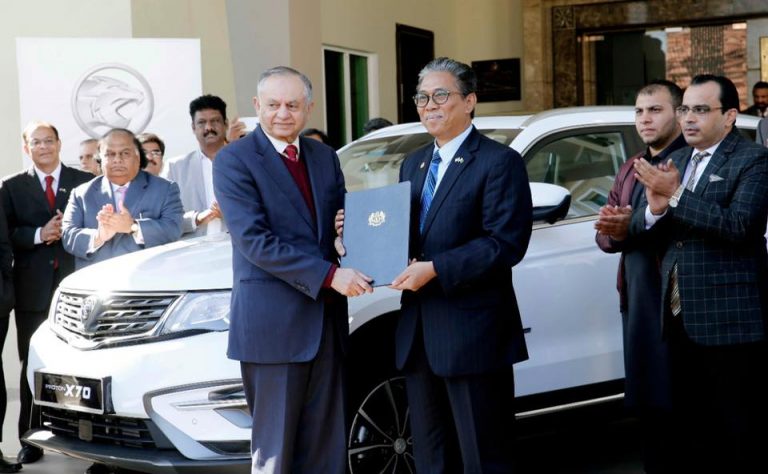
Services Industries Ltd., announced to set up a joint
venture agreement company “Service Long March Tyres (Pvt) Ltd” in collaboration
with Chaoyang Long March Tire Company of China and
Myco Corporation of Pakistan.
The three firms collectively plan to make a long-term equity
investment of $30.6 million within three years subject to regulatory approvals.
This was informed in a notification sent to
Pakistan Stock Exchange (PSX). Manufacturing plant will be setup in
Karachi, sources confirmed. Signing
ceremony will be held in Lahore on Monday 18th November-2019.
The project will
embark on manufacturing and sale of radial tires for trucks and buses to meet
the progressive demand of local market as well as its export to other
countries. According to the notification issued by the company, the equity
stake of parties in the Joint Venture Company will be; Service Industries Limited – 51%
(with or without collaboration of associates/others), Long March Tyre Company –
minimum 44% (maximum 49%) and Myco Corporation – maximum 5% (any shortfall will
be contributed by Long March Tyre Company)
The two-wheeler manufacturer said this recall affects 13,000 units of the Yamaha Fazer 25 and Yamaha FZ 25
Yamaha
FZ 25 and Yamaha Fazer 25 have been recalled in India. India Yamaha Motor has
issued a voluntary recall for 13,348 units of the two motorcycles citing issues
related to the head cover bolt becoming loose. Described as a precautionary
initiative by the Japanese two-wheeler manufacturer,
the recall affects 12,620 units of the Yamaha FZ 25 and 728 units of the Yamaha
Fazer 25.
Revealing further
details about the scope of the recall, Yamaha said that
bikes manufactured from June 2019 are covered under this recall. It added that
the affected bikes will be, of course, fixed up free of charge at Yamaha
dealerships across India. As for informing owners of the Yamaha FZ 25 and
Yamaha Fazer 25 units covered under the purview of this recall, the company
said it will contact owners individually. However, owners can also check if
their bike is affected by this recall by visiting Yamaha India’s official
website.
The brand also said that it is working closely with its dealer
partners all over the country to make sure that the repair experience for the
owners of the affected bikes is both efficient as well as convenient to the
best possible extent.
The company first added
the Yamaha Fazer 25 to its FZ series of bikes a little over two years ago — on
21 August, 2017, to be precise. However, the latest updates to the two aforementioned Yamaha bikes in India
came earlier this year, when the two-wheeler manufacturer introduced their ABS
models.
Anyway, both of them are propelled by a 249 cc engine that
delivers a maximum power of 20.6 bhp at 8,000 rpm and a peak torque 20 Nm of at
6,000 rpm. For suspension, they get telescopic forks and monoshock, while for
braking they get a 282 mm disc brake up front and a 220 mm disc brake at the
back. There’s also dual-channel ABS. on both bikes.
“GROW AUTOMOTIVE INDUSTRY OF INDUSTRY OF INDUSTRY OF PAKISTAN TO GLOBALLY PAKISTAN COMPETITIVE LEVEL BY 2040”
DICE has launched the concept design of its Demo car that
will not be a production car – and you can see why. DICE is a non for profit organisation that
brings together the talent in Pakistan with those expatriates living in various
parts of the world earning expertise in the field of Automotive Engineering.
Their role is to build a platform where new horizons for country’s economy can
be explored.
Targeting the urban market, the foundations are tasked
primarily with supporting a car that needs to be good ride and efficient in
economy. This DICE demo car is compact
in design and will be available in 2 variants, ICE and BEV.
The brains behind this concept are the team members of DICE
Automotive segment from US, UK, Canada and Germany and technological support
from academic Institutes of Pakistan like NUST, NED, NCA, CUST and DHA Karachi
Suffa and Industrial support is provided by TechnikNayyer.
The model revealed in Karachi this October is a non-functional
model setting the design concept.
Their next step is to build two Test prototypes for internal
combustion Engine and Battery Electric Variant. These engineering models will
take almost one and a half year to build provided they receive required funding
for their project, which is around approx, PKR 30 Million.
The car is design for a small family and will be capable to
seat three adults. Pricing of the car cannot be revealed at the moment but the
target is to make it cheaper than what’s currently available in this segment.
The price for BEV Variant will be 30 – 40 % more than ICE variant.
Chassis components of prototype have already been designed
along with electrical subsystems. Designs for Battery Electric Variant are also
completed. CAD designs and CAE simulations are being developed pre prototype.
It’s a positive way forward for engineering prospects in
Pakistan. And by looking at the design and engineering planning we can say that
the day is not far away when we will see the Automotive business flourishing in
Pakistan.
REQUISITES
BEV Variant specifics/targets
Range of 150km on full
charge.
V-max 125kmph.
Capable of maintaining
120kmph cruise.
Battery – Li-Ion
chemistry. ~25Kwh. Packaged in tunnel and in fuel tank space.
DC induction motor
Full charge in 8 hours from household outlet
Rapid charge in 30 minutes to 75% charge
Potentially a solar solution for charging at
home with car used as UPS.
Hyundai confirms it will put first pickup, the Santa Cruz, into production at Alabama plant in 2021.Hyundai handout
After an unexpectedly long delay, Hyundai has given the go to build a new compact pickup truck, a version of the Santa Cruz concept from the 2015 Detroit Auto Show, at its Montgomery, Alabama assembly plant.
Finding a place to build Santa Cruz was one of the biggest challenges delaying the project, according to a senior Hyundai official. The automaker will spend $410 million to expand the Montgomery plant which, in recent years, has struggled to keep up with demand for Hyundai products like the newly redesigned Santa Fe SUV. Adding Santa Cruz will create 200 direct jobs at the plant and another 1,000 for regional suppliers, the Korean carmaker said Wednesday.
If Santa Cruz were built today, it would become the smallest pickup on the market. With it, several Hyundai officials have said, they hope to recreate at least some of the success classic compact trucks, like the 1970s-era Chevrolet Luv, had attracting first-time baby boom buyers.
Pickups, on the whole, make up a massive segment of the U.S. automotive market with three full-size models: the Ford F-150, Chevrolet Silverado and Ram 1500 topping the sales charts year after year. Midsize models like the Toyota Tacoma, had been losing momentum since the 1980s but began rebounding early this decade with the launch of new offerings such as the Chevy Colorado and, more recently the Jeep Gladiator.
But it was the now-abandoned compact truck segment that proved wildly popular when boomers were getting their first set of wheels, models like the Luv proving rugged, affordable and cheap to operate. The Hyundai Santa Cruz hopes to tap into a similar target audience, though it is being position as “more of a lifestyle, urban commuter vehicle,” said the executive with Hyundai Motor America, than a rugged, go-anywhere product.
That’s because it will be based on a car-like crossover platform, rather than a traditional, body-on-frame truck chassis. Only one other pickup uses that approach, the large Honda Ridgeline.
“They may be tapping into something,” said Stephanie Brinley, principle automotive analyst with IHS Automotive told CNBC.
But how successful the Santa Cruz will be depends on several factors, including pricing and Hyundai own volume targets, said Brinley, cautioning that if the truck comes in somewhere in the low $20,000 it could have a large audience, “but if it winds up at $34,000, that won’t be the type of vehicle that appeals to a college kid,” as the compact trucks of decades past once did.
Hyundai hasn’t said what sort of numbers it is gunning for, but Brinley said she didn’t think hitting 30,000 a year would be a problem.
One of the questions is whether the Korean carmaker has waited too long to bring Santa Cruz to market. The company insider said it will likely be at least another 18 months before it can go into production, which would mean more than six years after the concept debuted to much acclaim at the North American International Auto Show in Detroit.
“We have so much on our plate (and) there were other priorities over the last several years,” such as mainstream models like the latest Santa Fe, a ranking Hyundai insider said on background Wednesday afternoon. “One of the big challenges was figuring out where we could build it.”
Another question is whether the production pickup will retain the unique bed extender that could stretch its cargo bed by more than an extra foot when necessary. The company insider would only tell CNBC that potential buyers “can expect to see something different with the tailgate.”
Just as the long-fading midsize truck market rebounded spectacularly over the past five years, the compact segment could also rebound, especially if Hyundai shows some success. Ford has already said it is working on an even smaller model than the midsize Ranger nameplate it revived last year. Volkswagen showed off a possible compact model in concept form at the New York International Auto Show last April and, said Brinley, she would expect that the Fiat brand might make a play at the segment, as well.
Under the
automotive development policy 2016-2021, the government of Pakistan has awarded
Greenfield investment status to Dysin Automobiles Ltd. They have been in the Pakistani market and
have been importing commercial vehicles from China for the past few years.
After being
granted this status, they plan to assemble commercial vehicles i.e. trucks with
Chinese counterparts. The will majorly work on the SINOTRUK and have obtained
25 acres of land to set up the plant in Hub, Balochistan.
Dysin will import trucks in Complete Knock Down and assemble them in Pakistan. Complete Knock Down (CKD) condition, refers to the manufacturing procedure in the automotive industry in which the parts are exported completely and then reassembled in the country where the finished product is to be sold.
The automotive
development policy (2016-2021) encourages theformation of new assembly plant
facilities, new and upgraded models with new technology.
After the
introduction of Auto Policy in 2016 and based on its performance since its
incorporation, DYSIN has decided to establish CKD manufacturing facility to
harvest the Government incentives and growth opportunity in the market. For
this purpose, DYSIN has acquired a land of 25 acres in Hub Industrial and
Trading Estate (HITE) under LIEDA, Balochistan. The company has planned to roll
over its first locally assembled vehicle in third quarter of calendar year 2020
with an estimate of an investment of two billion rupees in this CKD project.
The Company’s
product technology, quality, performance and existing set up along with strong
partnership with SINOTRUK has the potential of fulfilling the future market
needs. DYSIN enjoys nation-wide presence with headquarters in Lahore and having
3 regional offices, 4 area offices, and a team of sales and after sales of more
than 50professionals covering whole the territory; supported by 13 well
established 3S dealers and more than 50 1S/2S dealers across entire route from
Karachi to Gilgit Baltistan.
With their
previous experience in dealing with the sale of trucks in the Pakistani market.
This move is ideal for the Dysin Automobiles. At a time when the country’s auto
sector is going through a recession, this seems to be a silver lining. Also,
its presence in Balochistan is strategic and well planned to promote employment
to the locals and take advantage of the huge market to be formed once the CPEC
route is operational.
ABOUT SINOTRUK
SINOTRUK stepped
into Pakistan market in 2013 by joining hands with a local partner, Dysin
Automobiles Limited (DYSIN). DYSIN entered into distribution and technology license
agreements with China National Heavy Duty Trucks Group Company (CNHTC) through M/s
Sinotruk International, a wholly owned subsidiary of CNHTC, to exclusively import,
assemble and market a wide range of Sinotruk vehicles in Pakistan.
From 2014 onwards,
the Company imported CBU units and sold in local market. The products received
positive feedback from the transporters community and the Company received
repeat orders despite the somewhat inferior perception of Chinese origin products
in Pakistani market. DYSIN did show
tremendous growth and sold more than 4,000 trucks in Pakistan from which more
than 1,800 trucks are sold through direct import on account of DYSIN and
remaining are facilitated sales from Sinotruk to clients in Pakistan, majorly
Chinese construction companies working on CPEC projects. The Company has
developed a strong clientele through product awareness and timely after sales
services. It has established a comprehensive after sales network across the
country through 3S dealers, 2S dealers, containerized and mobile workshops. The
Company has a high tech training facility which is only second besides Hino
Pakistan. The Company assured frequent repeat orders and positive customer
feedback from large logistics companies which is a proof of acceptance of
product by Pakistani market.
Honda has announced details on the refreshed 2020 Honda CR-V, which it says is the most popular crossover in America. The vehicle landed in dealerships earlier this month and for 2020 there is a new powertrain for the LX trim. The 2020 CR-V LX gains a 1.5-liter turbo engine and Honda Sensing safety suite as standard.
Honda notes that the MSRP for the 2020 CR-V starts at $25,050 excluding destination and handling. That makes a $600 price increase compared to last year’s model despite gaining in a new and more powerful engine and Honda Sensing as standard in the LX. All CR-V models get a new front bumper and grille and new headlight designs.
EX and EX-L trims get new alloy wheels, and Touring grades get new 19-inch wheels and tires. 2020 bings three new colors to the mix with Radiant Red Metallic, Sonic Gray Pearl, and Aegean Blue Pearl. The new engine in the LX trim replaces a 2.4-liter engine from the last year. The new turbo engine gives LX buyers six more horsepower and a broader torque curve along with better fuel efficiency than past years.
The 1.5-liter Turbo engine is now standard across the entire line. It makes 190 hp and 179 lb-ft of torque. All versions of the CR-V use a CVT transmission. Honda also has a two-motor hybrid powertrain coming with more information early next year on that version.
The addition of Honda Sensing to the base LX model for 2020 means that the entire range has Honda Sensing as standard. Honda Sensing includes Collision Mitigation Braking System (CMBS) with Forward Collision Warning (FCW) and pedestrian sensing capability, Road Departure Mitigation (RDM) with Lane Departure Warning (LDW), Adaptive Cruise Control (ACC) with low-speed follow and Lane Keeping Assist (LKAS). The base CR-V LX 2-door is $26,145 with destination charge, and the all-wheel-drive version is $27,645. The top-of-the-line Touring AWD version sells for $35,845.
It is about time that Pakistan also steps
into producing and promoting electric cars and motorbikes in order to protect
the environment. Auj technologies a Lahore base company, are the first to
introduce Jolta e-Bikes which will be made in Pakistan.
Inauguration ceremony of environment
friendly Jolta e-Bikes was held on 11th November at Nisar auditorium
in Lahore.
With 900 PKR per month expense Jolta
e-Bikes will be soon available on showrooms for customers. Cars and rickshaws
will also be electrified.
The founder of Jolta e-bikes, Mr. Raheel
lqbal told the media at press club that Jolta E-70 and Jolta E-125 e-Bikes will
soon be available in the market for sale.
These e-Bikes will work on electricity and have monthly expense of only
900 PKR and its range will be 70 KM.
Another great aspect about the e-bike is
that it doesn’t possess parts like lever, mobile oil, chain and gear. It makes
it very easy to charge the bikes as well, at home or the office.
While discussing about National Electric
Vehicle Policy, Mr. Raheel said they are very pleased with the Prime Minister
and Federal Ministry for approving first National Electric vehicle policy. They
are thankful to add recommendations of AUJ technologies in the policy draft.
Furthermore, electric vehicles will
contribute not only in pollution reduction but it also save the country’s
Import Bill significantly. In Pakistan, 40% pollution is because of transport
which causes problems like smog. By reducing the usage of these vehicles,
another factor that also comes into play is oil import. Using electric cars and
bikes will also reduce the import of oil. In addition to this, local industries
will be installed which offer millions of jobs opportunities for local people.
Director marketing of a company (which produces e-Bikes that work with electrical energy) says AUJ technologies is first company in Pakistan that produce e-Bikes that work with electrical energy and design them locally. All parts of e-Bikes like battery system, chargers, controller etc are produced locally, and therefore they will be available easily which will give a boost to our automotive industry. Pretty soon, rickshaws or cars will be electrified.
South Korean fuel cell technology is heading in the right direction.
South Korea’s Hyundai Motor Group showcased its achievements in hydrogen fuel cell technology and electric vehicles at the second China International Import Expo, held from Tuesday to Sunday, in Shanghai, as part of the automaker’s efforts to strengthen its influence in future mobility in the world’s largest automobile market.
Hyundai’s Neptune concept vehicle is an example of the company’s research and development into hydrogen fuel cell technology and was exhibited at the expo.
The Neptune shows that Hyundai has extended the application of hydrogen fuel cell technology to commercial vehicles, according to the South Korean company.
The NEXO, another hydrogen fuel cell vehicle from Hyundai was another of the company’s models on show that attracted attention.
The model can be refilled with hydrogen in just five minutes and has a range of up to 800 kilometers, according to Hyundai.
Hyundai displayed its two fuel cell systems – the bigger of which can fuel the Veloster N ETCR, the automaker’s first electric racing car. And the other is a compact fuel cell system that can be used in industries such as rail and shipping.
The auto giant said that by 2030, it will have manufactured 700,000 fuel cell systems.
While developing hydrogen technology, Hyundai is also making inroads in producing electric vehicles.
The company said it will have an electric vehicle lineup of 23 models by 2025, and has a global sales target of 560,000 vehicles by the same year.
Hyundai’s affiliate Kia Motors debuted its high-end electric concept model Futuron at the second CIIE. The Futuron features chic design and high-level driver-machine interconnectivity, demonstrating Kia’s confidence and determination to lead the future mobility, especially in the Chinese market, according to the automaker.
The Soul EV, another electric model exhibited by Kia, demonstrated to visitors its commitment to make electric travel more efficient and convenient.
Coupled with world-leading wireless charging technology, the Soul EV will be able to be quick-charged through a ground induction device in the future, according to Kia.
The Sindh government plans to stop the operation of ride-hailing van services ‘Airlift and Swvl’
Sindh and Mass transit secretary, Ghulam Abbas Detho has written
a letter to Regional Transport Authority,secretary Nadir Shah, to put a hold on
Airlift and Swvl services. He says that both companies have started their
operations without first obtaining Non-objection certificate (NOC), fitness
certificates of their vans and route permit.
“They have started operations in Karachi without getting
registered with the regulatory authority,” Detho said, adding it is a violation
of Section 2(5)(20) and Section 39 and 40 of the Motor Vehicle Ordinance, 1965.
The RTA secretary, Nazar Hussain Shahani has said that the
authority has given these apps based services ‘Airlift and Swvl’ a week to
fulfill the registration process or else DIG will be informed to take action
against the service providers.
He also that at present, Pakistan does not have legislation
that deals with online transport services, however, the lawyers are working on
this and it will soon be completed.
On the other hand, Executive Director Airlift, Syed Maher
Hyder has said that they are ready to cooperate with Sindh authorities and fulfill
all legal requirements, however; they have yet to receive any letter from the
authorities. He also said that we have been assured by the government that the
company is a part of the system and taxable. So the news of operations being
stopped is just a mismatch of conversation. Further adding he said that the
government should accept technological advancements as this will open roads to
employment and ease of transport for the civilians.
In regards of the law being drafted, minister transport
Owais Shah said to Airlift, that the bill will be tailored to impose lesser
taxes on online taxi and vans services in Sindh as compared to other provinces
and the van services will be given a route permit. The bill will be discussed
in the next Sindh Cabinet meeting.
Airlift and Swvl are app-based van services which started operations last month. They have been quite popular amongst the citizens due to their A/C vans, the ease of booking rides and having cheaper rates than the online taxi services. Quickly gaining stardom ‘Airlift’ recently gained 12 million worth of investments and it seems to fulfill the lack of local transport system in a densely populated city like Karachi.
While the Honda CBR1000RR-R Fireblade took the centre stage for Honda at this year’s EICMA, another interesting model that was unveiled was the Rebel 300 and Rebel 500. The updated models are one of the most popular offerings in the company’s line-up in the international markets.
Updates for the motorcycle for the upcoming model year comes in the form of new slipper-clutch that Honda claims reduce clutch lever effort by 30 per cent, this also supplements the control over the motorcycle during hard braking. In addition to this, the motorcycle also gets receive an updated front fork with stiffer springs and revised oil levels. The motorcycle also receives a new instrument cluster that displays gear position and fuel. This comes along with the thicker seat and a new LED headlight.
At the heart of the Rebel 500 is a 471cc parallel-twin, liquid-cooled engine, while the engine on the Rebel 300 is a 286cc, single-cylinder, liquid-cooled unit. Honda has announced that the motorcycle will go on sale in March 2020. While there has been no official word from the company about its scope in India, Honda did announce that it is planning to bring 5 brand-new models in the next fiscal year.