Home Blog Page 56

Bumpy ride ahead for car assemblers barring Suzuki

The first month of FY20 may end on a depressing note for Indus Motor Company (IMC) and Honda Atlas Cars Limited (HACL) who were forced to slow down their production amid unsold stocks, low arrival of new orders, massive price hike, high interest rate and new budgetary measures.
Contrary to this, a new Korean auto giant was happier in thanking customers for their overwhelming response to its newly launched KIA Sportage SUV.

The first assembler to shake up the auto sector was HACL, ceasing production of vehicles from July 12-21, 2019 coupled with already observing Saturday as a holiday for the last two and half months.

HACL’s sales have been under pressure since January, following non-filer issue coupled with the imposition of 10 per cent Federal Excise Duty (FED) on Honda Civic which holds 40pc share in total HACL sales. The government in Budget 2019-2020 has levied FED in the range of 2.5-7.5 per cent on vehicles of various engine power.

Since January, Honda has been producing around 160 vehicles per day, down from 220 per day prior to that month.

The government has further dented the auto industry with additional taxes and duties in new Budget such as five per cent additional customs duty on imported parts coupled with new rates of FED. Car prices had gone too high due to the said changes in duties and taxes as well as persistent rupee devaluation against the dollar.
IMC had also decided not to roll out vehicles for eight days of July besides already observing two off Saturdays. IMC official attributed the lackluster business trend to consumers’ reluctance in purchasing vehicles following steep rise in prices, fresh taxes and duties in budget and high interest rates.


However, another hike interest rate to 13.25 per cent may further cut the already low share of auto financing in total sales.

Besides, the business and trading community has also curtailed their buying of new cars following their strikes and protests in July coupled with shutdown of many industries including textile processing mills. However, according to a group of traders, that resorted to shut down, said many issues related to trading community are still unresolved, while another group, who opened the markets, said that they were engaged with government officials for resolving the issues. It means that buying of new vehicles from business community may remain slow till the matter is resolved. The CNIC issues still haunts the traders.

Barring bus segment, the country’s auto sector ended the fiscal year 2018-19 on a dismal note despitearrival of some new models including Suzuki Alto 660cc car, JAC and D-Max pickups from existing and new manufacturers.

Under an unfriendly market condition, Toyota Corolla, Suzuki Cultus and WagonR performed relatively better but failed to arrest the overall decline in auto sales which fell to 207,630 units; down 4.2 per cent compared to 216,789 in FY18.
Total sales of Toyota Corolla, Suzuki Cultus and WagonR reached to 56,720, 22,763 and 32,614 units in FY19 compared to 51,412, 20,483 and 29,206 units.

Slump in Suzuki Mehran and Bolan sales, which usually made up for the largest chunk of country’s total auto sales, made a significant impact.

PSMC had shut down production of Mehran’s two models – one in November 2018 and second in April 2019, thus plunging Mehran sales to 31,981 units from 46,221 followed by drop in Bolan volumes to 17,628 units versus 21,738 in FY18.
Production of the most anticipated model Suzuki Alto started off with 1,472 units in July while sales in the same month stood at 1,685 units. Market reports suggest that PSMCL has received high booking orders for Alto 660cc especially fully loaded version.


Honda Civic/City sales declined to 39,189 units from 42,810 while Suzuki Swift sales inched up to 5,050 units from 4,916.

Sales of buses — Hino, Master and Isuzu — improved to 935 units from 762, while truck sales, dubbed as country’s barometer for economic activity, fell to 5,823 units from 9,331 in FY18.
Toyota Fortuner and Honda BR-V sales came down to 2,609 and 5,045 units respectively compared to 4,186 and 8,684 units.

D-Max vehicle production began from February and total FY19 sales stood at 400 units. Tractor sales plummeted on the back of decline in agriculture growth as Fiat and Massey Ferguson sold 17,993 and 32,018 units respectively compared to 27,839 and 42,707 units in FY18.
In two and three wheelers segment, sales of Honda bikes fell to 1.114 million units versus 1.150 million in FY18 while Suzuki and Yamaha sales rose to 23,352 and 23,610 units from 21,724 and 21,810 units.
Sazgar and United three-wheeler sales stood at 15,845 and 11,666 as compared to 21,978 and 12,642 units.

Auto analysts believe the sector would continue to face headwinds from existing macro environment where FY20 auto sales may come down by 15 per cent to stand at 203,000 units.
They said the total auto sector’s sales declined by 9 per cent year-on-year in FY19 to 1.76 million units due to rupee’s decline against the dollar by 31pc, restriction on non-filer customers in 1HFY19, rise in interest rates to 12.25 per cent and multiple price hikes by manufactures during the year.
Trucks sales slumped mainly on account of decline in infrastructure and commercial activities coupled with shrinking economic activity.

Amid a turbulent period for IMC and HACL ahead, Pak Suzuki Motor Company Limited (PSMCL) has given a ray of hope to its vendors by neither cutting production nor resorting to plant shutdown in weekdays in July-December, 2019.
It is a good news for the customers as well as PSMCL holds over 50 per cent market share which also means that vending industry is equally dependent on Suzuki vehicles’ production.

PSMCL, while sharing its production plans for July-December, informed vendors that it would roll out over 76,000 units in the second half of current year, compared to 60,000 units in the first half of 2019.

The management had assured vendors that the production targets of 2019 are same as those fixed at the start of year. It also said there is no need to worry as the company has got a big opportunity to fill the vacuum of used small cars whose imports had been curbed by the government through various measures from January on wards.

Vendors said PSMC had the advantage of making low-priced cars on which FED imposed in Budget 2019-20 is also low compared to high end models being produced by Toyota and Honda where the impact of FED is higher.

IMC and HACL may not be happy after PSMCL’s ambitious production plans in July-December and they may put pressure on Pak Suzuki to reverse their production plans for painting a grim picture of auto sales. Hopefully, Suzuki, if it is sincere, will not resort to any pressure tactics from IMC and HACL.

Few months back, the vendors and assemblers misguided the government through their print media campaign regarding massive production cuts and threat of workers’ lay off but the FY19 did not end up horribly as anticipated by the vendors and assemblers which were further justified with brisk sales of WagonR, new Cultus, Corolla and sales of some leading two wheeler makers.

Contrary to this, IMC has revised its assembly plan on July 10 for all its vehicles and would now assemble 3,521 units in July, instead of 5,061 as earlier planned on July 3.

In terms of overall units, Corolla’s production would drop to 2,890, from 4,430 in the current month. A Toyota vendor, on condition of anonymity, said the company would make total 3,850 units instead of 5,307 for August. Corolla’s production is estimated at 3,320 instead of 4,650 units.

IMC aims assembly of 4,101 units in September as against 4,818 out of which Corolla production is planned at 3,500 versus 4,217 units. The company plans to roll out 4,101 units in September as against the initial plan of 4,818 while Corolla volume would sink to 3,500, from 4,217. Similarly, October target has been revised downward to 4,320, from 5,990 of which the expected Corolla production is down to 3,700, from 5,298 units.

An authorized dealer of Toyota gave a dismal sales picture, saying only one to two vehicles are being booked on a daily basis as against five to six vehicles in previous months. “The situation is almost the same in other Toyota showrooms,” he claimed.
Market is also abuzz with news that IMC would roll out Toyota Yaris 1,300cc as a replacement for Corolla XLI and GLI either in the last quarter of 2019 or early next year.

Previously, the company had planned to introduce Toyota Vios but has changed its plan. Toyota vendors, who asked not to be named, said the parts making for Yaris has already commenced. They said they would supply parts to IMC hopefully by November and December so that Yaris could come out from the assembly plant either by January or February 2020.


Vendors hoped rolling out of Yaris either by end of this year or early 2020 with no change in plan yet despite a difficult period in terms of sales started from July. Vendors have already started parts development of Yaris.


The above gloomy production outlook in the auto sector especially in IMC and HACP may not augur well for the staffers and workers especially in the vendor industry which has been notorious in offloading workers in case of falling orders from the assemblers.
Permanent staffers and workers are a bit relaxed but daily wagers and contractual workers in the vendor industry will suffer.

Except for some, the new investors or entrants must be upset over the hovering dark clouds on the auto sector in which buyers are shying away from lifting high engine power vehicles due to their unaffordable prices coupled with government’s measures to scrutinize the income and imposing fresh taxes.

A report that Hyundai Nishat Motors may wind up its new project owing to abrupt changes in tax policy caused a stir in the auto sector but the company immediately clarified that “its manufacturing project in Pakistan is in full swing, regardless of the current tax-policy changes. There are no changes in its intention to manufacture locally, so the company officially refutes any rumors in this regard.”

This is not the one incidence as the auto sector watchers are still skeptical over no progress in Renault-Al Futtaim project as they believe it may not materialize in future due to various tax issues and changing market dynamics. Only the Pakistani government is playing safe on this project otherwise Al Futtaim and Renault have so far been tight lipped. Sources said that people associated with this project say that “everything relating to the project is at standstill.”

Besides, market is also quiet over any news from other new entrants (green field investors) relating to the current status of their projects while Master Motors Limited has so far been quite active in unveiling its new plans in the media.

If FED, rupee devaluation and other taxes continue to exist then there is a possibility that some more new entrants may ponder in pulling back from Pakistan because of unfeasible project cost and tight future sale prospects.

However, market is now wide open after persistent declining trend in arrival of three year’s old vehicles which means that the market has a vacuum of 70,000-80,000 used cars that need to be filled by the new and existing players. According to Pakistan Bureau of Statistics (PBS), import of new and used cars shrank by 51 per cent in FY19 to $222 million. The PBS auto import figures hold over 95 per cent share of used cars.

Market watchers are also surprised over Kia Lucky Motor’s intention to take the market by storm as the rupee devaluation against the dollar must have shaken its project cost and the company had to revise prices up on rupee-dollar parity.

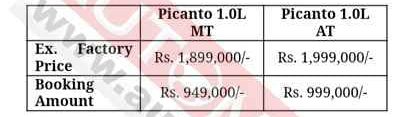
Sportage may lure buyers of Toyota Revo, Hilux and Fortuner whose prices had gone beyond the reach. Kia’s Picanto 1,000cc may face a tough time in view of competitive price of Suzuki Alto 660cc and market leaders like new Cultus and WagonR.

At a time when car and bike assemblers show their anxiety over current and future sales trend – some two and four wheeler companies have been regularly taking their vendors and dealers to foreign trips which a lay man hardly understands if sales and production are going down coupled with unpleasant business environment after take over by the PTI government. Perhaps these trips are planned to change the mood of vendors and dealers.

One can estimate huge travelling expenses incurred on the vendors and dealers who go in large numbers for a seven to 10 days international trip. This activity puts in doubt the hue and cry of auto assemblers over low sales as nobody knows where the companies are managing these handsome expenditures in providing fun to their vendors and dealers.

As far as dealers especially car dealers are concerned, they are charging over 300 per cent extra on service and tuning from their customers. It is not clear whether the companies have allowed them to fleece the consumers or they are doing on their own.

Indus Motor Company Limited (IMC) and Meezan Bank sign Memorandum of Understanding for Priority Delivery of all Toyota vehicles

Meezan Bank, Pakistan’s leading Islamic bank and the Best Bank in the country has recently signed a Memorandum of Understanding with Indus Motor Company Ltd (IMC) – one of the largest automotive manufacturers and distributors in Pakistan, to provide priority delivery of all Toyota variants to Meezan Bank’s customers. The signing ceremony took place in Karachi and was attended by Mr. Arshad Majeed – Group Head Consumer Finance, Meezan Bank and Mr. Abdul Rab – Senior General Manager, Indus Motor Company Limited along with their respective team members.

Under this agreement, Meezan Bank will provide additional value-added services of priority processing as well as fast track delivery of Toyota vehicles to customers of Meezan Car Ijarah, Pakistan’s first Riba-free car financing product.


Mr. Arshad Majeed while speaking at the occasion said, “Meezan Bank is the leading player in Pakistan’s Islamic Auto Financing industry. We are hopeful that our alliance with Indus Motor Company Ltd will further facilitate our clients by providing them with the best services across the country.”

About Meezan Bank
Meezan Bank is the leading Islamic Bank of Pakistan and the 7th largest Bank in the country. Meezan Bank has consistently been recognized as the Best Islamic Bank in Pakistan by numerous local and international institutions, which is a testimony of the Bank’s commitment to excellence. The Bank has also been recognized as the Best Bank – 2018 by Pakistan Banking Awards, the most prestigious awards in the country’s banking sector.

The Bank provides a comprehensive range of Islamic banking products and services through a retail banking network of over 680 in 190 cities supported by a countrywide network of over 700 ATMs, Visa & MasterCard Debit cards, a 24/7 Call Center, Internet Banking and Mobile Banking facility.

The VIS Credit Rating Company Limited (Formerly JCR-VIS Credit Rating Company Limited), an affiliate of Japan Credit Rating Agency, Japan has reaffirmed the Bank’s long-term entity rating of AA+ (Double A Plus) and short-term rating at A1+ (A One Plus) with stable outlook. The rating indicates sound performance indicators of the Bank.

  • Press Release

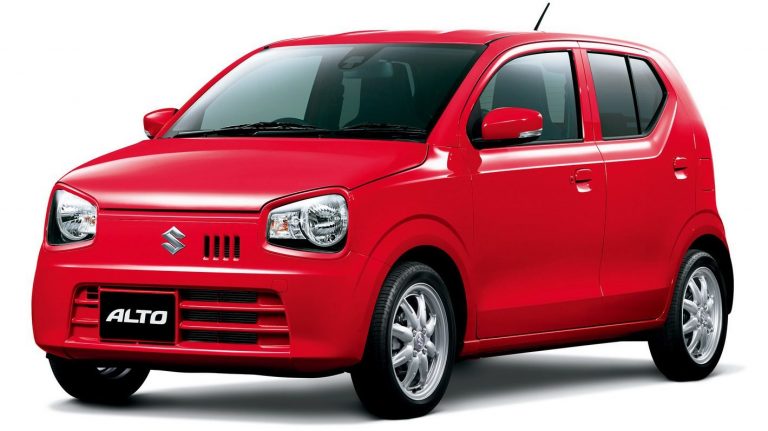
New Retail Prices issued by Pak Suzuki for Alto

Lately in Pakistan, business sector in general and automotive industry in particular is suffering through major setbacks. Tax being the burning issue of Pakistan now-a-days, has made various companies to raise product prices in order to meet their costs. Particularly in auto sector, various assemblers have marked an increase in prices owing to rupee devaluation and heavy duties and import bans on cars.

However, it seems like there is a long way ahead for auto sector to cover these obstacles of taxes and bans in order to excel for development.

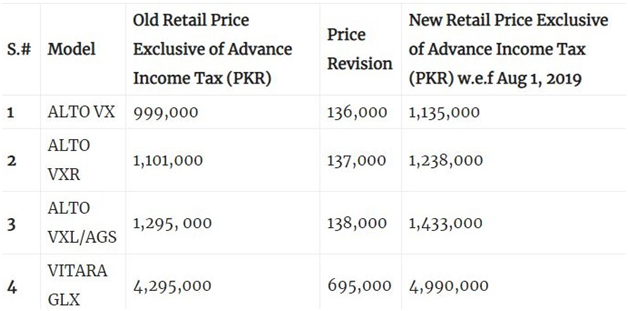
In one of Automark’s recent articles ( https://www.automark.pk/suzuki-alto-price-likely-to-go-up-by-rs-1-lac-from-1st-august/ ), the issue of increase prices and a major news about Pak Suzuki to increase price of its new Alto and Vitara cars broke out through industry sources. While it did not get official but the news was confirmed. In continuation of this, on July 31, 2019, Pak Suzuki sent a notice to its authorized dealerships clearly mentioning the new increased retail prices. This confirms the fact that automobile companies are not having enough paybacks to cover their costs and due to this, the strategy of incrementing price is coming into effect. Below are the exact retail prices of Alto and Vitara car variants by Pak Suzuki:

S.# Model Old Retail Price Exclusive of Advance Income Tax (PKR) Price Revision New Retail Price Exclusive of Advance Income Tax (PKR) w.e.f Aug 1, 2019
1 ALTO VX 999,000 136,000 1,135,000
2 ALTO VXR 1,101,000 137,000 1,238,000
3 ALTO VXL/AGS 1,295, 000 138,000 1,433,000
4 VITARA GLX 4,295,000 695,000 4,990,000

Note that while the above mentioned prices are inclusive of Ex-factory price and freight charges incurred on vehicle to reach dealership premises, they are exclusive of Advance income tax. In addition, the new retail prices will be implemented from August 1, 2019. The notice also states:

“The above prices are subject to change without notice and prices at the time of delivery shall apply. Any government tax applicable will be charged to the customer.”

Clearly, both the producers and consumers are getting worse off at this point. The opportunity cost of high taxes and duties have to be borne by customers. Starting from putting import bans on used cars, moving towards high duties and taxes and now these price hikes are restricting the auto sector of Pakistan to grow and giving hard times to car assemblers. In current scenario, there is a dire need of a passive and productive dialogue between government officials and stakeholders of auto sector so that a middle way can come out which benefits both the parties. If this does not happen now, the consequences of present situation will last long in future.

by Amara Aqsa

Suzuki Alto price likely to go up by Rs 1 Lac from 1st August!!

Pak Suzuki to increase Alto prices in the upcoming days!!

During the past few months, pricing strategies in the auto sector of Pakistan has displayed significant and mostly increasing patterns. In response to the high imposed taxes, rupee devaluation and impose FED on cars, automotive companies have increased their prices for each car model.


Suzuki Alto 660cc Launch Prices
VX 999,000
VXR 1,101,000
VXL 1,295,000

However, great things come with great prices and especially in the developing countries like Pakistan where automotive sector is suffering. According to industry sources; Pak Suzuki will further increase prices for their Alto car models in upcoming days. According to industry sources, each of the above mentioned numbers will be hiked above 1 Lac in addition to their current prices which may apply from August 1, 2019. Assemblers say that owing to the rupee devaluation and high duties levied on the automotive sector, price hikes are now the major source of coping up with the cost. Keeping in mind the current situation of Pakistan, the future of every business seems to doom with every passing day. Specifically the auto industry has been facing major obstacles in running smooth.

While in the last month, Honda, Toyota and Suzuki already increased their prices, there is still much more to know about. With reference to our another blog posted on the website.

https://www.automark.pk/pak-suzuki-raises-car-prices-of-various-models-in-pakistan/

Pak Suzuki Motor Company Limited (PSMCL) initially raised prices of vehicles by Rs 40,000-329,000 including a hike in prices of Mehran 800cc. The company in its letter issued to the authorized dealers attributed the price hike to negative exchange rate impact on account of recent rupee devaluation and new duties/taxes/federal excise duty levied by the government in the fiscal budget.
Recently, a new category of Alto by Pak Suzuki got hype for its fuel efficiency and adaptability feature. Alto 660cc which is locally manufactured passenger car stole the show in auto industry.
The brand new 600cc car has a R-series engine, with a modern exterior and interior both. There are three variants of this Alto; Alto VX which is without AC, Alto VXR which is with AC and Alto VXL AGS which has AC and automatic transmission. Each variant’s introductory price is given below:
Suzuki Alto 660cc Launch prices
VX 999,000
VXR 1,101,000
VXL 1,295,000

However, great things come with great prices and especially in the developing countries like Pakistan where automotive sector is suffering. According to industry sources; Pak Suzuki will further increase prices for their Alto car models in upcoming days.According to industry sources, each of the above mentioned numbers will be hiked above 1 Lac in addition to their current prices Assemblers say that owing to the rupee devaluation and high duties levied on the automotive sector, price hikes are now the major source of coping up with the cost. Keeping in mind the current situation of Pakistan, the future of every business seems to doom with every passing day. Specifically the auto industry has been facing major obstacles in running smooth operations lately. Stating that, Government needs to take proper measures and make business friendly laws in order to promote country’s economic growth.

By Amara Aqsa / Hanif Memon

Be A Customer Service ROCK STAR

My purpose in this article is to present some of the key mindsets and metaphors that makes the dealership staff Customer Service ROCK STAR at dealership aims to further enhance excellence in Customer Delight
Are You Ready to Be A Customer Service ROCK STAR?

Customer Service ROCK STAR knows the quality processes in Sales, Service and Parts operations raise productivity, keep the sales & service staff, technicians efficient and ultimately, work to produce happy & delighted customers.

8 winning mindsets that I’ll reveal to help you be a Customer Service ROCK STAR neatly summarized by the acronym ROCK STAR. Reason behind acronyms, it hooks into your mind like a catchy pop song. So, you will never forget them. Work and live by this little well-known code that distills what a World class Customer Service ROCK STAR is all about and you are guaranteed breathe taking results.

R in ROCK STAR remind you about the importance of resourcefulness. Resourcefulness is using our wits, proper judgment and common sense to resolve customer’s complaints, problems and meet challenges at dealership floor.It is using initiative in difficult situations and involves thinking, creating, evaluating, classifying, observing and analyzing solutions to overcome the challenges at dealership. Resourcefulness is dreaming up ways to meet our goals. It’s all about within us, how we behave in a situation. “Hazrat Ali (RA) said, Get afraid from a problem is a big problem”.
O in the ROCK STAR stand for Organized.Daniel Carneigie said that “an hour of planning can save your 10 hours of doing. Daily Action Plan that allows Customer Service Rock Star to focus on what’s important and most importantly provide them the feelings of everything is under control necessary to suffocate any sign of anxiety or stress. Daily action plan for Customer Service ROCK STAR is not only a guide designed to eliminate the stress of uncertainty but also to motivate them to carry out a set actions that they have formulated as fully feasible.
C in the ROCK STAR stands for Challenger. Customer Service ROCK STAR always challenge the limits of his/her possibility to create delight in the sales/service process and inspire customers to experience the joy and excitement of self-transcendence in a unique way. Customer choices are fast changing.Dealership staff need to gear up with right skill sets to deliver in such a dynamic environment. ROCK STAR needs to think beyond the boundary and showcase the right attributes of skills sets, attitude and knowledge. Batter practices and adopting new approaches will define ROCK STAR’s perspective to make impossible a POSSIBILITY.

“SKY IS NOT THE LIMIT; MIND IS THE LIMIT”

K in ROCK STAR stand for Keen Learner. Customer Service ROCK STAR always is on learning mode, take initiatives on personal and professional development throughskill enhancement, on job training and motivation thereby ensuring high level of customer satisfaction. ROCK STAR also attentive and learn from customer’s feedback that they received and considered to improve their personal performance.
S in the ROCK STAR stand for Service Driven.Customer always comes first. Customer Service ROCK STAR must be willing to go the extra mile to delight each and every customer. My Mantra for Customer Service ROCK STAR is neatly summarized by the acronym “SONG”. S stand for Serve, O stand of One Step Ahead, N stand for No Comparison and G stand for Give All. Every Customer Service ROCK STAR must sing his own SONG all the timeto delight the customer.
T in ROCK STAR stand for Team Player. Customer Service ROCK STAR understands the team/department’s goals and he know how his role supports team/department’s goal. He helps and encourage his teammates and don’t hog the credit for team wins. ROCK STAR keeps his/her commitment, communicate clear and value their teammates.
A in ROCK STAR stand for Adaptable:No day in dealership customer service is the same.Every customer is different and some may even seem to change week-to-week.In order to thrive in a constantly-changing environment, Customer Service ROCK STAR needs to adapt to their surroundings and be able to handle surprises, sense the customer mood and adapt accordingly.This also include a willingness to learn, providing good customer services at dealership floor is a continuous learning process.
R in ROCK STAR stand for Reliable. Customer Service ROCK STAR always goes extra miles ensuring high level of customer satisfaction with world-class experience at dealership floor.

This consistent mindset increases their reliability and trust in the eyes of customers. This mindset will not only result in an indebted and happy customer, it can also lead to higher customer retention and business sustainability.

Natural Metaphors For Customer Service ROCK STAR
I have mentioned below five natural Metaphors which Customer Service ROCK STAR must have:
FIRE: Customer Service ROCK STAR must have fire within. Fire gives ENERGY to perform.
WATER: Customer Service ROCK STAR must be like water. Water reflects FLEXIBILITY.
AIR: Air reflects ENVIRONMENT. Customer Service ROCK STAR must surround himself/herself with Positive and growing environment where he/she can grow more.
EARTH: Earth reflect GROUND to Paly. Customer ROCK STAR play hard on ground to deliver Results.
SKY:

Customer Service ROCK STAR always Fly High and above the Sky.

Exclusive written by Moazzam Abu Bakar and published in Automark Magazine’s July-2019 printed edition.

Tyre Care and Knowledge

Vehicle maintenance standards and guide lines are elaborated in the Maintenance Manual supplied to customers along with the vehicle by Original Equipment Manufacturers. Authorized workshops are available for the routine or emergency trouble shootings of the vehicle.

A tyre (air container) is the only part of a vehicle which bears the load, speed, friction, wear , tear, heat , cold, snow, mud and wet weather. Tyre suffers in any case when a vehicle goes in trouble. Tyre it self can create many troubles if not taken care of itself by the owner/driver. Let us discuss the tyre from it’s usage, service, re-purchase and disposition of used tyres.

TYRE SIZE DESIGNATION:
P195/60R15 87S
-P = Passenger car tire
-195 = Approximate cross section width in millimeters
-60 = Aspect ratio (height to width)
-R = Radial construction
-15 = Rim diameter in inches
-87 = Load index
-S = Speed rating symbol (S=max. speed of 112 mph)

MANUFACTURING DATE:
The date of manufacture is embossed on every tyre produced by the tyre manufacturers. It is mandatory requirement and is implemented internationally.
-The pattern is of international Standard as per cited below:
-3417 means 34th week of 2017.
-4517 43109 : 45th Week of 2017 & Tyre serial number.

INFLATION PRESSURE:
It is the standard inflation required to maintain in a tyre. In Pakistan we use pneumatic pressure in psi ( Per Square Inch) for Tyre air pressure. The sticker on the pole of driving side door have been pasted on all vehicles to inform the air pressure to be maintained in each tyre.
If we put a high pressure in the tyres it will create high noise and jerks / hard feelings in driving. A low air pressure normally damages the tyre itself in longer runs.

TOE IN – TOE OUT
Toe – in result when the front of the wheels are closer together than the rear of the wheels.
Toe – out is just the opposite.

Static Imbalance:
Occurs when there is a heavy or light spot in the tyre. Static Imbalance result in a vibration felt through the car seat, floor and steering column.

Dynamic Imbalance:
Occurs when there is a heavy or light spot on the side or off-center of the tyre tread, side wall or wheel. Dynamic Imbalance result in an unstable ride or wheel shimmy.

PURCHASING TYRE FOR REPLACEMENT IN VEHICLE

It is recommended that replacement of tyres to be made from the specification provided by the vehicle manufacturer. Change in rim size, aspect ratio, tread width and side wall dimension shall effect the vehicle performance and may lead to damages of axels, shock absorbers, chassis, side fenders and it also invalidate the vehicle warranty.

Disposition of old tyres:
Generally we dispose off tyres to the dealer for resale as scrap. Scrap Tyres are used I making rubber bushes, furniture fillings, sole of shoes and it may be burnt as a fuel ( Environmental Hazard).

AGEING OF TYRES:
Age of tyre can be assessed from the manufacturing date, physical conditions may also define the time to replace the tyre. International Laws and regulations are available for tyre age. It ranges up to a maximum of Five years to allow the use of tyre. In few countries maximm tyre age is three years.
In certain special arrangement tyres can be stored in dark rooms with special wrappings for protection form heat , sunlight and oxygen. How ever a shelf life has never crossed the time of more than three years before the fitment.

By: SYED ABID RAZA, Ex: Divisional Manager
Quality Assurance & Head of HSE Department at GTL

Electric Cars – A 100 Years Old Technology Again Knocking

The Doors of The Vehicle Industry

Ministry of climate change has been instructed by Prime Minister of Pakistan for preparation of Policy for Electric Vehicles. This is the right time for Pakistan to enter in Electric Vehicle market. It will solve envoirmental problems and will help to reduce surging oil import bill. In view of the need and worldwide transformations accordingly a separate ministry is required for transportation. However in the meantime, the Ministry on Climate Change, can be given the task of Ministry of Transport, as well, as it has already taken the initiative of getting the EV Policy 2019. There are no two ways on thinking on the subject, as the Ministry of Transport is imminent, and additional charge can be given to Advisor to the Prime Minister on Climate Change, for speedy disposal.

This assignment of Climate Change Ministry, for electric vehicle policymaking is a big task. The barriers to enter into the market are immense (from car manufacturers, transporters, etc). No charging infrastructure, no revenue collection streams in place, ambiguous import duty polices, no design for self-assembly industry and high cost of vehicles are just some of the stumbling blocks are on the way. It may be noted that a comprehensive and integrated policy is required.

Surprisingly electric car / vehicles are not a new thing for the world.Electric cars are older than the today’s normal internal combustion engine cars. Electric cars were introduced more than 100 years ago.In the early part of the century, innovators in Hungary, the Netherlands and the United States — began toying with the concept of a battery-powered vehicle and created some of the first small-scale electric cars, in the meanwhile Robert Anderson, a British inventor, developed the first crude electric carriage around this same time, it wasn’t until the second half of the 19th century that French and English inventors built some of the first practical electric cars. In the U.S., the first successful electric car made its debut around 1890 thanks to William Morrison.

Over the next few years, electric vehicles from different automakers began popping up across the U.S. New York City even had a fleet of more than 60 electric taxis. By 1900, electric cars were at their heyday, accounting for around a third of all vehicles on the road. During the next 10 years, they continued to show strong sales.

Many innovators at the time took note of the electric vehicle’s high demand, exploring ways to improve the technology. For example, Ferdinand Porsche, founder of the sports car company by the same name, developed an electric car called the P1 in 1898. Around the same time, he created the world’s first hybrid electric car — a vehicle that is powered by electricity and a gas engine. Thomas Edison, one of the world’s most prolific inventors, thought electric vehicles were the superior technology and worked to build a better electric vehicle battery. Even Henry Ford, who was friends with Edison, partnered with Edison to explore options for a low-cost electric car in 1914.

However, it was Henry Ford’s mass-produced Model T that dealt a blow to the electric car. Introduced in 1908, the Model T made gasoline-powered cars widely available and affordable. By 1912, the gasoline car cost only $650, while an electric roadster sold for $1,750. That same year, Charles Kettering introduced the electric starter, eliminating the need for the hand crank and giving rise to more gasoline-powered vehicle sales.

By the 1920s, the U.S. had a better system of roads connecting cities, and Americans wanted to get out and explore. With the discovery of Texas crude oil, gas became cheap and readily available for rural Americans, and filling stations began popping up across the country. In comparison, very few Americans outside of cities had electricity at that time. In the end, electric vehicles all but disappeared by 1935.Over the next 30 years or so, electric vehicles entered a sort of dark ages with little advancement in the technology. Cheap, abundant gasoline and continued improvement in the internal combustion engine hampered demand for alternative fuel vehicles.

In early 1970s. Soaring oil prices and gasoline shortages — peaking with the 1973 Arab Oil Embargo — created a growing interest in lowering the U.S.’s dependence on foreign oil and finding homegrown sources of fuel. Congress took note and passed the Electric and Hybrid Vehicle Research, Development, and Demonstration Act of 1976, authorizing the Energy Department to support research and development in electric and hybrid vehicles.

Yet, the vehicles developed and produced in the 1970s still suffered from drawbacks compared to gasoline-powered cars. Electric vehicles during this time had limited performance — usually topping at speeds of 45 miles per hour — and their typical range was limited to 40 miles before needing to be recharged. So interest in electric vehicles had mostly died down.

After 20 years in 1990’s new American federal and state regulations begin to change things. The passage of the 1990 Clean Air Act Amendment and the 1992 Energy Policy Act — plus new transportation emissions regulations issued by the California Air Resources Board — helped create a renewed interest in electric vehicles in the U.S.

During this time, automakers began modifying some of their popular vehicle models into electric vehicles. This meant that electric vehicles now achieved speeds and performance much closer to gasoline-powered vehicles, and many of them had a range of 60 miles.

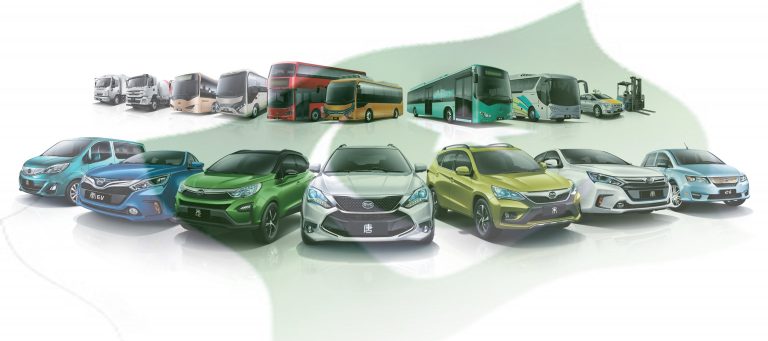
The first turning point that helped reshape electric vehicles was the announcement in 2006 that a small Silicon Valley startup, Tesla Motors, would start producing a luxury electric sports car that could go more than 200 miles on a single charge. In 2010, Tesla received at $465 million loan from the Department of Energy’s Loan Programs Office — a loan that Tesla repaid a full nine years early — to establish a manufacturing facility in California. In the short time since then, Tesla has won wide acclaim for its cars and has become the largest auto industry for Electric Vehicle production.

Surprisingly now “The biggest electric vehicle manufacturer in the world isn’t Tesla, but the Chinese company BYD (or “Build Your Dreams”). The company began as a battery manufacturer — and that expertise led it to electric cars and trucks, which depend on battery cost and performance”.

It is good to note that Prime Minister’s Adviser on Commerce Abdul RazakDawoodrecently said the electric vehicle (EV) policy would be formulated in consultation with the stakeholders and it would be aligned with the current auto policy.

The policy would incorporate global and regional best practices, growth of the EVs and the environmental concerns would be addressed properly.

by Anwar Iqbal, published in Automark magazine printed edition of July-2019

Huge and tough year ahead for auto industry of Pakistan

Recently, the economic environment of Pakistan has not been in a good weather sadly. Moreover, the effects are escalated on both the consumer and production side in every sector of industrialization.

Initially, high-end taxes were being imposed and now you might have come across sky high prices of cars in auto industry of Pakistan.

According to sources, Honda Atlas assembler and manufacture of Honda cars in Pakistan has plan to cut down its annual production target from 50,000 cars to 30,000 cars due to the current economic situation and expectation of lower sales for year 2019-20.

Due to lower production target, Honda Atlas may also layoffs considerable number of labor force from its firm where most of the employees are from manufacturing department.

In addition to Honda Atlas, Indus motors which is another car assembler of Toyota cars in Pakistan may reduce its production by 25% as per industry source, giving a huge set back to auto sector of Pakistan. It has also been said by the market sources that these companies are trying to become more technology intensive and less labor intensive.


The rupee witnessed massive depreciation against the US dollar, which then led to the existing carmakers raising their prices on multiple occasions to pass the impact of increased cost on to the consumers.

In the light of budget announcement for the fiscal year 2019-20, high Federal Excise Duties (FED) were presented to be imposed on local assembled different car types:
• 2.5% FED to be imposed on cars up to 1000cc engine displacement; whereas previously there was 0% FED on this engine capacity
• 5% FED to be imposed on cars between 1001cc and 2000cc engine displacement, while the previous FED was 0%.

Since most of the people use cars with engine displacement in the above given range, it is getting hard to buy these vehicles on high rate. Apart from FED, drastic increase in price of cars is the major issue at this point. Toyota, Suzuki, Honda and other companies have rise the prices almost got doubled from the previous ones, making things worse on the consumer’s side. Due to this increase in FED, prices of these cars have also increased making things worse on the consumer’s side.


While government on the other hand proposed a lower FED on few cars with high engine displacements, it does not seem to be much of a use. The change is FED is as follow:
• FED on 1700 cc-2000 cc cars should be lowered from 10% to 5%
• FED on high-end cars (2001 cc and above) should be cut down from 10% to 7.5%

However, most of these vehicles are made for commercial purposes but customers mostly buy low capacity engine vehicles in Pakistan. The reduced purchasing power of customers and low selling power of producers is giving a serious hitch to auto sector which is already struggling through inflation.

It was a trying year for Indus Motors, Pak Suzuki and Honda Atlas, as company profits suffered owing to various developments in the economy. The previous government’s decision to restrict non-filers from purchase of automobiles and the massive depreciation in the rupee significantly dented demand.

In this current scenario, auto industry is losing its major opportunities in terms of investment and innovation. In continuation of used car import policy and high prices, federal excise duty is a new hurdle in the way of progressing auto industry of Pakistan. Government should take steps and make friendly policies for buyers and producers. If the current situation persists for a longer period, the auto sector will soon be in devastating condition and the whole economy will suffer due to this major setback.

by Aqsa Amara

Bike prices reach another high in Pakistan

Since October 2018, Atlas Honda has continued to increase its bike prices as the Rupee kept on devaluating against the Dollar. Yet again, the prices have increased up to Rs.6000 of various motorcycles including Atlas Honda and Yamaha.

The budget for fiscal year 2019-20 and increasing tax rates has a huge role to play in the increment of prices as the cost needs to pass on the customer at the end of the day, the Chairman Muhammad Sabir Shaikh mentioned. Even the Chinese companies have increased their prices in order to adjust the taxes that are levied in the new budget.

Moreover, the spare parts of motorcycles will also be taxed according to a statement released by the FBR stating that the parts will be taxed according to the motorcycle’s retail prices and not the custom’s value.

There was change in many models of Atlas Honda bike prices. Some of them are as follows:

  1. CD7O (red and black); from Rs70,900 to Rs73,900 with total sales tax of Rs10,737.
  2. CD7O Dream (red, black and silver); from Rs74,900 to Rs77,900 with total sales tax of Rs11,318.
  3. Pridor (red and black); from Rs96,900 to Rs100,500 with sales tax of Rs14,602
  4. CG125 (red and black); from Rs117,500 to Rs123,500 with sales tax of Rs17,944.
  5. CG125 Self (red and black); from Rs136,500 to Rs144,900 with sales tax of Rs21,053.
    Yamaha also followed through:
  6. YBR 125Z; from Rs127,500 to Rs130,500 with sales tax of Rs18,962
  7. YBR 125G; from Rs149,500 to Rs153,000 with sales tax of Rs22,231
  8. YBR 125; from Rs144,500 to Rs147,500 with sales tax of Rs21,432
    Therefore, it doesn’t seem like these prices will slow down anytime soon as the bike prices rise very frequently within a year.