Home Blog Page 81

IMC profits surge 14 per cent to Rs11.6bn

Indus Motor Company (IMC) Friday posted after-tax profit of Rs11.6 billion up by 14 per cent during July-March 2017-18 against Rs10.2 billion, same period last year (SPLY).

The Board of Indus Motor Company Ltd announced that the combined sales of IMC Completely Knocked Down Units (CKD) and Completely Built Units (CBU) for the nine months ended March 31, 2018, clocked at 47,103 units, up 2 per cent over 46,216 units for the SPLY. Meanwhile, IMC enjoyed a 22 per cent for the nine months period.

The company’s net sales turnover for the nine months ended March 31, 2018, increased by 19 per cent to Rs100.2 billion as compared to Rs84.3 billion for the same period last year.

Commenting on the performance, IMC CEO Ali Asghar Jamali said that the increase in revenues and net profit against SPLY was mainly attributable to improved turnover of both CKD and CBU vehicles on account of minor model changes of all major vehicles during the year and improvement in operational efficiencies and sales mix.

He also said that demand momentum for automobiles remained strong throughout the period, due to rising disposable incomes, availability of reasonably priced auto financing and growth in ride-hailing services. On a nine months basis, the sales of locally manufactured PCs and LCVs witnessed an increase of 23 per cent to 198,176 units compared to 161,692 units sold during the same period last year.

The Board of Directors declared third interim cash dividend of 325 per cent at Rs32.5 per share for the quarter ended March 31, 2018 which, on cumulative basis, adds up to 950 per cent i.e. Rs95 per share for the nine months ended March 31, 2018 compared to 800 per cent i.e. Rs80 per share for the same period last year.

Pak Suzuki declares profits of Rs900mn for Q1FY2018

Pak Suzuki Motor Company Limited (PSMC) in the first quarter (Jan-Mar) 2018 posted a profit after tax (PAT) of Rs0.9 billion with earnings per share of Rs10.99, down by massive 31 per cent Year on Year (YoY) as against a PAT of Rs1.3 billion in the same period last year.

Sales revenue in first quarter 2018 grew by 32 per cent YoY on the back of a 58000 units increase in off-takes (up 18 per cent YoY), thanks to the impressive sales of Wagon-R, Cultus, and Mehran, and a 4 per cent YoY increase in average selling prices.

Gross margin for the quarter fell by 3.85 percentage points YoY on the back of an 18 per cent YoY increase in steel prices, and 11 per cent rupee depreciation against the Japanese Yen (JPY). This dented earnings considerably as gross profit fell by Rs287 million with an EPS of Rs3.49 per share.

On a quarterly basis, the OEM registered a handsome 24 per cent QoQ growth in earnings, on the back of a 7 per cent QoQ rise in sales revenue owing to better off-take (+16000k cars QoQ). Higher average prices meant that gross margins saw an uptick of 51bps QoQ, despite rising steel costs and a constantly falling Pakistani rupee.

Nissan introduces new retail concept at dealerships worldwide

Renovations at more than 9,000 dealerships will offer improved customer services within a globally consistent brand experience

YOKOHAMA, Japan (April 20, 2018) – Nissan Motor Co., Ltd. plans to introduce a new retail concept to dealerships around the world to improve customer services within a globally consistent brand experience, in response to diversifying expectations and lifestyles.
All Nissan-brand dealerships will be encouraged to align with the Nissan Retail Concept, or NRC. The new concept aims to improve all aspects of the customer experience at Nissan dealerships, including facility design, service process and digital environment. More than 400 dealerships in 30 countries have already made the change. Nissan aims to implement NRC at more than 9,000 dealerships in more than 170 countries by the end of fiscal year 2022.
Dealerships aligned with the Nissan Retail Concept feature a number of new design elements, such as an exterior with the familiar red Nissan signage and an exclusive delivery area that enhances the exciting moment when customers receive their vehicle. Customers will also be able to learn about Nissan cars using a digital car configurator and navigate through the service process on salespeople’s tablet computers. NRC also incorporates the Nissan brand’s key elements, such as Nissan Intelligent Mobility, electric vehicles, light commercial vehicles and the NISMO performance sub-brand.
NRC has been rolled out in North America, Europe and China. Beginning this fiscal year, Nissan is renovating dealerships in Japan, and the company will continue carrying out NRC in tandem with efforts to optimize its sales network.
“The relationship between dealers and customers is changing, with customers expecting a more digital and customized experience. So Nissan is proud to introduce a new retail concept to deliver these exciting and diverse customer experiences worldwide,” said Daniele Schillaci, executive vice president for global marketing and sales at Nissan. “The Nissan Retail Concept will improve all aspects of a customer’s experience, from the minute they arrive at a Nissan-brand dealer until the moment they hopefully drive away in their new Nissan.” – PR

Forland Bravo 1.0 Technical Review 2018 by Team Automark

Team Automark presents Forland Bravo 1.0 Technical Review 2018.
Foton company released a new truck which is Forland Bravo 1.0 and they all are available in a reasonable price. Check out the review for further details.

Master Motor introduce Yutong-Master Bus, Double Glass Model in Pakistan

Master Motor introduce Yutong-Master Double Glass Model 6127 luxury bus in Pakistan.

Launching ceremony held on 17th April 2018 at MMCL Plant, Port Qasim, Karachi.

Transporters from across the country attended elegant unveiling ceremony while all the Chinese staff of the bus department was present at the occasion.

Watch the complete video and see by yourself.

Reported by Team Automark


Pakistan needs uniform taxation policy for SMEs and large scale units. Time has come to remove SRO culture

To come out this turmoil, the government must reduce customs duties on import of Chinese goods on maximum items to over 7,000 tariff lines especially spare parts for the assembly of motorcycles, cars, commercial vehicles and all electrical and electronic goods.

Current scenario of trade in Pakistan does not favor small and medium industries especially Chinese based manufacturing and assembling in automobiles and electronics sectors.

Around nine per cent devaluation of the rupee against the dollar in the last four months, finalization of import/export data exchange with Chinese and Pakistani governments and country political environment may shake up positive economic indicators.

When one dollar was equal to Rs 60 the trade and industry people were involved in misdeclaration and under invoicing in exports and imports. At that time tax rates were same as compared to current rates of taxation.

To come out this turmoil, the government must reduce customs duties on import of Chinese goods on maximum items to over 7,000 tariff lines especially spare parts for the assembly of motorcycles, cars, commercial vehicles and all electrical and electronic goods.

“This is the only solution which can bring out country out any financial crisis”, said Mohammad Sabir Sheikh, Chairman Pakistan Tajir Itehad and Association of Pakistan Motorcycle Assemblers (APMA).

He said the losing value of the rupee against the greenback is increasing production cost of local industries besides triggering increase in petroleum prices, raw material prices of auto sector, electrical and electronics and raising transportation cost.

Market is abuzz with rumors that the caretaker government would further devalue the rupee value before taking of power by the new government, he said.

Sources said the government, which is on verge of completing its five years term, is not ready to take responsibility for depreciating the rupee value. However, the government had already done devaluation in the last four months to improve exports especially of textiles goods.

Sabir said Pakistan produces 2.5 million bikes annually in which two million units are 70cc bikes. Of total 70cc bikes some 1.4 million units belong to Chinese based assemblers while Honda assembles 600,000 units of 70cc bikes.

He said rupee-dollar parity does not favor Chinese based assemblers who are already facing stiff competition. Only Honda can survive in this scenario because of its good brand image, higher volumes and no change in price of CD-70cc in the last four years.

However, any change in the policy, customs issues or rupee dollar parity make a big impact on Chinese bike assemblers while Honda survives the scare easily.

A real challenge for Chinese based bike assemblers is coming up as Pakistan and China are all set to launch online trade verification from April 2018 to authenticate the volume of import and exports of both the countries.

China is reported to have agreed to provide online certificate of origin to all its exports for Pakistan.

The working for data verification between the two countries was started couple of years back in order to streamline the trade between the two countries. In this regard, both the countries under free trade agreement (FTA) have agreed to develop electronic data interchange.

Pakistan Customs was ready to roll out electronic payment solution from December 31, 2017. The e-payment system had been developed with the help of State Bank of Pakistan (SBP) and 1Link – payment solution provider.

Under the e-payment system importers would be able to make payments related to goods declarations (GDs) online and through ATMs. Usually banks have restricted amount transaction limit through ATM. However, there will be no limit of payment through ATMs for consignment clearance.

The government has also been working on various modules to comply with trade facilitation agreement (TFA) under World Trade Organization (WTO). Prime Minister has approved single window operation for trade clearance. A team had been constituted at the Federal Board of Revenue (FBR), which would complete the task in three years.

The single window programme would facilitate the trade as importer would have to file a single page document and all the relevant departments would submit their certificates / verifications of their own under this programme.
Currently the WeBOC system – online clearance system developed by Pakistan Customs – allowed 50 per cent import consignments for clearance through green channel. This will be increased to bring it at international standard of 90 percent.

During the past ten years the customs clearance system witnessed massive changes.
The automated system is facilitating the trade and it reduced the time for clearance.

The Online Verification of Goods would start in Pakistan and China from April 30. Traders from both the countries are advised to provide accurate packing lists of their goods to concerned authorities.

It has been further clarified that prices will be subjected to change according to changes in sales tax and customs tariff. Any extra charges imposed by custom will be paid by the customer.

Last year Pakistan had suggested this measure change through various high level meetings with Chinese authorities to end over-invoicing and under-invoicing menace by the traders in Pakistan, due to which actual amounts of import-export were difficult to assess by the authorities.

Pakistan will able to check misuse of Free Trade Agreement (FTA) with China from April 18 as Chinese Customs has agreed to provide certificate of origin on real-time basis. Certificate of origin would authenticate the exports from China to Pakistan. There is huge gap between figures in imported goods from China reported by Pakistan Customs and goods exported by Chinese Customs.
The goods imported from China are under invoiced or mis-declared to the tune of three billion dollars.

The Commerce Division has announced to sign a revised Free Trade Agreement (FTA) with China next month. Out of the total 7,120 tariff lines, the Commerce Division held out an assurance to China to reduce duties to zero per cent on 6,000 tariff lines while protection will be provided only to the remaining 1,120 tariff lines, mostly textile products.

The duties will be brought down to zero in a period of 15 years in three phases. One-third of these tariff lines will be removed immediately; half of the remaining will be exempted from duties in the next five to seven years while the rest will be eliminated within 15 years.

However, the Federal Board of Revenue (FBR) fears that the proposed massive tax exemptions will cause considerable revenue loss for the country and has estimated a revenue loss of around Rs100 billion per annum in case the second phase of the FTA is implemented.

A summary has been already sent to Prime Minister Shahid Khaqan Abbasi to apprise him over the move of the Commerce Division allowing 75 per cent tariff lines on zero duty to China under the second phase of FTA. The premier has directed the Commerce Division to consult all associations over the proposed move.

Pakistan has already lost Rs 32 billion revenue because of exemptions under the first phase of FTA in 2016-17.

The issue is not only related to revenue loss but also about adequate protection to the local industries. Small industries cannot compete with the mighty manufacturers in China. The proposed move will complete wipe out the small industries in the country. As a result of the first phase of FTA, Pakistan’s exports stood at $1.5 billion in 2016-17, while imports from China surged to $15 billion.

These massive imports are the outcome of zero duty on 35 per cent of total tariff lines. The impact in terms of imports and revenue loss will be much higher in case the exemption limit reached 75 per cent.

Pakistan had imposed regulatory duties on certain tariff lines to protect local industry. There is no compulsion to go for the second phase as Pakistan has no export surplus.

FPCCI on FTA II

On 15th March 2018, a meeting was held in Ministry of Commerce – Islamabad, in presence of Dr. Miftah Ismail (Advisor to PM on Finance, Revenue and Economic Affairs) and Secretary Commerce Younus Dagha, wherein presentation was made to the private sector led by Mr. Ghazanfar Bilour President FPCCI, Amir Waheed, President of Islamabad Chamber of Commerce and Industry, ZahidLatif Khan, President Rawalpindi Chamber of Commerce and Industry and others.

It was informed that Pakistan will reduce Customs Duty to Zero per cent on 70 per cent tariff lines and China will do the same for Pakistani goods.

FPCCI President and others demanded to place 70 per cent tariff lines on website for study of all stakeholders, which was denied by Commerce Secretary. He offered to have another meeting in next 10 days with the stakeholders where they can give the details of tariff lines to concerned sectors.

FPCCI is concerned that FTA Part-1 resulted in favour of China, where their exports to Pakistan are more than $15 billion and Pakistani exports to China stand around $1.5 billion in last year.

Syed Mazhar Ali Nasir, Senior Vice President of FPCCI feels that 2nd round of FTA will give more advantage to Chinese exporters and resulting further closure of Pakistani industries and also significant increase in joblessness.

Mazhar proposes that FTA imports be related to Pakistani exports and China must meet 25 per cent imports from Pakistan against their export value to our country, i.e. If China exports touch $20 billion, they must import $5 billion goods from Pakistan. Otherwise there is no benefit to the Pakistani economy with the current FTA or 2nd round of FTA.

While negotiating 2nd round of FTA, Pakistani existing industries must be protected as well as market gap for new potential local industry.

We have high respect for China-Pakistan friendship, but we must protect the economical interest of Pakistan. If 2nd round of FTA is implemented in present manner, our import dependence will increase to 40-50 per cent from China in next five years.

It is also suggested that finalization of 2nd round FTA be postponed till after elections.

Rupee-Dollar Parity

The value of the US dollar hit a high of Rs115.50 on March 20, 2018 in interbank trading, with currency dealers suspecting the government’s commitments to foreign monetary bodies being the cause behind the sudden rise. The value of greenback also rose by Rs5.40 in the open market.

The State Bank of Pakistan (SBP) held rising demand for dollars responsible for the rise in the USD, adding that it is closely monitoring the situation, but forex dealers seemed reluctant to accept this line of reasoning.

Foreign loans, the government’s unannounced commitments to international bodies and corruption are responsible for the lower value of the rupee.

Given that Pakistan is set to be placed on the Financial Action Task Force’s grey list in June, it is not the right time to devalue the rupee, some currency dealers believed.

Where Pak rupee devaluation against the dollar may improve revenues of Power and Oil and Gas Exploration companies, those companies which substitute imports may get benefit. However, we believe that export oriented companies will be a major beneficiary, especially textile firms. With 9 per cent Pak rupee devaluation in last 4 months and rebate of 3-7 per cent on textile exports, their revenue may significantly improve, an analyst at Sherman Securities said.

This exclusive article published in Automark magazine’s April-2018 printed edition

Car assemblers come under fire for price increases, low standards, and cartelisation

CCP holds public hearing on complainants against car assemblers/manufactures 

As the Competition Commission of Pakistan (CCP) organised a public hearing on complaints against car assemblers in the country here on Thursday, the car manufactures/assembler come under fire for higher prices/lower quality, and safety standards of vehicles they produce in Pakistan.

Dozens of customers, who were largely associated with the business of used car imports, attended the hearing at the CCP office, also severely criticised the assemblers for not producing required vehicles forcing the customers to wait for over six months or pay premium for early delivery of new booked vehicles. They claimed that unlike vehicles in other countries, the new cars being produced in Pakistan lacked the basic safety standards as there was no regulatory body to inspect and check the vehicles.

CCP Chairperson, Vadiyya Khalil who chaired the hearing, said that the hearing was organised to listen to those who complained against the vehicle manufactures/assemblers. The CCP, she said, had received many complaints during the past few months. She was flanked by member Advocacy and the Office of Fair Trade Dr Shahzad Ansar,  and member Competition Policy and Research (CP&R) Dr Muhammad Saleem.

A complainant, Muhammad Gilani, while talking about the premium or ‘On money’ being charged by investors/black marketers of new cars, said that the vehicle should be registered in the name of the person who first booked the car instead of registering in the name of a 2nd or 3rd man who later purchases the vehicle while paying the premium. He said both dealers and assemblers were responsible for the illegal business.

However, Indus Motor Company (IMC) Chief Executive, Ali Asghar Jamali claimed that his company was taking an all-out effort to discourage the menace of ‘on money’. While talking about the number of steps taken so far to stop the illegal business, he said, the only way out of the issue to make it mandatory to register a vehicle on the first customer name and introduce a tax on transfer within six months of purchasing the vehicle. However, he regretted that the government’s response for the IMC proposals against premiums is still awaited. No action has been taken on wholesale/retail mechanisms and the suggestion regarding transfer tax is still unheard.

He said that IMC has gone so far as to cancel thousands of suspected investor’s orders where multiple vehicles were booked on the same CNIC in the last 2 to 3 years. He also mentioned that on late deliveries, IMC makes a payment of Kibor + 2 per cent to its customers. In rupee terms this has amounted to Rs0.5 billion to date paid by IMC and Rs1.5 billion to date, paid by the industry as a whole.

Another complainant, Suhail Sarfaraz claimed that the vehicles being produced in Pakistan lack the list of ingredients mentioning their quality, manufacturing date and other specifications. There is no regulatory body to inspect and check the quality and standards of the vehicles and auto parts in the country. An official of the Engineering Development Board (EDB) also admitted that Pakistan Standard and Quality Control Authority (PSQCA) lacks the expertise and facility to inspect the quality of products in the automobile industry. Former chairman of the Pakistan Association of Automobile Parts and Accessories Manufacturers (PAAPAM), Aamir Allawala, while speaking on the occasion, said that every new auto part, manufactured here, goes to Japan for test and approval.

Another participant of the hearing complained about the culture of SRO saying that the recent blockage of imported used cars at ports had caused a huge loss to importers besides the sudden jump in premium of new cars from Rs0.2 million to Rs0.4 million. Fawad Hassan, another complainant claimed that small cars, as compared to bigger ones, were costlier in the country. He said even the locally produced cars, which cost Rs1.9 million on new cars, do not carry airbags, a mandatory safety item in other parts of the world.

“We will provide new cars at cheaper rates if we are allowed to import the same commercially. The vehicles being assembled here are not only of old technology but costlier as compared to the same vehicles abroad,” said Shaukat, an importer of used cars. “The auto industry in Pakistan is an import oriented industry. Even a window screen is not manufactured here. We give 200 per cent revenues in terms of taxes,” he said.

Aamir Allawala, while referring to New Zealand and Australia, said that Pakistan should not allow the import of cars as the industry is providing job opportunities to hundreds of thousands of people in the country. He said the import of used cars has generated Rs120 billion in  black economy for the country.

Rizwan, another participant at the hearing said “importing a steel plat and molding it is not called manufacturing. Even the parts manufacturers import all raw material from various countries. Those criticising the import of used cars should also know that 80 per cent of parts manufacturers are also importing raw material from abroad.”  An FBR official also admitted that last year Rs45 billion were spent for imports in the auto parts sector. He said the government was extending concessions to both assemblers and used cars importers.

IMC chief Jamali said that every part being imported by the Original Equipment Manufacturers (OEMs) are guaranteed as compared to the ones imported by others.

During the hearing, Jamali said the industry takes this open hearing by CCP as an opportunity to share its efforts in reducing premiums and curbing the black marketing of new vehicles. Highlighting the efforts made for progressive localisation, he claimed that the industry has achieved more than 60 per cent localisation on their flagship products and the players continue to study the techno-economic feasibility of further parts. However, raw materials for all localised parts continue to be imported as Pakistan doesn’t manufacture either auto-grade steel sheets or resin which are the two primary raw materials for all auto parts. After becoming signatory to the Trade Related Investment Measures (TRIMS) and the General Agreement on Tariffs and Trade (GATTS) agreements, the government had to do away with the industry specific deletion program and instead, it introduced a tariff-based system. Non localised CKD is imported at 30 per cent and localized CKD imported at 46 per cent. Irrespective of the fact that there is no mandatory localisation regime anymore, all OEMs continue to pursue localisation based purely on cost merit.

Addressing the recent price hike, he explained that the rupee devalued by almost 10 per cent whereas manufacturer increased their prices by 3 per cent to 4 per cent only. Furthermore, RD on raw material leads to increased steel prices and increasing utility costs due to prevalent load shedding which is adding to the cost burdens.

He said that almost all OEMs have either increased their capacity or are in the process of increasing it. IMC has recently invested $40 million and enhanced its capacity by 20 per cent to meet the growing demands and to shorten delivery periods.

The auto sector is host to 3 million direct and indirect employees and the largest contributor to national exchequer. If provided with transparent and stable regime, it can serve as a launch pad of economic growth,” he added.

Interestingly, despite severe criticism from customers, the representative of Pak Suzuki, the largest car assembler in Pakistan, remained silent throughout the hearing.

Later, the officials of EDB suggested CCP to wait for the next couple of years as new entrants in the auto sector will change the situation of present demand and supply. Chairperson CCP asked the complainants to submit their detailed complaints within the next 7 to 10 days.

Courtesy: https://profit.pakistantoday.com.pk/


Pakistan Auto Show-2018 lacks presence of innovative products

Show is becoming a family gala rather than showcasing latest auto brands while Big new entrants were also absent   

Pakistan Auto Parts Show, the so-called pride and initiative of Pakistan Association of Automotive Parts and Accessories Manufacturers (PAAPAM), has been transforming into a “family gala” rather than showcasing any innovative products. PAPS Auto Show 2018 held at Lahore Expo Centre from March 2 to 4, 2018 was more disappointing than the previous shows.

The show is turning into an event in which old friends belonging to PAAPAM from various cities hug each other after one year and return home saying “I will be back” next year. This is how PAPS has been running under the monopoly of some senior PAAPAM members.

The Association claims to have pulled in thousands of visitors to PAPS but it is not an achievement as shows relating to lawn exhibition, plastic, stationary, cooking, education, etc also draw huge crowd and many companies like textiles also introduce new products.

Like past practice the existing three Japanese car assemblers, who had set up their stalls, had nothing new to offer. Indus Motor Company (IMC) had been taking half body frame of Toyota Corolla to every nook and corner of the country to highlight higher localization achieved by the company. IMC had also taken the same body frame at an auto workshop held at Muzzafarabad Azad Kashmir in the third week of March in which the car had imported tyres.

IMC had never shown any new model or any model change in the PAPS amid reports that Corolla XLI and GLI are reportedly being replaced by Vios by 2019 which the company had been denying so far.

If a big assembler like IMC had been showing old products then what one can expect from Pak Suzuki Motor Company Limited (PSMCL)  however, has been showing brand new heavy bikes which neither can be assembled nor can be imported in bulk for commercial sale.

Honda Atlas Limited and Atlas Honda Limited had also nothing new to offer. All the three existing assemblers had only supported and sponsored the show otherwise their products do not create any extra enthusiasm among the visitors who daily watch them on the roads.

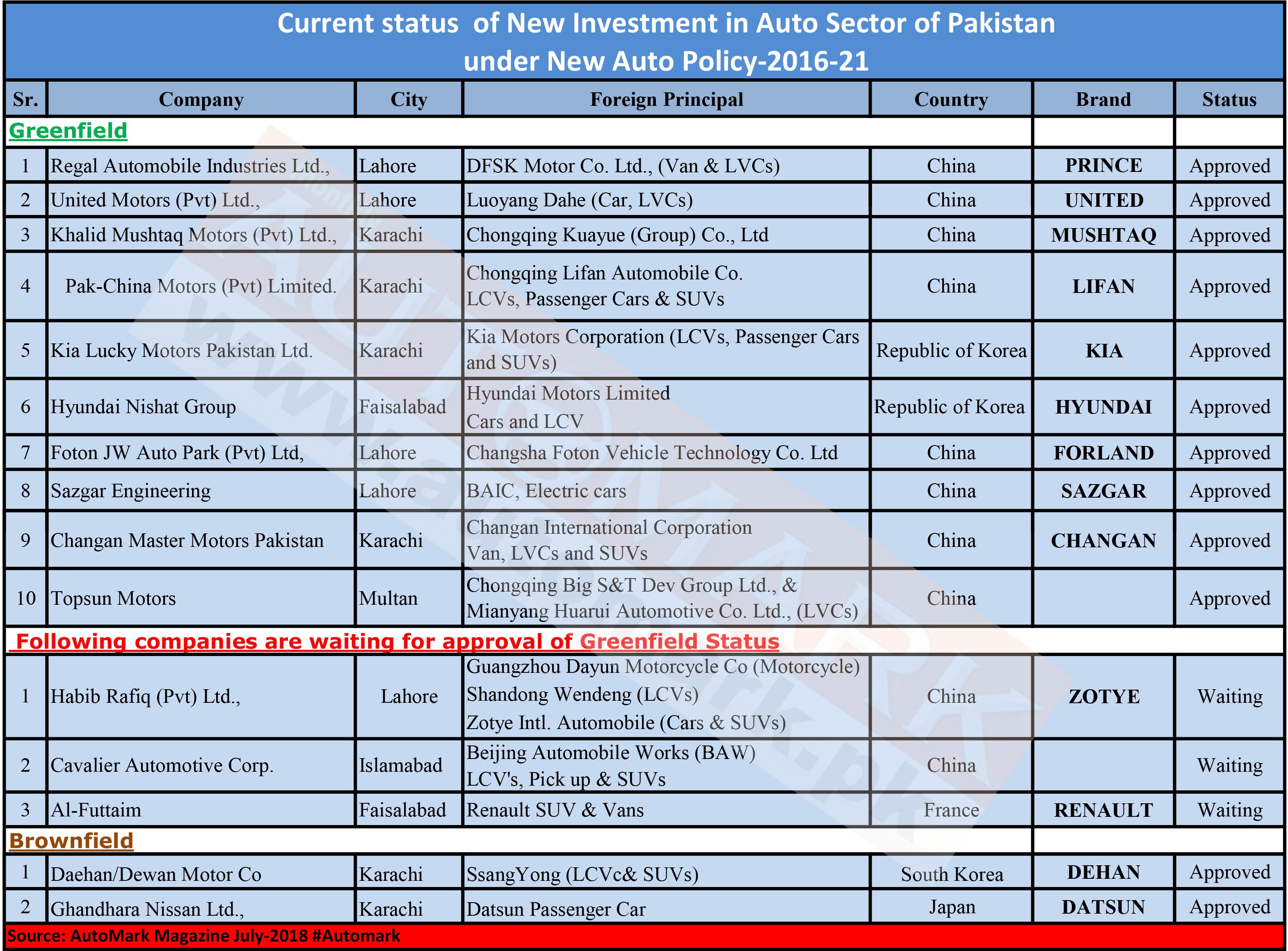
Amid media reports regarding the brown field status given to two old players and five green field investment status awarded to new entrants by the Ministry of Industries for local assembly of cars and LCVs but the PAPS show had only two stalls – one by Regal Automobiles and other was Foreland.

People had definitely missed the stalls of upcoming assemblers of Kia, Hyundai, Datsun and Renault vehicles. If these vehicles had introduced in the PAPS then it would have certainly brought in bigger turnout of visitors.  The makers of Ravi bikes introduced Italian made Vespa in the show which succeeded in drawing attention of buyers.

Many exhibitors had been seen complaining regarding higher amount taken by PAPS organizer in providing space in the show. They were also irked by low presence of media persons as well as mediocre coverage in news channels and print media owing to lack of coordination between press/media and public relation firm. Some exhibitors said the show organizer had taken double rate for providing stalls this year which was unjustified.

Automark magazine had covered the auto show as per its own resources and circulated the news and videos in the social media.

Many seasoned vendors were also absent from the event and even they did not set up any stall. Many Karachi-based as well as Lahore-based vendors also stayed at home.

Surprisingly, Al Haj Faw Motors, who had been one of the regular exhibitors and main sponsors in previous PAPS, backed out from PAPS 2018 due to some very valid reasons.

Lack of enthusiasm by the organizer was much evident as no big shot from the government was invited to inaugurate the event. If big ministers were too busy in various engagements the state ministers should have been approached. Nobody knows why PAAPAM had not invited any ministers or state ministers to the show when PML-N government’s Auto Development Policy (ADB) 2016-2021 had lured $800 million investment in the auto sector for setting up new plants.

PAAPAM had maintained its past tradition of holding the event from Friday to Sunday. The first day was marred by late opening ceremony held on Friday (March 2). Almost half of the day passed in opening ceremony followed by break for Juma prayer. The Saturday and Sunday were completely family days in which people came to enjoy with family and friends.

The B2B meetings were quite slow than previous years. Many visitors with no knowledge about auto industry just came to collect gifts after end of the show. College and universities students also took part and got cash money on winning the competition.

The slogan of the show was “Make in Pakistan” but more than 80 Chinese auto parts makers were present in the show threatening a direct competition to our local vendors. Chinese auto investors had been in forefront in investing in automobile sector of Pakistan.

During three days’ event, many seminars were held with very low attendance of people.

PAPAM should ponder now and force the existing and upcoming assemblers to show their latest brands otherwise they would not be allowed to participate. However, It will be a hard decision for PAAPAM members as they will lose big orders from existing assemblers if they are denied entry in PAPS show.

Imported Chinese auto products are only be allowed in the show in case the exhibitor or investor of the product is interested in setting up an assembly plant in collaboration with local partners.

Hyundai Motor releases customized subcompact SUV Encino in China

South Korea’s largest automaker Hyundai Motor Co., struggling to save its sagging business in China, has launched Encino, the localized version of its popular subcompact sport utility vehicle known as Kona in Korea.

Beijing Hyundai Motor Co., a joint venture between Hyundai Motor and China’s BAIC Motor, said Wednesday it held an opening ceremony for the Encino at the Shanghai World Expo Exhibition and Convention Center.

“The Encino SUV was developed with an aim to reflect the different lifestyle needs of young customers,” said Vice President Chung Eui-sun in his opening remarks at the ceremony. “We will continue releasing new models that meet the ever-shifting demands of Chinese customers.”

The Encino offers improved driving performance as it comes with a 1.6-liter gasoline turbo engine and a seven-speed dual clutch transmission. Embedded with smart sensors and other safety features, it also supports the connectivity software developed by Chinese tech giant Baidu. The car body has been made to look lower and wider compared to previous SUVs, a design change made specifically to appeal to Chinese customers, the company said.

The subcompact SUV is one of the fastest-growing segments in the Chinese auto market. Car sales have seen a threefold increase in four years, from 211,000 units in 2013 to 676,000 units last year. The number of models has also grown from five to 16 in the same period.

Beijing Hyundai sought to capture a piece of the lucrative subcompact SUV market by releasing the ix25 crossover in 2014, which has so far sold a total of 298,000 units in China as of last month.

In marketing the Encino to young Chinese customers, the company plans to sponsor a dance competition on China’s video streaming giant Youku and launch a set of digital advertising campaigns.

Hyundai Motor said a stream of clean vehicles, including a Sonata plug-in hybrid, are on the pipeline in the latter half of this year. It also plans to strengthen marketing efforts for its hydrogen fuel-cell SUV Nexo by holding events to promote its eco-friendly technologies.

ORIENT ENERGY SYSTEMS (PVT) LIMITED AT AGRITECH2018 IN PAKISTAN

ORIENT ENERGY SYSTEMS (PVT) LIMITED AT AGRITECH2018
PARTICIPATE AT PAKISTAN’S AGRICULTURE INDUSTRY
EXHIBITION #AGRITECH2018
WITH THE COLLABORATION OF CASE NEWHOLLAND AND AL-GHAZI TRACTORS LIMITED
IN LAHORE ON 6 – 7 APRIL-2018 AT INTERNATIONAL EXPO CENTER

Brief introduction shared about Orient Energy Systems by Syed Shamshad Ali, Assistance GM of Machinery Sales Division from Orient Energy Systems with #Automark’s editor-in-chief at exhibition ground.