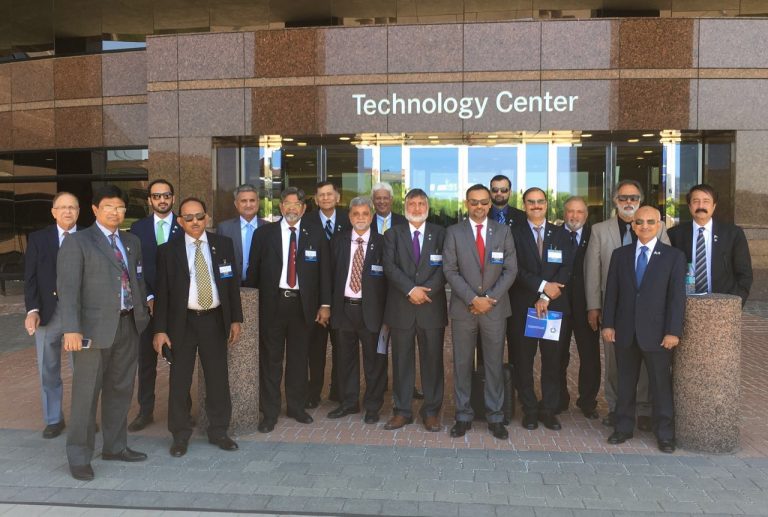
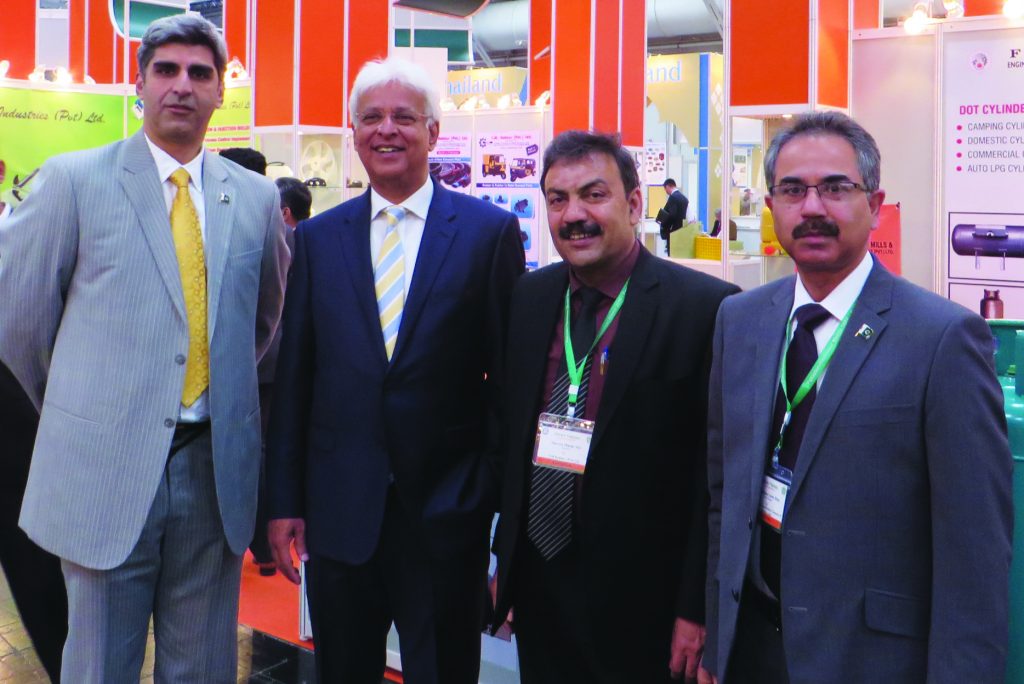
During the end of last month, a Pakistani delegation under the vigilance of PAAPAM’s senior vice Chairman Mashood Ali Khan visited the PAAPAM–DICE exhibition held in United States, Michigan, Sheraton Novi hotel. DICE Foundation is the oldest innovation platform in USA and is being fully supported by major stakeholders since 2007.
The four day event had a Pakistani delegation to meet Fiat Chrysler Automobile (FCA) on the first day, followed by a visit to Ford Company, an exhibition in which Pakistani auto parts were displayed on the third day and lastly B2B meetings being held with the community and other stake holders and a formal dinner on the 25th May. Informative and healthy B2B meetings were held with the community and visitors.
The successful event had more than 100 visitors in the exhibition and a major reason behind this was that there are many American based Pakistanis working in automotive sector in USA which felt proud and at the same had a welcoming attitude.
The companies participated in the very successful DICE exhibition held under the surveillance of Coordinator of DICE Foundation USA Dr. Khurshid. There were almost 14 Pakistani companies with 24 representative are participated in this delegation, namely: Mehran Commercial, Sherani Engineering, Faraz Industries, Auvitronics, Thal Ltd., Agri Auto Industries, Razi Sons, Automotive Spare Parts and Accessories, Noor Engineering, Yusuf Auto industries (Pvt) Ltd, Sigma Industries, Rubatech, Load Limited, Skyhigh Industries (Pvt) Ltd and General Engineering Industries.
The senior vice Chairman of PAAPAM, Mashood Ali Khan, were talk with editorial team of Automark Magazine conveyed a lot of positive information about the whole event.
The PAAPAM delegation’s in discussion with Senior Manager FCA (Fiat Chrysler Automobiles) Brett Schauber, while visiting the company’s plant, revealed that the company is willing to work with Pakistan in the after sales market. This willingness of FCA is a big opportunity for the Pakistani industry to flourish and make their name in the global market. PAAPAM delegation also met the head of tool purchaser at FCA and gave a very positive and warm response to the opportunities displayed by the delegation.
During the visit, there were many employees of FCA from different departments such as forging, casting, aluminum and interior parts. Presentations were conducted by PAAPAM about the Pakistani auto parts and how Pakistani manufacturers specialize in low volume parts. It revealed that FCA is willing to work with PAAPAM for low volume products in the start. PAAPAM also briefed the company about the parts made in Pakistan and how efficiently and effectively they can be used. On this delegations member confirmed FCA that the Pakistani industry is able and capable of providing the goods in an excellent quality.
The visit was not just restricted to FCA and the delegation met senior management of Ford Company, who also gave a positive response on the invite put to them for visiting the Pakistan Auto Parts Exhibition going to take place in Karachi in the upcoming year. The company also met Tier 1 and Tier 2 suppliers and received promising orders from the company.
A very strong gesture was undertaken by PAAPAM by inviting the FCA delegation to visit the Pakistan Auto Parts Show which is going to be held in Karachi in 2017. Mr. Brett agreed to the invite and is willing is to visit the auto parts show, not only this but Mr. Brett is going to visit the plant of different companies to further give him better understanding. Both the companies Ford and FCA exchanged contacts with the PAAPAM authorities and agreed to stay in contact and have business in the upcoming years.
Such delegations should be made for every international exhibition so that Pakistani companies can have a wider view of the industry and meet the demand of not just of local industry but international as well.
PAAPAM Delegation returns from DICE exhibition with positive response
APMA, PAMA, PAAPAM, APMSPIDA AND PASPIDA ASK GOVERNMENT TO CUT TAXES IN BUDGET 2016-17
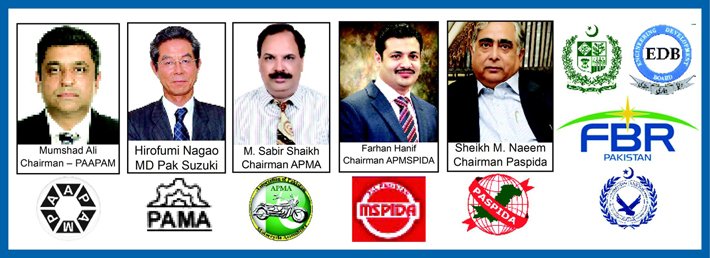
CHINESE BASED MOTORCYCLE ASSEMBLERS – APMA
Motorcycle assemblers have demanded the government to relieve the industry of some taxes in the upcoming federal budget of Fiscal Year (FY) 2016-17. According to the Muhammad Sabir Shaikh, Chairman, Association of Pakistan Motorcycle Assemblers that over 50 plants out of total 120 are shut and the remaining are not meeting their production maximum. Only 50 percent of total production capabilities are being utilized currently by production houses in the country.
The industry is capable of producing around 4 million units per anum but sales are stagnated at 2 million since last two calendar years. Some of the Industrialists who are members of APMA said that lesser production leads to increased manufacturing cost while government’s production quota scheme under SRO 656 (I)/2006 through EDB has resulted in limited use of capability and licensed by PSQCA is totally a waste of time.
Sabir Shaikh further stated that employment opportunities would increase if the government considers industrialists’ recommendations and cuts taxes. Federal budget for fiscal year 2016-17 is scheduled to be announced in June. Federal Minister Ishaq Dar had delayed the announcement which was to be made in May in light of the burning Panama leaks issue.
JAPANESE BASED MOTORCYCLE & CAR ASSEMBLERS – PAMA
The body of Japanese bike assemblers and car producers Pakistan Automotive Manufacturers Association (PAMA) in its budget proposal for 2016-17 has urged the Govt to consider its recommendations regarding levy of 1% extra tax on auto sector, Regulatory Duty on steel products, WHT on exports, duty on dies, tools and machinery, and sales tax adjustment issue for Motorcycle dealers. PAMA stated that there is levy of Regulatory Duty on Steel Products under SRO 568(1)/2014 by two amendments vide SROs namely SRO-131(I)/2015 and SRO-246(I)/2015.
These SROs affected few HS codes with regard to basic raw material to Auto Industry increasing per vehicle cost impact for around 3,000 to 5,000 depending on extent of sheet metal and pipes used in a vehicle. ‘Certain categories of steel materials (Sheets) which are not manufactured locally have been inadvertently included in the said SRO, which form basic raw material, for component or sub-components of the automotive industry.
It is proposed to include imports made under SRO 655(I)/2006 as exempt from regulatory duty under SRO 568(I)/2014, as such exemption has also been given to other sectors such as imports covered under 678(I)/2004,’ proposed PAMA. The association justified their suggestion by stating that steel sheet is required as raw material for manufacturing automotive components, so including the list of steel materials under SRO-568 the exemptions already available to the auto-industry have been ignored, resulting in discouraging localization of such materials and reverting to imports, which hopefully was not the intention because the additional duty will surely increase the cost of goods manufactured. Similarly, PAMA stated that there is levy of 1% Additional Custom Duty on imports of goods specified in first schedule of Customs Act 1969 vide SRO-1178(I)/2015.
‘It is proposed to exempt imports made under SRO-655(I)/2006 and SRO-656(I)/2006 from additional custom duty under SRO-1178(I)/2015,’ proposed PAMA. The association stated that additional duty on input items like raw material, component, sub-components and CKD of the automotive industry that are not manufactured locally have impacted the highly cost sensitive sector. ‘Custom duty on machinery, parts, dies, moulds and tools should be reduced from the present rate of 5% to 0%,’ proposed PAMA.
The association justified this proposal by stating that the industry is in growth phase, so to encourage local manufacturing, investment needs to be made attractive and lower initial investment will encourage organized sector. PAMA also proposed that motorcycle dealer/retailer should be included into the exempted category as listed in SRO-647(I)/2007 as amended by SRO-564(I)/2012. ‘Motorcycle being a high unit cost item warrants special treatment otherwise the excessive refund will tie up the working capital of the dealers and make his business unviable,’ reasoned the association.
MOTORCYCLE & CAR PARTS VENDORS – PAAPAM
Pakistan Association of Automotive Parts and Accessories Manufactures (PAAPAM) urged the government to reduce sales tax on 800cc cars produced in Pakistan – from 17 to 5 percent, well informed sources in EDB informed to Automark. The Association which recently met with the top brass of Federal Board of Revenue (FBR) submitted four major proposals to include in the federal budget to be announced on June 3, 2016. PAAPAM has urged the government to exempt raw material imports from Regulatory Duty under SRO 655 by auto parts vendors, through addition of SRO 655 in the RD exempted SROs listed in SRO 568 and credit lines for auto parts manufacturers for setting up plants to produce high-tech parts in the country. The rationale provided for this is that tariffs for raw material imports by auto parts manufacturers (APMs) under SRO 655 are prescribed for a period of 5 years under Automotive Development Plan (ADP-2016-21). Imposition of RD on raw materials imports by APMs has put them at a disadvantage, as no RD has been applied on finished auto parts imported by auto assemblers/commercial importers. Imposition of RD will affect the sanctity & predictability of the ADP and render the local APMs uncompetitive. Secondly, the auto parts manufactures have also sought revision of import levies on imports of used cars below 1000cc, by arguing that on the average, APMs supply local parts worth Rs 250,000 to Rs 300,000 for locally produced cars below 1000cc. They suffer loss of sales/profit when used cars take market share from cars produced in the country. During the last 9 months (July 2015 March 2016), a total of 24,500 used cars below 1000cc were imported. Had these cars been produced locally, the APMs would have generated sales of approx Rs 7 billion and created 49,000 new jobs in the manufacturing sector. The Association has calculated that fixed import levies of used cars below 1000cc under SRO 577 are suppressed and need a review. Thirdly Association has also requested a reversal of 50 per cent & 25 per cent duty rebate on import of hybrid vehicles below 1800cc and above 1800cc respectively, reasoning that through SRO 499 (1) 2013, the government allowed a 50 percent & 25 percent duty rebate on new/used hybrid vehicles below & above 1800cc respectively to encourage fuel conservation and control balance of payment deficit. This tax rebate, amounting to around Rs 950,000 per vehicle led to annual import of around 6,500 hybrid vehicles, causing loss of business for auto parts vendors, who are supplying local parts to comparable vehicles domestically produced in the 1600-1800cc category Currently, the price of oil has dropped to historic lows, due to which pressure on Pakistan’s current account has eased and there is no apparent need to subsidise hybrid vehicles. Also, there is no protocol/procedure for disposal of lithium batteries used in hybrid vehicles and this can cause major environmental disaster in the country.
COMMERCIAL MOTORCYCLE & CAR PARTS IMPORTERS – APMSPIDA
Motorcycle Spare Parts Importers have proposed the government to reduce customs duty of spare parts to 20 percent from 35 percent and should abolish additional tax.The association in its tax proposals 2016/2017, has urged the tax authorities to reduce customs duty by 15 percent to 20 percent and further requested to withdraw 15 percent additional tax.
It said, “Mass scale smuggling of motorcycle spare parts rendering legal importer at the verge of collapse.”
The following HS codes of spare parts should be granted customs duty reduction.
8409.0000; 8483.5010; 8407.3110; 8532.3010; 8714.0000; 8483.9020; 8483.1012; 8483.6091; 8544.4221; 8532.3010; 8481.8020; 8512.2010; 8536.5021; 8511.3010; 7315.1910; 8544.4221; 8421.3110; 8481.8020; 9029.2011.
Pakistan Automobile Spare Parts Importers and Dealers Association (PASPIDA)
One of the major problems in Pakistan is non-documentation of the economy and due to non- documentation the tax net cannot be expanded. If we analyze the real situation, we find that the imports through smuggling and illegal channels cannot be documented, and nor the traders dealing insuch goods can come under the tax net.
When we study in depth, we find that only those products are lucrative to be imported through smuggling and illegal channels on which the import duties are higher, or the imports are banned or restricted. There is no doubt that Auto Parts is one of the most lucrative productsfor the smuggling regime. The aggregate import duties and taxes on imports of locally manufactured parts are more than 90% while the import duties and taxes on non-locally manufactured products are around 75%. These rates are not highest rates in Pakistan for any products, but may be one of the highest in the world, and this is the reason that Auto Parts is one of the most attractive product to smugglers, as there is no way that the local bonafide importers can complete with such smuggled goods.
The exorbitantly high rates of customs duties and taxes levied in Pakistan on import of Automotive Parts, are the part of Auto Policy, which is aimed for the development of Auto Industry in Pakistan, while no other Industry in Pakistan is protected with such high rates of duties. One cannot deny about the protection needed for the local industry, but until now in last 10 years of tariff based policy the Government is unable to achieve its targets to develop the Auto Industry at desired rate.
The commercial importers and the Government exchequer are already suffering due to this policy, but we must admit that the Industry is also not benefited from this policy, as like commercial importers the industry also can’t compete with illegal channels, as due to lower volumes and lack of advance technology, it’s cost of production is already much higher than the countries like China, India, Thailand or other regional countries.
As such, if the Government is sincerely interested to discourage smuggling, and illegal imports, it has to discourage the importsthrough illegal channels by bringing down the customs duties and taxes to a reasonable level and it is the only way by which the Government can expand its tax net and also move towards the documentation of economy.
This exclusive article published in Monthly AutoMark Magazine’s June-2016 printed edition.
Zongshen with Norton, Fantic and a global Cyclone
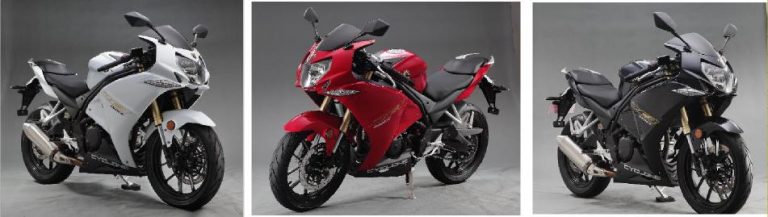
A couple of years ago I predicted that the winds of change would have to blow through the Chinese motorcycle industry for it to evolve. It was quite obvious that the industry was flagging and needed a large injection of new ideas to get it rolling again and it seems that Zongshen have taken the lead in pushing forward the reputation of the industry.
One of the serious problems facing the industry is the ‘Indian invasion’ on traditionally safe Chinese markets in Latin America and Africa. Zongshen’s reaction to this is to start a campaign which actively targets commuters in Europe and the USA. Over the next couple of years many marketing campaigns will be launched at EICMA Milan, EUROMOT Cologne and other venues which will see Zongshen changing their brand name to ‘Cyclone’ and producing high quality products for these regions.
The ‘Cyclone’ brand naming is a reaction to the Chinese industry trend of producing OEM and rebranding for just about every customer. On the European and American markets Cyclone will be the name of Zongshen’s products and there will be no rebadging much in the same was that QJiang promote their ‘Keeway’ brand in Europe.
Another boost to the Zongshen reputation comes from joint ventures and technical partnerships with international motorcycle manufacturers and parts factories. Zongshen have enjoyed a successful partnership with Piaggio for many years and share a scooter making factory in Foshan, Guangdong. In recent months Zongshen have stepped up their quest to produce better quality products as they are just about to dry the ink on an exciting new adventure which will see them collaborating with Norton to make bigger (in China 600cc is a big displacement engine) and better engines and perhaps eventually (according to Zongshen) produce a Norton motorcycle for the Asian market.
Zongshen Manager Thomas Fan stated “it’s a perfect partnership, we get to improve the quality of our bigger displacement engines and then we can help Norton to their rightful place as one of the world’s leading motorcycle manufacturers. We initially went to David McMullan to ask him if he could advise us on whom to approach with regard to evolving our engine technology and producing bigger engines for our new market targets. David put us together with Norton and after a very successful visit to the UK we have been negotiating the terms of our agreement to get the best win/win situation. Our partnership is starting carefully but there is no reason that it can’t expand and evolve to become one of the more famous working relationships in the global motorcycle industry.”
Zongshen also have a good working relationship with Fantic of Italy. Famous old 70’s off-road brand Fantic has enjoying a renaissance in recent times and has expanded their catalogue to include street bikes. Fantic and Zongshen have collaborated to produce an excellent engine and it won’t be long before they step up to the next level with full partnership as Zongshen look to increase their influence in Europe.
Zongshen are backing up their new market campaigns with the biggest and most expensive research and development centre in the Chinese motorcycle industry. Mr. Fan reports “Zongshen are one of the only factories who have actually increased their spending on research and development and I think we have made a decent statement to the world with our new 50 million dollar facility. No one else in China has anything like what we have developed with the possible exception of Haojue and they really do not concentrate on export motorcycles. With the new facility we can concentrate on trying to produce new types of products for different markets like snowmobiles. We feel now that we are starting to get everything in place to make a big push in to Europe and the United States. We have the technical partners and also the facility to make the best of them. What we really need now is to speak to the media in the countries we are targeting and make sure that everyone knows that Zongshen, and more to the point Cyclone, is looking to become one of the major players on western markets.”
To conclude I think it’s safe to say that if Zongshen do not succeed with this new venture it is certainly not for lack of trying. Industry experts have been advising the Chinese motorcycle industry to take these measures for years, especially the decision to launch their own brands which marketing wise should be a no-brainer! I think one of the major catalysts of Zongshen’s decision will be a domino effect which will see other Chinese motorcycle companies follow suit in trying to evolve into new markets and attract partners that can improve their technical quality and know-how.
Now let’s hope they get their marketing right!
by David McMullan
[email protected]
China
PAAPAM delegation leaving for USA to introduce Pakistani automotive parts
For the first time in the history of country, Pakistan Association of Automobile Parts and Accessories will be exhibiting at the Distinguished Innovations, Collaboration and Entrepreneurship (DICE) exhibition which is going to be held in Sheraton Michigan, United States. DICE is an umbrella program under which there are many platforms actively working. The main objective of these platforms is to jump start cycle of innovation in the country necessary for its sustainable growth, progress and economic prosperity.
DICE is the oldest innovation platform in Pakistan and is being fully supported by major stakeholders since 2007. The exhibition will be on 25th May while next day will be an arrangement for B2B meetings, while before the exhibition the PAAPAM delegation is going to visit Fiat Chrysler Automobile (FCA) and Ford Car production planton 24 May, they will invite OEM representative to attend the exhibition and see the products made by Pakistani vendors. PAAPAM members will also meet the local community to encourage them to invest in Pakistan, while law and order situation is much better than previously.
The main aim to attend this exhibition and visit the OEM, is to promote the export of Pakistani auto parts and accessories in the international market. The delegation will be led by Mashood Ali Khan who is the senior vice chairman of PAAPAM. The delegation is going to meet OEM tier 1 and tier 2 to brief them about the parts Pakistan can provide.
There are almost 14 Pakistani companies with 24 representative are participating in this delegation, namely: Mehran Commercial, Sherani Engineering, Faraz Industries, Auvitronics, Thal Ltd., AgriAuto Industries, Razi Sons, Automotive Spare Parts and Accessories, Noor Engineering, Yusuf Auto industries (Pvt) Ltd, Sigma Industries, Rubatech, Load Limited, Skyhigh Industries (Pvt) Ltd and General Engineering Industries.
The companies are motivated and see huge potential for Pakistani automobile spare parts and accessories in the international market. Therefore members are bearing the cost on their own. The companies have no financial support from the government however it is seen that the government of Pakistan is making positive and welcoming policies for foreign investors. The very big step taken by the government is the CPEC which is bringing in many international investors into the Pakistani market. Pakistani vendorsare already exporting auto parts to almost 40 countries across the world.
As the major goals of DICE states is to share and collaborate innovative concepts and products. Through transfer of knowledge and technology, a company can make better products and export better products. This is going to improve the economy of the country. Another major goal is to make the world aware of different variety of products produced by different companies in different countries all around the globe, which are not widely known.
A lot of effort has been done by members of DICE foundation and PAAPAM to manage this trp. The participants are determined to attend the exhibition and are hopeful to receive orders from different companies operating all around the globe.
Benefits of Islamic Car Financing
Introduction:
The feeling of owning a car is one of those enchanting feelings that every man wants to cherish with the key in the hand of a vehicle he owns. Due to financial barriers and the strict measures of car financing companies, this feeling goes to the grave with almost half of the lot. In Pakistan, in order to abate the outburst that may cause due to the involvement of foreign financing companies on one hand, and due to their non-conformable payment conditions, Islamic Car Financing has been introduced by the banks and financing companies all over the country. Here in this article, we are going to list some of the most prominent Islamic Car Financing banks along with the benefits, which are providing the customers with their dream cars under the terms and conditions of Islamic Loan system. PakWheels provides Car Loan Calculator facility on its website to calculate monthly loan payment installment for each bank.
Islamic Car Financing Banks:
- Dubai Islamic Bank:
Being crowned as the No. 1 Islamic car financing bank, Dubai Islamic Bank comes with the provision of lowest installment rate and the markup as well. The salient features that are being offered by Dubai Islamic Bank are:
- This bank is offering the lowest insurance rate in the market, than any other car financing firm.
- You can choose a time span for the payment from a period of 1 to 7 years.
- The best point is, no any additional charges or rental payments are to be paid by the customer in lieu of the advance payment, till the day your vehicle arrives at your doorstep.
- Lowest markup rate is 100,000 PKR and the highest markup is 500,000 PKR.
- Faysal Bank Car Financing:
Faysal Bank is at the second place in providing quality and hassle free services to its customers. The vital points that make it distinguished from those who follows it, are as under:
- This bank provides relaxation on selecting the cars either they are local or imported.
- The payment time span varies from 1 to 5 years.
- It also provides the facility of advance booking, just in case you are a car enthusiast and can’t wait for much.
- Bank AlFalah Auto Car Financing:
Bank AlFalah, another well-known conglomerate in the Islamic banking, have also stepped in the race of Islamic car financing and has added Islamic Banking Car Financing Calculator on-site as well, in order to get the customers to calculate even the minute details about what they are going to step into and under what payment plan. The benefits, this bank is offering as follows:
- Customers are free to choose from a list of new or used cars.
- After the car has been selected, again the payment plan and the rate is also set by the customer himself, in order to avoid any monetary inconvenience in the future.
- A groundbreaking feature is a relaxation being offered in selecting the fixed or the variable payment plan.
- No any charges, in the case of termination, are charged from the customers.
- Minimum documentation is required if you are applying for a vehicle from AlFalah Car Insurance.
- Meezan Bank Car Financing:
Also known by the name of Meezan Bank Car Ijarah, it also provides its customers the best Islamic car financing services strictly under the shariah law. It also has its own formula being used by many customers in its Islamic car financing calculator. Its distinguishing features are as follows:
- The lessor has the ownership, unless or until the contract has been ended.
- According to a provision in the shariah law, that the asset will lie with the user, the lessor, on the other hand, will have liability rights over the vehicle.
- In case the vehicle gets stolen, the insurance company will keep charging the rent till the claimed amount has been recovered.
FAW-Volkswagen JV to build fifth plant in China
FAW–Volkswagen Automotive Company announced it would build a fifth vehicle factory, in the port city of Tianjin, as it looks to increase its exposure to growing demand in the world’s largest vehicle market.
FAW-VW is a joint venture established in 1991 between Volkswagen and China’s FAW Group, producing Volkswagen- and Audi-branded passenger vehicles for sale mainly in China. It is one of VW’s two main vehicle-producing joint ventures in the country, with production at around 1.65m vehicles in 2015.
Volkswagen’s other joint venture in China is Shanghai-Volkswagen, with production of around 1.72m units last year. VW group sales in mainland China and Hong Kong total led 3.55m units last year, including 177,000 imported vehicles.
Construction of the new fully-integrated plant will begin this month, with production scheduled to start in 2018. Total spending earmarked for this project is reportedly CNY19.5bn (around US$3bn) for a plant with annual capacity of 300,000 vehicles per year.
The world’s second largest economy and the biggest car market by volume, China is expected to have 1 billion licensed drivers in the next 15 years. Taking advantage of this, Volkswagen Group has already announced it will incest €18.2 billion ($24.7 billion) in development and production facilities through 2018.
At full capacity it is expected to employ about 6,000 people. FAW-Volkswagen’s other plants are scattered in different locations in China, including Changchun, Foshan, Chengdu and Qingdao.
The Latest Honda Civic with Ever Best Features
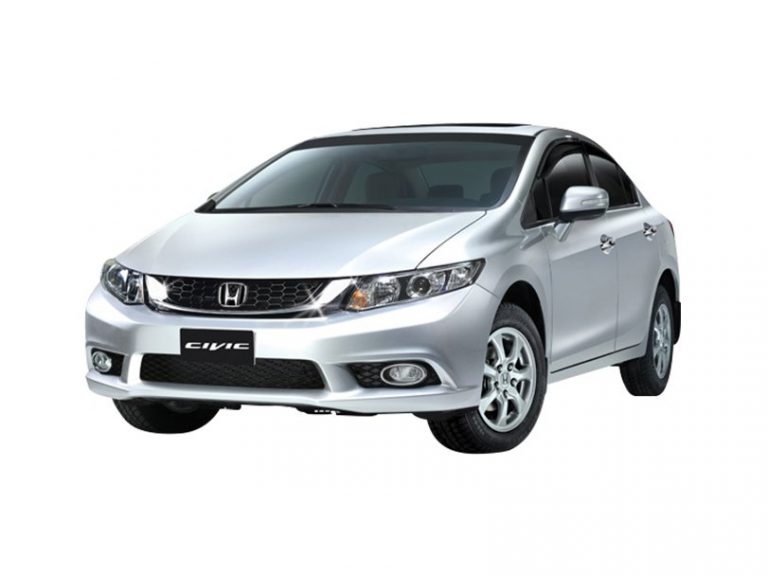
A detailed introduction of the latest features in newly launched Honda Civic along with its tag price in Pakistan, is all that can be read in this article
Honda Civic, a Luxurious Sedan:
Honda Civic, for most of the readers, just the name may convey the charm and style that it comes with. For the rest, we would like to introduce this vehicle as the “Dream Car” of every automobile enthusiast in Pakistan. From the tech-savvy interior to the amazingly crafted exterior, this car blows off everyone’s mind whenever the latest model is introduced in the market. The Honda Atlas Cars (Pakistan), in the latest annual report, revealed the highest increase in the sales that amounted to 54% this year within a time span of at just nine months. This boon recorded in the selling percentage is being attributed to two major factors namely the increase in local demand and economical cost of this car.
Features:
The latest Honda Civic comes with a bunch of new features, most of them are the refined form of the features from the previous versions of the car yet, many are new and mentioned as below:
Interior:
The concept of the digital speedometer in sedans being shipped to Pakistan were firstly introduced by Honda in its 2006 Model Honda Civic Car. The latest Honda Civic also inherits the same feature but with much alteration and improvements in the speedometer display case. The display case in front of the pilot seat is divided into three panels that give a bit more explicit and a clear view of the stats of your car. The Honda Connect Multimedia system comes with all new 7-inch multi-touch capacitive touchscreen that gives the driver and the passengers a splendid feeling to control the media buttons, navigate maps freely, and parking the car with much precision with the display of the rear on screen, with the help of a rear camera. The connect to phone feature via Bluetooth is another amazing provision that has ruled out the concept of long/small aux cables that tangles with the gear shaft and with your feet whenever you enter or leave the car. Another cool feature that it comes with is the smoked sunroof glass that gives the interior a more natural look. The leather covered seats add to the elegance and charm to the extent that makes it more attractive and eye-catching.
Exterior:
Whenever we talk about the exterior of Honda Civic, its elegance and charm are quite of its own like and an epitome of its kind. Amongst the models that have been introduced in Honda Civic, the uplift version of Honda Civic 2010 model garnered much appreciation as it came with all extended features and till now, is being considered the car with unmatched streak whose looks are being inherited by every succeeding model. The sharp looks that it exhibits from the front, the cross cut design of steel-enforced grill and the integrated daytime headlights, are enough to dazzle the eyes of the onlookers. The best part is the location of side indicators that distinguishes the design of all new Honda Civic 2016 from its counterparts. The rear bumper is more stylish and has the built in a spoiler with stylish rear lights that imitate the design of a boomerang.
Pricing Details:
Honda Civic price in Pakistan starts from 2 Million PKR and goes up to 2.35 Million PKR. The Honda Civic Car finance calculators have been added on almost every site in order to calculate the price of Honda Civic cars. The major platforms where you can buy Honda Civic cars in Pakistan are the virtual garages being run online like OLX Cars Islamabad, considering the most cars being searched under Islamabad’s registration number. Keeping the style, elegance, looks, designs and features of this car, it is being considered as the pure blend of perfection and is the most sought after car since its new models are breaking their own sales records.
Get detailed information about Honda Civic latest features and price in Pakistan, PakWheels provides comprehensive information about all the latest models of Honda including Honda Civic, Honda City and Honda Vezel.
Obama and Merkel open Hannover Messe-2016
Dancing robots, emotional speeches and a friendly “rivalry” between US President Barack Obama and German Chancellor Angela Merkel: HANNOVER MESSE 2016 began on Sunday evening with a high-caliber opening ceremony.
We want to build on the spirit of innovation in the USA,” said POTUS Barack Obama in his opening speech. This spirit has been driven by Germany and HANNOVER MESSE, especially over the past 70 years. Obama added that the USA has now created new production facilities, subsidy schemes and jobs in recent years to help reach this goal.
In what is likely his last visit to Germany as President, Obama spoke in particular about the TTIP free trade agreement. He believes that there are too many obstacles restricting trade between the EU and the USA. Different regulations and standards lead to higher costs. Therefore, one of TTIP’s aims is to establish harmonized high standards.
Politicians and the industry agree on TTIP
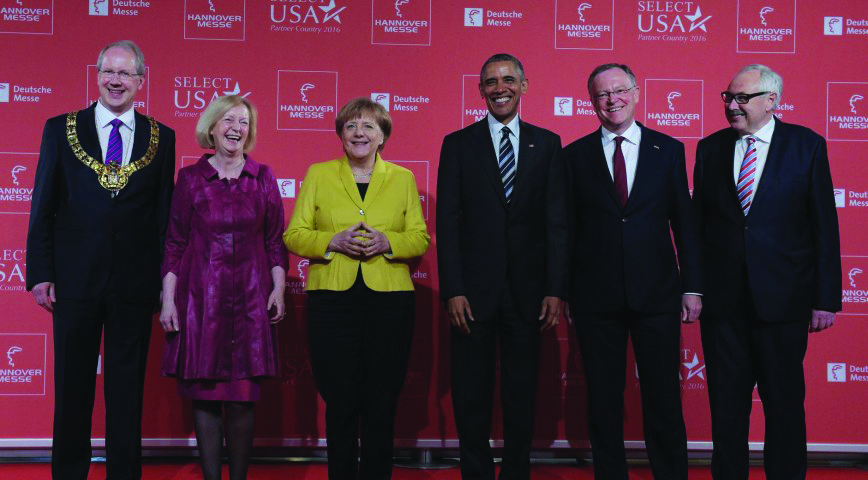
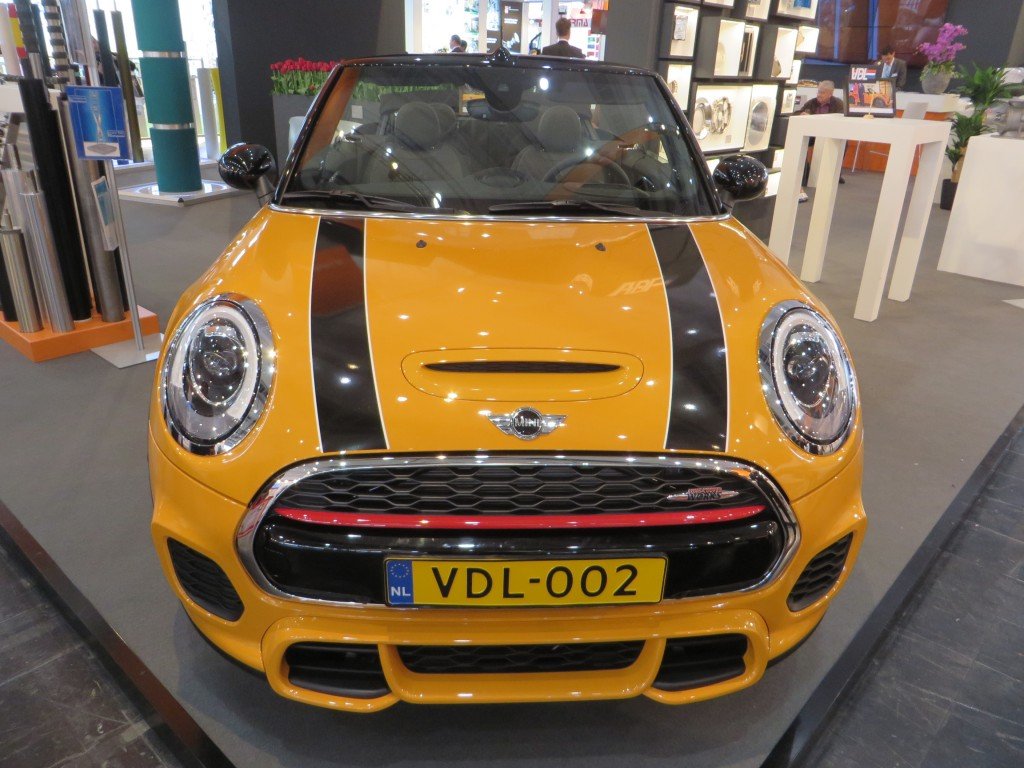
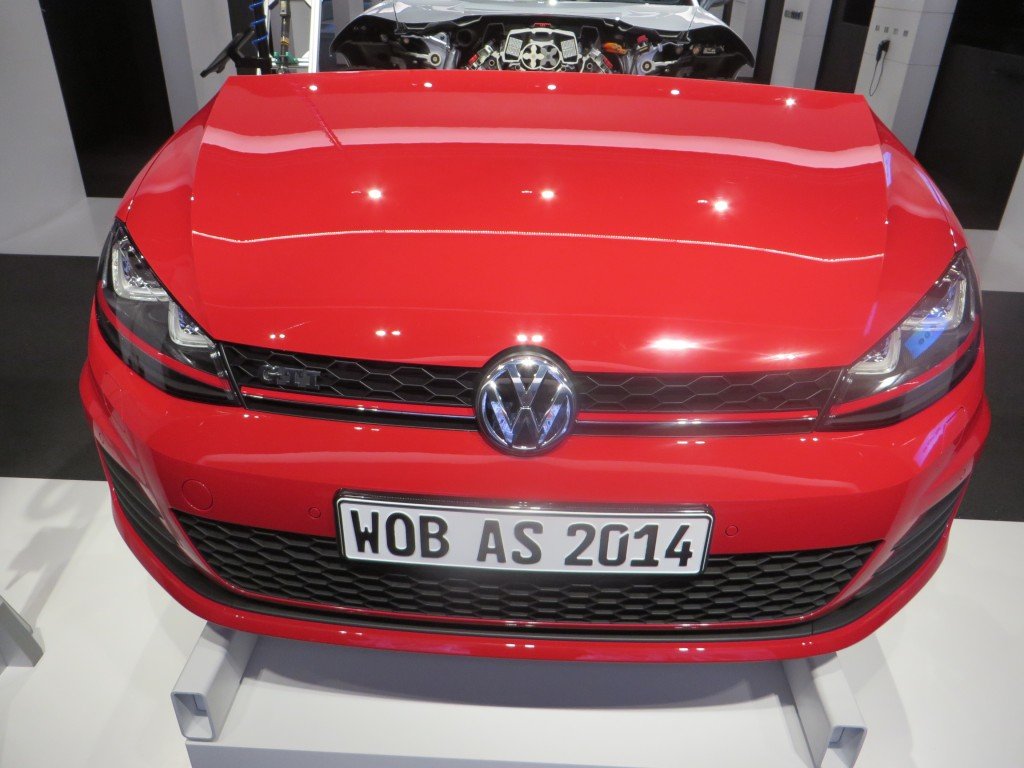
Obama also promoted the USA as a production location for European companies. Angela Merkel gladly took the opportunity to respond: “We love competition. But we also like to win,” replied the German Chancellor.
A challenge with a smile. In her speech, Merkel emphasized that cooperation is essential for the future of industrial production – in a transatlantic partnership. “We in the EU want to lead the way, together with the USA,” said the Chancellor, referring above all to the development of global communication and IT standards for integrated industry.
Germany has always been ahead in bringing up innovative technology and products to the market. Yet again the grand event being held at Germany has been doing great. Companies from all over the world have participated and presented their innovations.
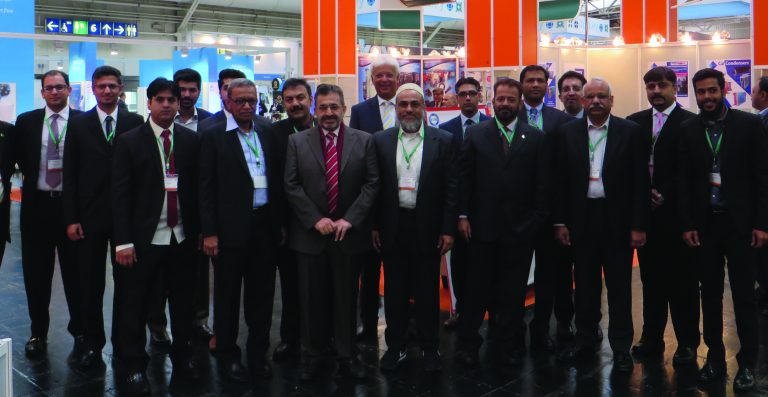
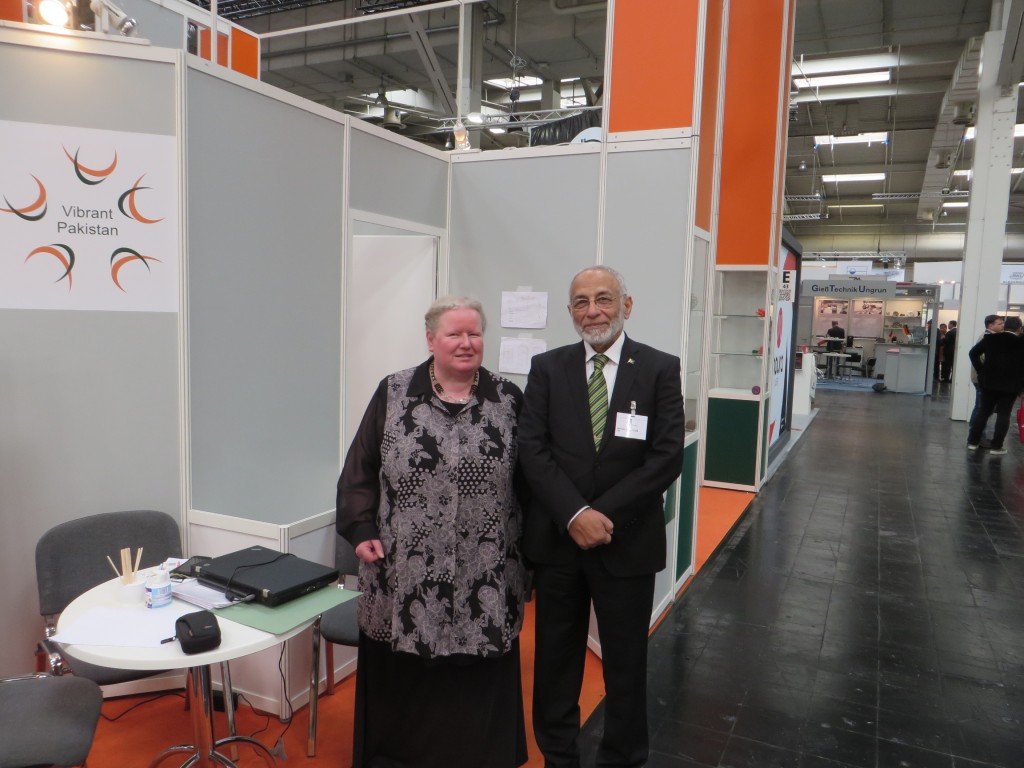
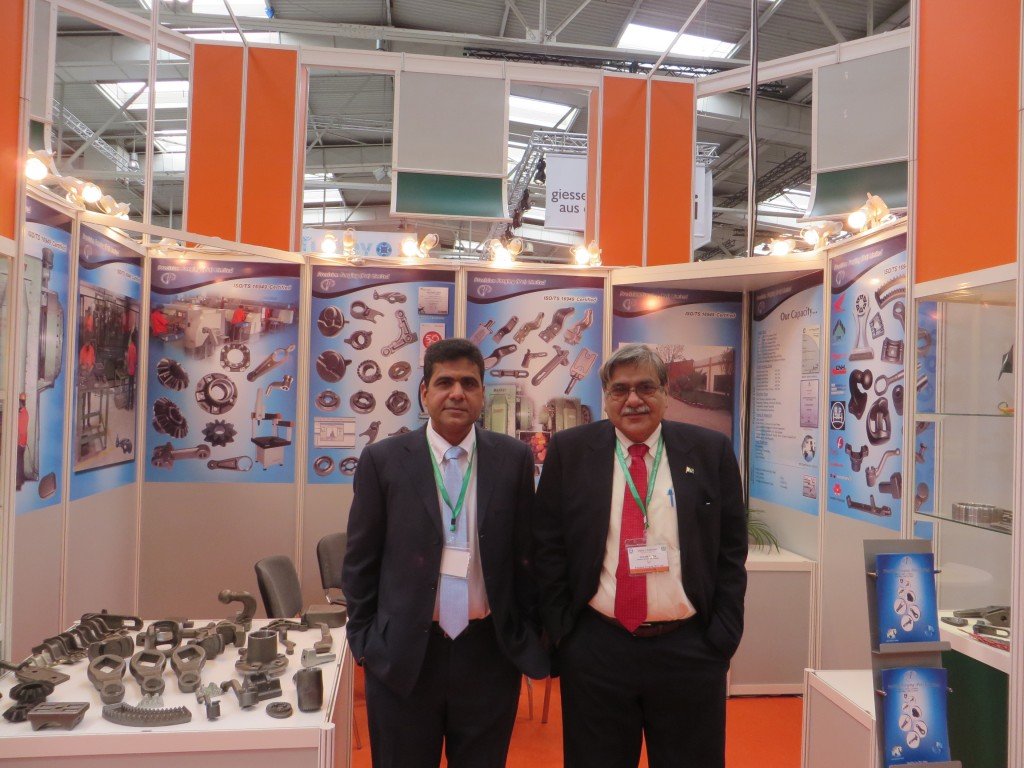
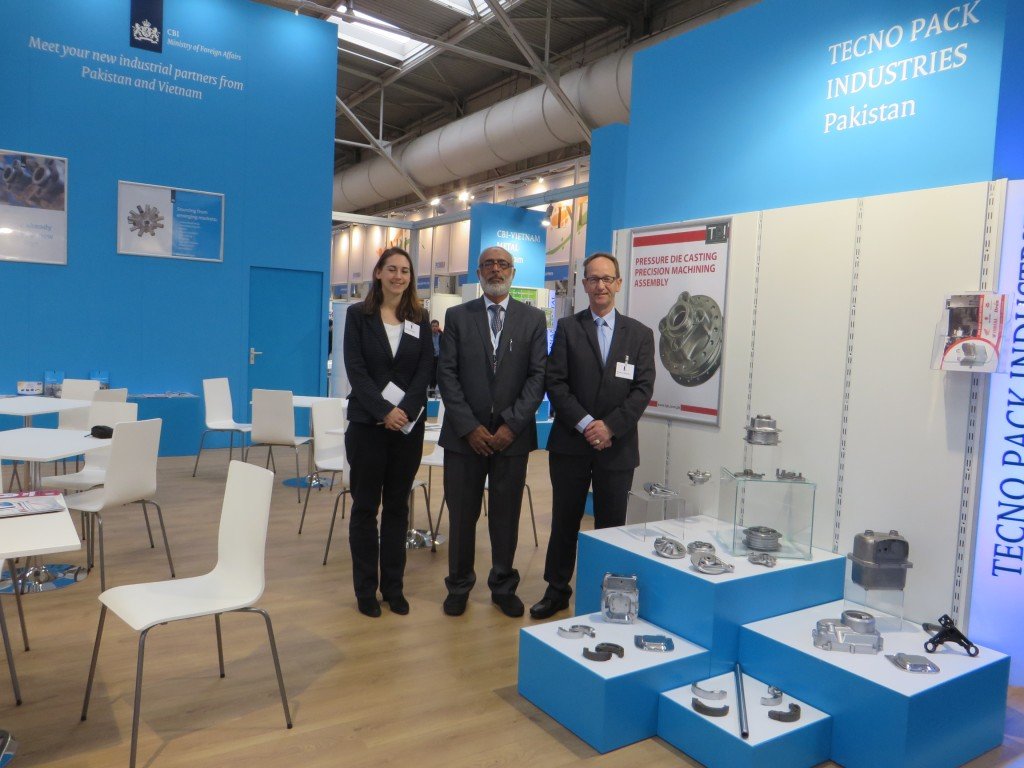
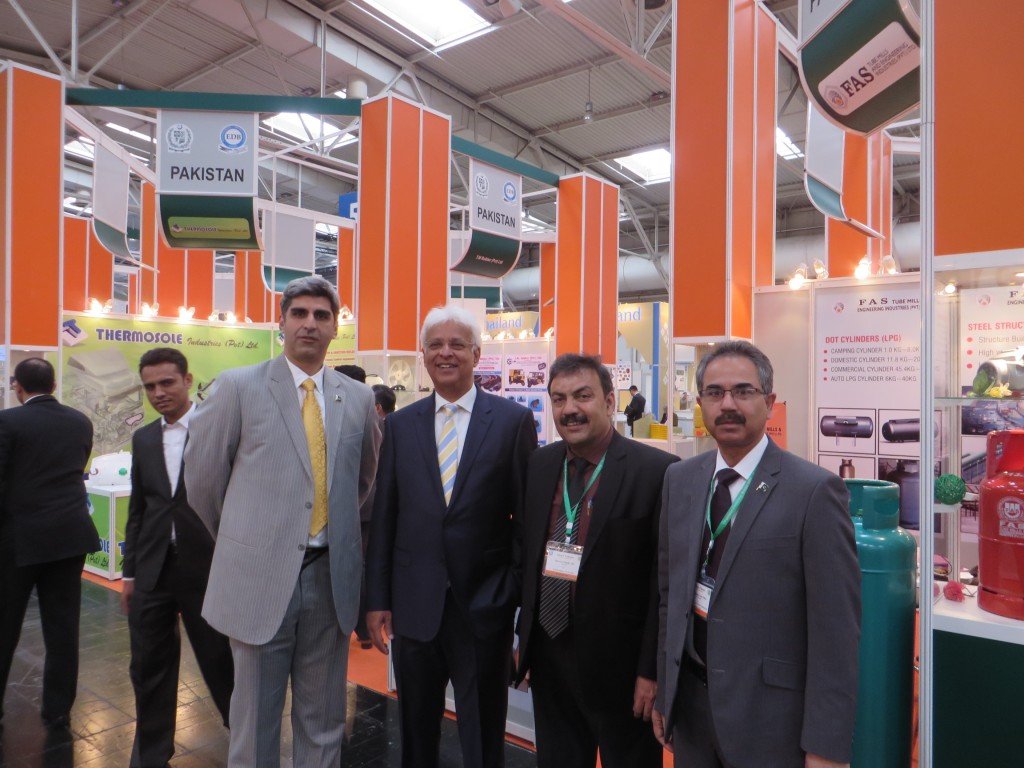
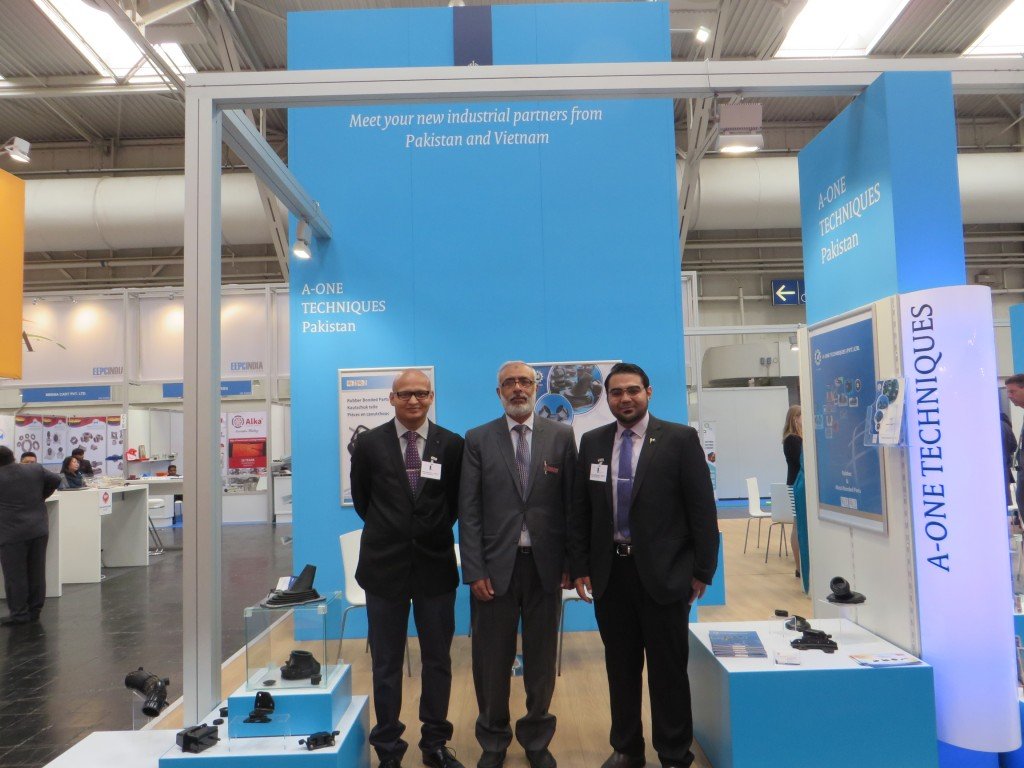
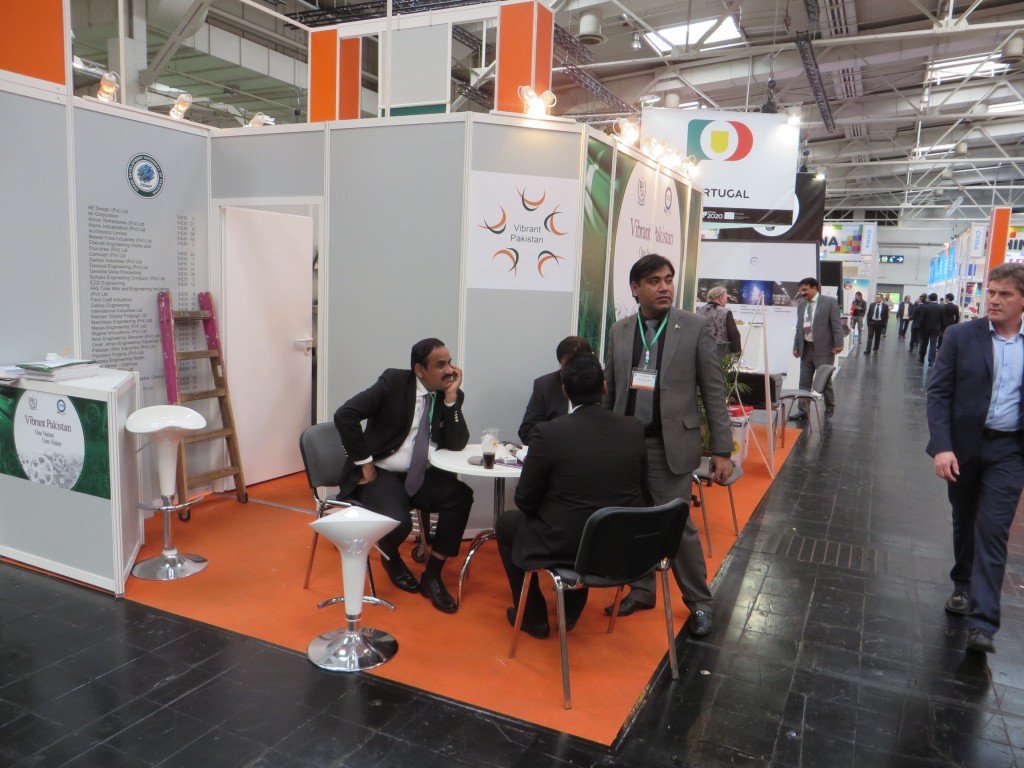
Pakistan is nowhere behind, the ministry of commerce made sure that Pakistan can present itself in the international fair of Germany. As many as 32 companies have participated in the fair from Pakistan and huge success is seen till date. The companies are named as; Omar Jibran Engineering Industries Ltd.,The General Tyre and Rubber company of Pakistan Ltd, AuVitronics Limited, Noor Engineering Services Ltd, Thal Engineering, International Industries Ltd, Dawood Engineering Ltd, Pakistan Wire Industries Ltd, EZZI Engineering, Galaxy Engineering, Western industries, FAS Tube Mills and Engineering Industries, Razzaq Engineering Works, Mughal Innovations Ltd, Mecas Engineering Ltd, Ali Tech (Pvt) Ltd., AlNoor Refractories Ltd, T.M Rubber Ltd, Matchless Engineering, Breeze Frost Industries, AE Desing Ltd, Scon Valves, Dendrite Metal Processing, Chenab Engineering Works and Foundries Ltd, Alpine Industriaicon Ltd, Darson Industries, Eehabs Engineering Company Ltd, Fibre Craft Industries, Thermosole Industries ltd, Precision Forging ltd, Mistequay International, NES Enineering and last but not the least Concept Ltd, while Technopack Industries and A-One Technique were participate under umbrella of CBI pavilion.
Participating such event is very good for a country and it presents the image of the country. Pakistani companies had been missing this event since the last 8 years due to no funds and motivation. The government this time made sure that Pakistan can represent itself too.
Such global events being held should be a benchmark for Pakistan and the government should learn and try to organize such events in Pakistan as well. The reason why events like Hannover Messe are important for Pakistan is that each and every company is going to benefit from it. There will be recognition of local companies all around the globe which is going to increase the economic situation of the country itself because of international demand and more exports.
The feedback received from Pakistani companies present at the event is positive and the companies are motivated to meet the international demand and increase their services as much as possible. All in all it is a good step taken which is eventually going to benefit Pakistan itself.
Feedback from Pakistani Exhibitors was recorded by Editor-in-Chief of Automark, Mr. Hanif Memon as he were also attended the ongoing event. He received feedback was positive and the exhibitors were very motivated. Pakistani companies are looking forward to participate in such events in future as well. It can be said that holding such technical fair is easy for Germany because technological and engineering industry accounts for major earning in their economy where as on the other hand Pakistan lacks in excelling in both industries. Exhibitions related to agriculture can be held in Pakistan where different countries can be invited who have agriculture based economy to learn and share their experience.
Pakistani firms to participate Hannover Messe-2016 fair in Germany
After the gap of eight long years, the Engineering Development Board (EDB) is preparing Pakistan to become the part of this event. The finances are going to be raised by ministry of commerce through export development funds. A group of 15-20 delegates from leading technical universities is going to accompany the delegation. Monthly AutoMark magazine’s editor-in-chief also going to attend this year’s fair.
As many as 32 prominent engineering product exporters from Pakistan will participate in Hannover Messe, the world’s largest fair of industrial products. The event is going to be held in Hannover, Germany from April 25th to29th 2016.
An official of Ministry of Commerce said: “About 5000 exhibitor from across the world will be showcasing their latest technologies for factories and energy systems at the exhibition;The setting up of the Pakistan pavilion after a long hiatus at the world’s largest industrial fair is a step in the right direction,”
“While 34% of the international trade is in engineering goods, Pakistan’s export of engineering products is barely 1% of total exports of the country,” he said. “On the other hand, textiles constitute around 56% of Pakistan’s exports but its share in international trade is only 4%.”
Attending such events for Pakistan is important to boost its exports and participating in such events has been a priority in the strategic policy framework 2015-18. With the increase in the current situation of the country the government of Pakistan should held such programs in our own homeland and invite delegations and companies from all around the globe to visit and showcase their technology. Also this can be an excellent opportunity for other countries to have a look at the highly potential market of Pakistan. The Pakistani market has tremendous amounts of potential and majority of the market is untapped which should surely be an incentive for companies because of good profit margins.
Twin Earthquakes Force Toyota to Suspend Production, Disrupt Manufacturing Across Japan
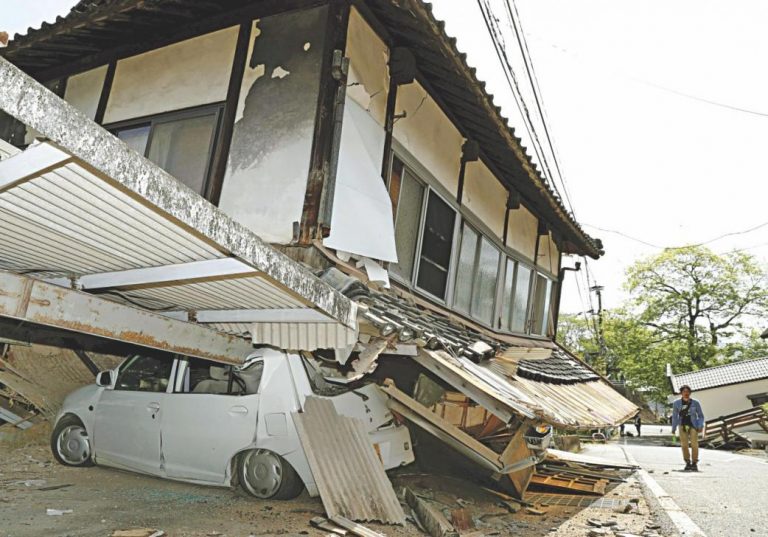
The twin earthquakes that struck southern Japan were having ripple effects far beyond the disaster zone, forcing Toyota to suspend production at most of its factories across the country, and affecting other manufacturers as well.
The quake damaged Honda’s motorcycle plant in Kumamoto, the largest city affected by the two quakes that hit late Thursday and early Saturday, killing at least 42 people. Japan’s Nikkei 225 stock index tumbled more than 3 percent Monday in part on worries over quake repercussions as well as a spike in the yen and a drop in oil prices.
But the economic impact is nowhere near as large as the havoc wreaked by the 2011 quake and tsunami disasters, which slammed supply chains so badly that Japanese automakers’ production was halted even in the U.S. They learned the hard way about their vulnerability to such interruptions, especially from second- and third-tier suppliers, and have worked to create contingency plans.
Disasters tend to hobble Japan’s mighty manufacturers because they are supported by small machine shops that provide components to bigger suppliers, which in turn supply bigger players.
“That kind of lesson has been learned,” said Nissan Motor Co. spokesman Dion Corbett. “We now have maps that show where exactly the suppliers are.”
Nissan’s two plants in Kyushu were temporarily shut down after the quakes for checkups. The checks found damage was minor, allowing the plants to be resume operations on Monday, Corbett said.
Some of the worst-affected areas are deep in the mountains surrounding Mount Aso, Japan’s largest active volcano, an area renowned for dairy farming. But one of the hardest-hit cities was Mashiki, a center for semiconductor fabrication and other manufacturing.
Sony Corp. said its sensor and device plant in Kumamoto was closed. Although the building’s structure was intact and no employees were injured, the precise nature of the production processes requires that delicately calibrated equipment must be checked carefully.
“The impact to near-term economic activity looks inevitable, while the comprehensive picture is difficult to gauge now, particularly due to the continued aftershocks,” Masamichi Adachi of J.P. Morgan said in a commentary.
Overall, the risk to the outlook for growth is “to the downside,” he said.
In trading Monday, Toyota’s shares lost 4.8 percent, Nissan lost 2.8 percent and Sony shed 6.8 percent.
Renesas Electronics Corp.’s computer chip plant in Kumamoto city was also shuttered, spokeswoman Makie Uehara said. It was unclear when production would resume. Gases that can be dangerous are used to maintain antiseptic conditions for chip production, and so safety had to be confirmed before other damage could be checked.
Toyota Motor Corp., the most heavily affected of the big car makers, has stopped production not only at a factory in Kyushu but at 15 others in Japan through Friday. Output will resume depending on the availability of parts.
Toyota’s Japan output will drop by 50,000 vehicles in April, or about 7 percent of Japan production, according to a report on the quake’s effects on automakers by SMBC Nikko. Toyota declined to comment on that estimate.
Critically affected parts include door frames, door hinges and cast-aluminum engine parts, said Toyota spokesman Itsuki Kurosu. The maker of the Camry sedan, Prius hybrid and Lexus luxury models was working hard to get substitute parts, he said.
Honda Motor Corp.’s motorcycle plant was severely damaged. Due to repeated aftershocks, it was unsafe even to go inside to carefully inspect the damage, said company spokesman Teruhiko Tatebe. Production has been stopped until at least Friday.
So far, production at Honda’s auto plants has not been affected, Tatebe said. The company did not rule out future supply problems.