Home Blog Page 49

First train from China to Europe makes ‘Silk Railway’ dream come true in Turkey

Turkey and the world witnessed a historic moment on Wednesday as Ankara welcomed and sent off the first train that departed China and for Europe passing below the Bosporus via Istanbul’s Marmaray tunnel for the first time, marking the realization of the “Silk Railway” dream.

China’s Railway Express will directly connect Czech Republic’s Prague to Xian, the capital city of Shaanxi Province in central China, via Turkey.

The real Silk Road was an active trade route used between the 2 B.C. and the 18th century that connected China and Europe through Anatolia and the Mediterranean region.

Within the scope of the Belt and Road Initiative (BRI), which aims to connect Asia, Africa and Europe via roads and sea lanes, the railway will reduce freight transportation time between China and Turkey from one month to 12 days thanks to the Baku-Tbilisi-Kars (BTK) railway line, while the whole route between the Far East and Western Europe will take 18 days with the integration of the Marmaray tunnel, said Transportation and Infrastructure Minister Cahit Turhan at the welcoming and sendoff ceremony at the historic Ankara Train Station on Wednesday.

“Considering the $21-trillion trade volume between Asia and Europe, the importance of the issue will be easily understood. The Iron Silk Road line, which benefits a population of nearly 5 billion and 60 countries, has become a new and a very important alternative for the global commercial network,” Turhan stressed.

The minister pointed to the geostrategic and geopolitical importance of Turkey, which connects three continents to each other. Turkey, which is an Asian, European, Balkan, Caucasus, Middle East, Mediterranean and Black Sea country with its geographic location and historical and cultural continuity, holds an important role in the economic and social development of the geographies, Turhan stressed.

The first freight train from China entered Turkey via the eastern province of Kars on Sunday, Nov. 3 after it traveled through Kazakhstan, Azerbaijan and Georgia. It then passed through the Turkish towns and cities of Ahılkelek, Kars, Erzurum, Erzincan, Sivas, Kayseri, Kırıkkale, Ankara, Eskişehir, Kocaeli, Istanbul’s Marmaray tunnel and Kapıkule in Edirne.

Turhan emphasized that the country established uninterrupted and high-quality transportation infrastructures between continents by establishing a wide variety of transport links as well as corridors in recent years to further strengthen Turkey’s current position.

“With an investment of nearly $754 billion, we have strengthened our transportation and communication infrastructure and completion of the missing links on international transportation routes was among our priorities,” the minister underscored.

On the basis of cooperation between Turkey, Azerbaijan and Georgia within the scope of the Belt and Road Initiative, the Baku-Tbilisi-Kars (BTK) railway line established a freight and passenger link between Europe and China and was launched in October 2017.

Providing the shortest rail link between Europe and Asia, the BTK plays an important role in the implementation of the initiative.

Turhan said China Railway Express, which made its first trip via the BTK line has given new direction to the global rail transportation.

With the said line, the minister stressed Turkey has become the most important connecting point of the Middle Corridor stretching from Beijing to London and the Iron Silk Road that extends from Kazakhstan to Turkey.

The minister said that the China Railway Express, carrying a freight of electronic goods equal to the load of 42 trucks, will make 11,483 kilometers in 12 days, starting from Xian in China and passing through two continents and seas and 10 countries with 820-meter-long 42 containers.

Carrying the freight through Baku-Tbilisi-Kars railway and Marmaray saves time and energy compared to other corridors. “This is a historic moment for global and regional trade. This train symbolizes the beginning of a new era in railway transportation,” Turhan remarked.

NEW COOPERATION ON HORIZON

Kazakhstan National Railway Head Sauat Mynbaev also remarked that the project reinforces the connection between Asia and Europe and stressed that the “One Belt, One Road” project will result in further development of freight transportation.

Azerbaijan’s Deputy Economy Minister Niyazi Seferov also pointed out that the China Railway Express is the first train to cross under the Istanbul strait. “The train will contribute to the friendly dialogue among the countries through which it passes,” Seferov said.

Shaanxi Regional Party Committee Secretary Hu Heping also emphasized that the Chinese freight train contributes to enhancing the economic and commercial dialogue among Eurasian countries. “I believe that the train will expand cooperation among the regional countries,” he remarked.

Turkish State Railways Transportation, ADY Konteyner, Georgia Railways Logistics Terminals, KTZ Express Pacific Eurasia, Xian International Trade and Logistics Park and Xian Intercontinental Bridge International Logistics, signed a protocol on the quality development of the Trans-Caspian route of the China Railways Express.

Courtesy: Daily Sabah


Airlift Secures $12M Series A Financing

Airlift was born in April 2019, with a vision to build a decentralized mass transit system—one that enables the use of higher-capacity vehicles, as opposed to single-car ownership and usage. The core belief is that this makes urban commute more efficient, while reducing traffic volume and carbon emissions in the increasingly congested, polluted cities of South Asia. The team are also driven by the mission of making daily commute safer and hassle-free for vulnerable groups like women, whose lack of mobility inhibits their economic and social participation.

With tens of thousands of daily commuters now relying on Airlift, they are excited to announce having secured $12M Series A financing, led by First Round Capital, a New York based venture capital firm, that has previously invested in companies like Uber and Square. This is not only First Round’s first investment outside the US, but also the first time that a leading US fund has invested in Pakistan. They are grateful to have played a role in this, and hope this signals a spurt for the country’s startup ecosystem.

In the wake of this financing round, they look forward to expanding our current team of 25, as well as scaling our network of buses and vans beyond Lahore and Karachi. This is also the right time for us to actively seek out exceptional teammates, and to invite their customers’ and fellow Pakistanis’ ideas and feedback. They are here to listen, adapt, and deliver! Their team would love to hear your thoughts about cities we should go to next, additional services we should provide, or other ways in which Airlift can make your commute easier. You can reach them at [email protected].

The Series A financing marks a key milestone in their vision for a progressive Pakistan – a Pakistan in which daily commute is neither unsafe nor a struggle, a Pakistan that is a profitable prospect for foreign investors, a Pakistan that provides exciting, meaningful work opportunities for young people, and a Pakistan that supports and enables ambitious entrepreneurs with a global vision. This has been, and continues to be, the vision of their founding team (Ahmed AyubAwaab KhakwanyMuhammad OwaisMeher Farrukh and Zohaib Ali).

Airlift is built in Pakistan, for Pakistan, and by Pakistan.

Courtesy: Linkedin

Yamaha Announces 2020 Carryover Models

Not every model needs a complete makeover every year, and today, Yamaha released the information about its 2020 carryover models. Here, you’ll find three classes of motorcycles. First, the Touring models of adventure and sport persuasions. Then we get Yamaha’s Hypernakeds. Finally, the Sports Heritage models for you Faster Sons (and Daughters) out there. 

For riders who like to travel long distances on both pavement and off-road, the Super Ténéré ES and it’s 270-degree crank-driven 1199cc parallel-Twin has you covered. The ES in the nomenclature points to the electronic suspension that is easily tunable. The big Ténéré also comes with electronic rider aids, a low-maintenance shaft drive, and an adjustable seat/windshield to complement the multipurpose riding position. Available in December 2019 for $16,299 in a Ceramic Ice color scheme.

How much do we like the Yamaha Tracer 900 GT? How about enough to ride one over 1,000 miles in one day on the way home from the introduction. The 847cc Triple offers a great combination of torque for highway cruising or thrilling acceleration when the road gets twisty. You get the features you need for long days in the saddle: electronic rider aids, adjustable suspension, QSS, a height-adjustable windshield, an adjustable rider seat height, and integrated side cases. The 4.8-gallon tank allows for a good distance between fuel stops. The 2020 color combination is Matte Raven Black/Reddish Copper. The Yamaha Tracer 900 GT will be available in December 2019 for an MSRP of  $12,999.

Picture yourself cruising down the highway or arcing through the corners on Yamaha’s biggest sport tourer, the FJR1300ES. The 1298cc inline-Four is singing in the powerband, and all is right in the world. Being made for travel means that the FJR comes with tuneable electronic suspension, electronic rider aids, lean angle-sensitive LED cornering headlights, an electronically-adjustable windscreen, adjustable handlebars, an adjustable rider seat height, integrated quick-release side cases, heated handlebar grips, and a 6.6-gallon fuel tank. The 2020 models arrive in showrooms in December 2019 for $17,999 in a Liquid Graphite color scheme.

With the popular MT-07, Yamaha’s approach is that if it ain’t broke don’t fix it. So, for 2020 the torquey 689cc parallel-Twin gets nothing new except color choices. And that’s not a bad thing with its narrow, lightweight design and fun-to-ride performance. 2020 models will begin arriving at dealers this month. The color choices will be Ice Fluo, Team Yamaha Blue, and Matte Raven Black with an MSRP of $7,599.

Aggressively styled and powered by an 847cc Triple, the MT-09 has been turning heads since its introduction. The sporty chassis features an adjustable suspension and comfortable ergonomics – whether you’re commuting or straightening out a winding road on the weekend. Also available in November 2019 from your local Yamaha dealer, the MT-09 will carry an MSRP of $8,999 and be available in Ice Fluo, Team Yamaha Blue, and Matte Raven Black.

What can be said about a bike with an engine derived from the flagship R1 sportbike? With tuning designed more for the street and with rider aids to back it up, torque is the main dish that is served with a heaping helping of top-end horsepower. Add in the MT-10’s aggressive styling, lightweight and responsive chassis, and adjustable suspension, and you’ve got a ticket to good times. Showing up at dealers this month, the 2020 Yamaha MT-10 will be available in Ice Fluo and Matte Raven Black color schemes for an MSRP of $12,999.

Modern classic styling certainly isn’t dull when you wrap it around a cross-plane concept 689cc parallel-Twin. Harkening back to Yamaha’s XS series of motorcycles, the XSR700 brings the aesthetic into the 21st Century with features like fuel injection, a sporty chassis with modern suspension, powerful braking with ABS, and LCD instrumentation. The 2020 Yamaha XSR700 will arrive in February 2020 in Radical White/Rapid Red livery for an MSRP of $8,499.

That cross-plane crankshaft concept 847cc makes another appearance in the XSR900, bringing performance to a motorcycle with neo-retro styling. While retro touches appear throughout – just look at the single-piece stepped seat, teardrop mirrors, and headlight and front fender that feature aluminum stays – the bike is thoroughly modern, with adjustable suspension front and rear, powerful braking with ABS, an assist-and-slipper clutch, and electronic rider aids that include traction control and D-MODE selectable throttle response. Get yours in November 2019 for an MSRP of $9,499 in Radical White/Rapid Red.

Courtesy: Motorcycle.com


Toyota efficiently moving towards providing greener options in its Hybrid cars in Indonesia

Car manufacturers in Indonesia are showing a shift in trend, moving increasingly toward producing more environmentally friendly vehicles, following the issuance of Presidential Regulation No. 55/2019 on accelerating the electric motor vehicle program.

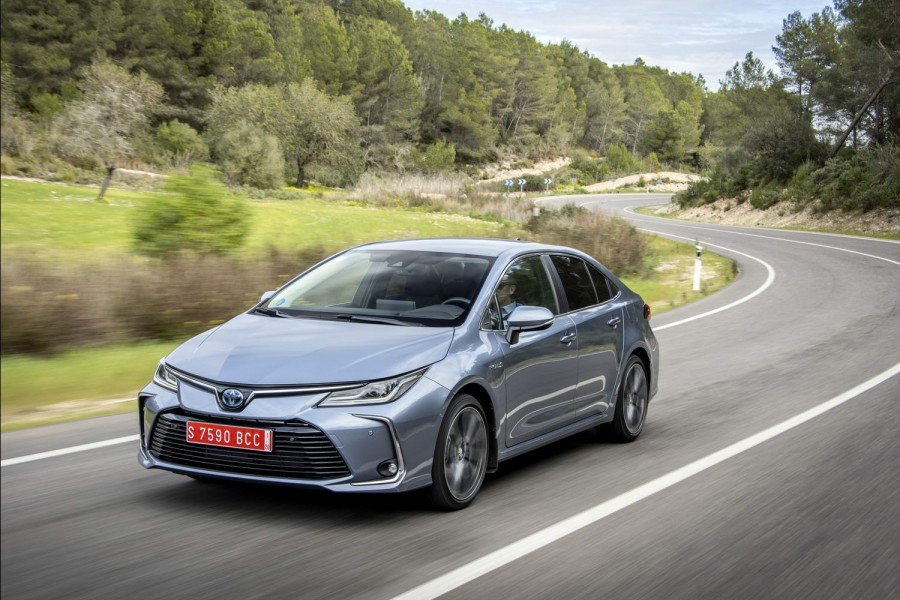
One carmaker ready to comply with the regulation is Toyota, which is offering two types of electric cars in the country: the Hybrid Electric Vehicle (HEV) and the Plug-In Hybrid Electric Vehicle (PHEV).

The HEV has two engines: one that uses gasoline and an electric motor that is powered by a battery. The two engines combine to achieve optimum fuel efficiency, and the vehicle can rely solely on the battery-powered engine if the gasoline engine stalls. This battery stores the kinetic energy it captures from braking and is also powered by the gasoline engine.

Toyota’s HEV models already in distribution in Indonesia include the Camry Hybrid, the Alphard Hybrid, the Altis Hybrid, the CHR Hybrid and the Prius Hybrid.

The PHEV is also a hybrid vehicle that contains both a gasoline and an electric engine, but the difference is that it has a battery that can be recharged by external power sources like charging stations as well as home and office electrical outlets. The PHEV operates primarily on the electrical engine, with the gasoline engine taking over when the battery is depleted.

While luxury carmakers BMW and Mercedes-Benz are already selling their PHEV cars in Indonesia, Toyota has started manufacturing its PHEV cars, like the Prius PHEV, but is still studying the Indonesian market before selling them.

HEV cars are currently the best choice for environmentally conscious customers interested in heading down the road to the electric car era, because they combine an electric motor with a conventional fuel-powered engine.

This hybrid system has the zero-emission advantage of the electric engine that is supported by a fuel-saving conventional engine and does not depend on the battery capacity, because the HEV battery is charged by the conventional engine. Their cruising range is also the same as that of conventional cars, because the battery is internally charged.

In addition, these hybrid cars are practical, as they still rely on gas stations the way conventional cars do. As a bonus, they are more soundproof.

With their practicality and ease of use, HEV cars are expected to enjoy smooth entry to the Indonesian market.

The Jakarta Post was recently invited by distributor Toyota-Astra Motors ​​​​to test drive four of its HEV cars (Alphard Hybrid e-Four, Camry Hybrid, CHR Hybrid, Corolla Altis Hybrid) and one PHEV, the Prius Plug-in Hybrid, on Oct. 9 to 11 from Banyuwangi, East Java, to Denpasar, Bali. The route passed through Baluran National Park before taking a one-hour ferry crossing from Ketapang Port in Banyuwangi to Gilimanuk Port on Bali.

The test drive offered two distinct points, with the first being fuel consumption.

Fuel consumption data from Toyota-Astra Motor are as follows; Toyota C-HR can run up to 28 kilometers per liter of fuel, Toyota Corolla Altis 26 kilometers, Toyota Camry Hybrid 18.4 kilometers, Toyota Alphard Hybrid e-Four 15 kilometers, and Toyota Prius Plug-In Hybrid Electric Vehicle 55 kilometers.

Interestingly, none of the cars were refueled to full along the 380 km journey, meaning that they saved a lot more fuel and were more environmentally friendly than conventional cars.

The second noticeable point was that all of Toyota’s HEV models come with four driving modes, so drivers can choose the mode that best matches their character: Normal, ECO, Sport and EV.

Normal mode is certainly as named and nothing special, but in ECO mode, the vehicle’s computer – or electronic control unit (ECU) – operates gentler acceleration.

Sport mode displays the engine’s power and accommodates more aggressive maneuvers, while EV mode is relatively silent, since the vehicle switches to the electric motor.

The Gilimanuk-Singaraja-Tabanan highway offered a smooth asphalt road that climbed through mountainous areas and descended in sharp bends as far as Jimbaran, and the test drive ended successfully in Denpasar.

The journey proved the reliability of Toyota’s HEV and PHEV cars and their undoubted performance, handling and power, but the Prius PHEV definitely trumped the others.

The Prius has the advantage of its greater battery capacity of 8.8 kWh, and the battery can be fully charged in about two hours using common household electrical outlets. This means the Prius can travel farther in EV mode at the fairly high torque typical of electric engines, so it was the most comfortable to drive.

In EV mode, the Prius can travel as far as 60 km starting with a full battery, depending on driving technique and road conditions. The range can diminish the more aggressive one drives and the more congested, damaged or winding the road is.

The switch to electric vehicles is just around the corner, but patience is still needed until all necessary supporting infrastructure are ready, like charging stations, to transition through hybrid vehicles to arrive at fully electric vehicles.

Courtesy: The Jakarta Post

Swvl plans to invest $25 million in Pakistan

Swvl, an app-based bus-hailing pioneer, has announced that it will be investing $25 million in Pakistan. The news comes over a month after the Dubai headquartered company further expanded into Pakistan and launched in Karachi.

The $25 million investment could rapidly change the way people commute in the 3 big cities of our country. By choosing a bus or a van, not only are people saving money but also have an affordable way to commute to their desired place. Swvl dubs itself as a convenient, reliable and affordable transport solution. It aims to revolutionize the way people in developing countries travel by running buses on fixed routes that users can book seats in through the Swvl app.

In an interview, Mostafa Kandil, Founder of Swvl, said about the investment:

“We have plans of mobilizing half a million Pakistanis by 2023 and creating 10K jobs a year. We are also planning to start an incubator to fund pre-seed startups to kickstart a healthy tech ecosystem in Pakistan. Moreover, the company plans to open an offshore support and engineering office in Pakistan.”

The plan to mobilize the citizens and the creation of over 10,000 jobs a year will have a great impact on our economy. This planned investment shows the impact of startups in our ecosystem and how they can help in improving the overall lifestyle of our country and create new opportunities.

The global mobility leader in mass transit space launched in Nairobi over six months ago and started its operations in Lahore in July this year. Pakistan is the second international market for the company and according to sources, half of its employees are Pakistanis. It is the first startup in the mass transit space to launch in all three metropolitan cities; Karachi, Lahore, and Islamabad.

The bus hailing service aims to enable women to reclaim public space, mobilize people and do their part in moving Pakistan forward. The investment will further revolutionize the transportation scene in the country by providing a perfect option to commute with convenience at an amazing price.

Courtesy: Techjuice

New auto entrants cautiously optimistic over their investment projects

Rising project cost, economic slowdown, budgetary measures FY20, falling rupee

The auto market is now facing aftershocks of the Auto Development Policy (ADP) 2016-2021, though it was certainly a pro-industry policy by the PML-N government to promote new players and open new job avenues in the country.
New entrants are either considering pulling back from Pakistan or putting on hold development work due to rising project cost in view of eroding rupee value against the dollar.

The Auto Policy was announced by the PML-N government to lure European, Chinese and Korean investors to break the monopoly of three Japanese assemblers mainly.

Everything was going smooth till April 2019. Suddenly, some shocking news had started making newspapers’ headlines from May that new entrants were perturbed over economic slowdown followed by more concerned over rupee depreciation against the dollar, taking their project cost to new peak.

Currently one dollar is equal to Rs 156 in the inter bank market which was Rs 110 on January 1, 2018 and reached to Rs 123 when PTI government came into power from August 17, 2018. Two months back, one dollar was trading at Rs 160.

The rest of the damage was done by Budgetary measures FY20 like imposition of federal excise duty (FED) of 2.5-7.5 per cent on locally assembled cars of different engine power followed by seven per cent additional customs duty and three per cent additional sales tax on all imports that jacked up input costs, resulting in massive price hike in locally assembled cars amid claim of higher localization.

In addition to above taxes and duties, increase in interest rates had further shaken the confidence of buyers. The local industry believes that the government takes away 40 per cent in terms of taxes and levies on a total retail price of locally assembled car.

The above anti business climate has definitely caused sleepless nights to the new entrants who had put up huge money for local assembly. Some entrants under the umbrella of well organized business groups like Kia (Yunus Brothers) and Hyundai (Nishat Group) had so far not sparked any anger over current business environment relating to the auto sector. However, Younus Brothers’ Lucky Cement CEO Mohammad Ali Tabba had blasted the government’s business policies recently, which are destroying business environment.

The first shock received by the auto market was reports of Al Futtaim pulling back from the Renault project but nothing concrete has so far come from the Gulf and French-based companies.

Market was also abuzz with reports that Renault has revoked Al-Futtaim’s license to build its manufacturing plant in Pakistan following which Al Futtaim decided to hold its investment in the venture.

Board of Investment, Al Ghazi Tractors’ Chief Executive, Shahid Hussain and Faisalabad Industrial Estate Development and Management Company (FIEDMC) had so far been playing safe by not coming out with any negative news in this regard. Lower and high salary staffs at Al Futtaim-Renault had already quit their jobs.

UAE’s Al Futtaim Group had purchased 67 acres of land at M-3 Industrial City in May last year to establish an assembly-cum-manufacturing plant at a cost of $165 million to produce and assemble Renault vehicles and create around 500 jobs.

However, the company has not started any construction work so far which is also evident from the absence of any project details in the website of FIEDMC. Besides, no details are available at worldwide site of Renault-Al Futtaim over Pakistan project.

There were reports that investors were demanding extension till 2,023 in Auto Policy which expires in 2,021. In addition to that, the investors were also seeking an extension of 10-year tax holiday under Special Economic Zone incentives.

Prime Minister Imran Khan was also apprised on the issues faced by Al Futtaim-Renault project. Prime Minister asked concerned departments to remove any bottlenecks at the government’s end to save the huge investment in auto sector.

In 2018, Al-Futtaim announced that the design and pre-engineering work of the project was underway, and on-site activities would commence shortly in Faisalabad. The company aimed project completion in the fourth quarter of 2018 and begin production by 2,020.

Surprisingly, French Senator Pascal Allizard, leading a three member French Parliamentary Group, during April 2019 said that Renault was keen to set up a manufacturing plant in Pakistan.

Soon after above development in May, Adviser to Prime Minister on Commerce and Industry Abdul Razak Dawood quickly assured full cooperation and support to Al Futtaim in resolving various issues in a bid to safeguard $165 million Al Futtaim-Renault investment.

With dark clouds already hovering over Al-Futtaim-Renault project, the auto market received another disturbing news from Ghandhara Nissan Limited (GNL) that has struggling to save “Datsun project in Pakistan.”

“Under economic conditions and uncertain exchange rates one cannot afford to go for a project of this magnitude especially with that level of uncertainty,” GNL said.

Apart from project related challenges, the local economic conditions, particularly the automobile market situation have compelled us to revisit project’s sustainability, GNL added.

Ghandhara, which had planned to invest Rs 6.5 billion in the next four years, has extended its production plan of Datsun by six months to first quarter of 2,021 besides reducing production target by 30 per cent from earlier plan of 50,000 vehicles in five years time, citing uncertain economic conditions, interest rates and vulnerable exchange rate. Market people see “50/50 chance of Datsun project.”

GNL had planned to start assembly of a 1,200cc Datsun Cross in July 2,020 and then rolling out the 1,200cc Datsun Go (five seater) and Datsun Go Plus (seven seater) in the next two to three months.

Sources said GNL had shelved its plan for rolling out Datsun vehicles amid negative reports over Nissan-Renault relations after financial misconduct by its chief Carlos Ghosan. However, GNL wants to avail the opportunity and incentives announced in ADP 2016-2021.

GNL had also planned to achieve 35-40 per cent localization in the next three years after initial start of 18pc.

The company had informed the Pakistan Stock Exchange that due to a substantial devaluation of Pak Rupee against the dollar, localization of parts has become mandatory to make the project viable. However, the technical evaluation study depicted that localization of some parts is either not possible or will take significant time and resources due to lack of technology and expertise in local market. Therefore, Nissan Motor Company (NML) has been exploring options to get these parts developed at a minimum cost by global vendors so that they can be imported as part of CKD.

At the same time, GNL is concerned that it has a limited time frame available to complete all the necessary requirements and start commercial production positively before June 30, 2,021 to avail the brownfield incentives for the new entrants.

Nevertheless, the teams of NML and GNL have been working day and night to address the above issues and hopefully will be able to address these challenges to launch our products within time as both the partners do not want to miss this opportunity of incentives for new entrants. Ultimately, GNL will be the biggest sufferer if it cannot meet the target dates as GNL has been working on this project since long utilizing all the resources including monetary investment as well as manpower.

This is Nissan’s second attempt in Pakistan as it had assembled 599 Nissan Sunny in 1996-1997 but later production came to a halt in 2003-2004.

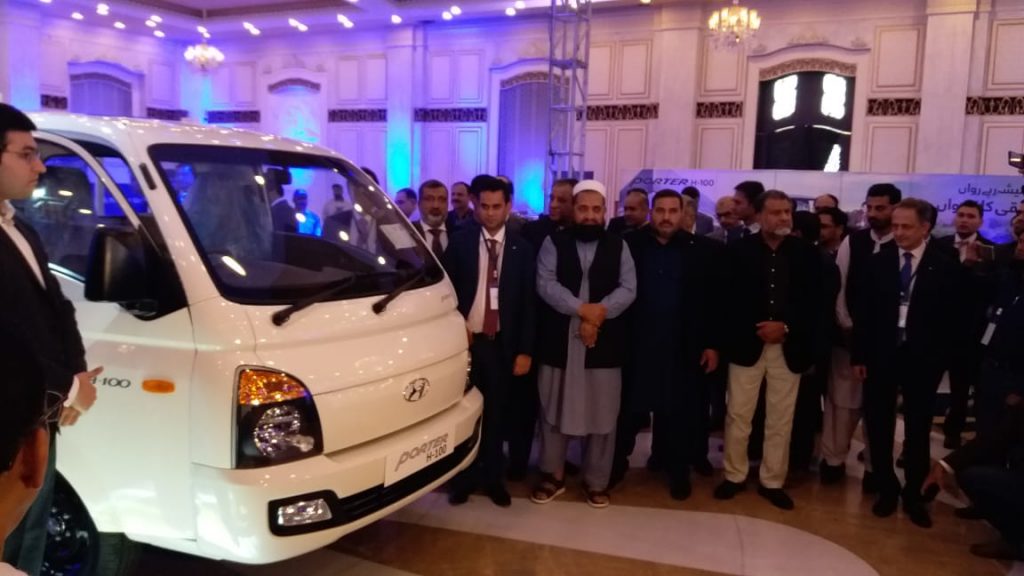
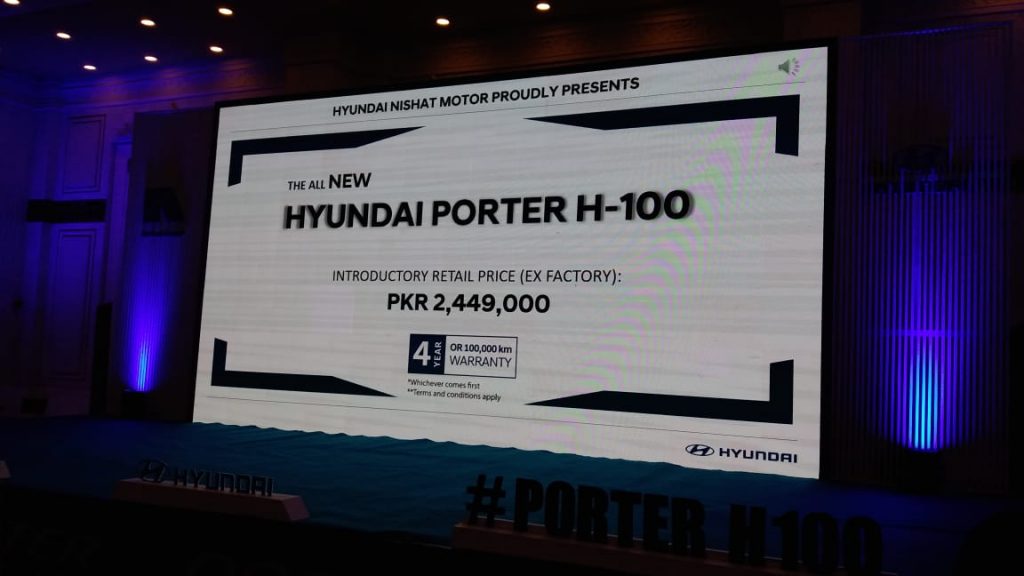
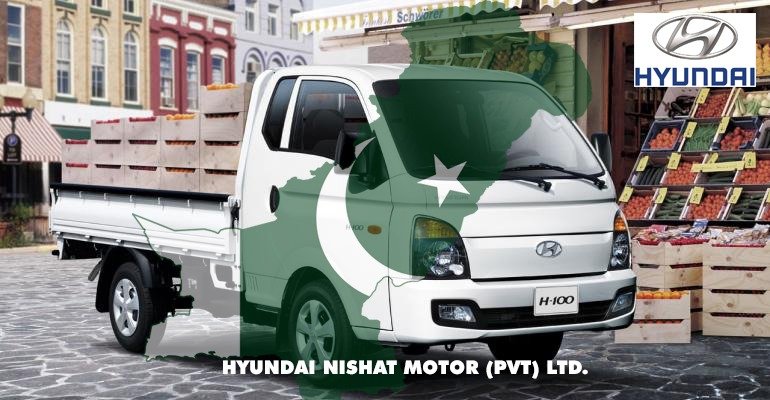
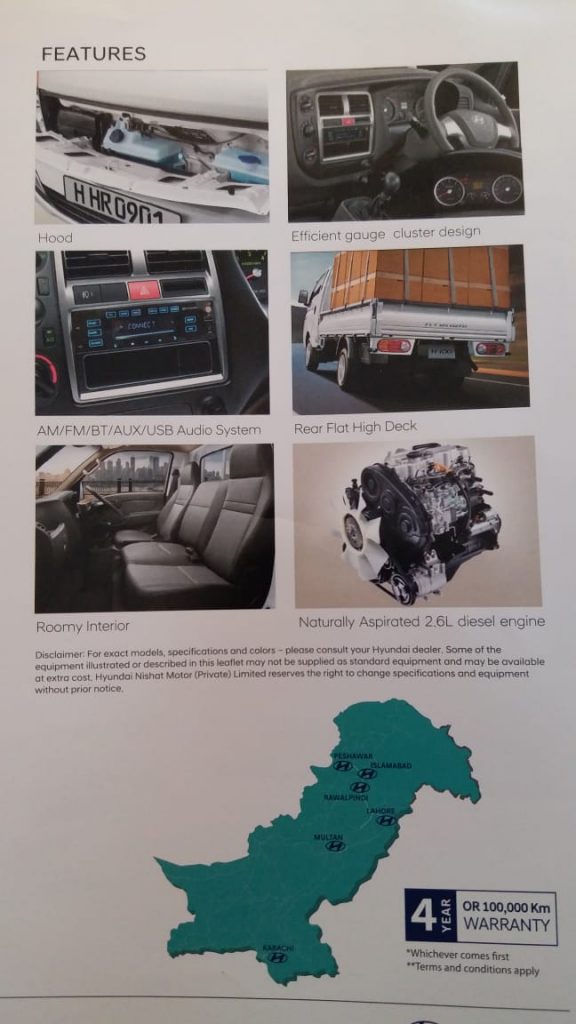
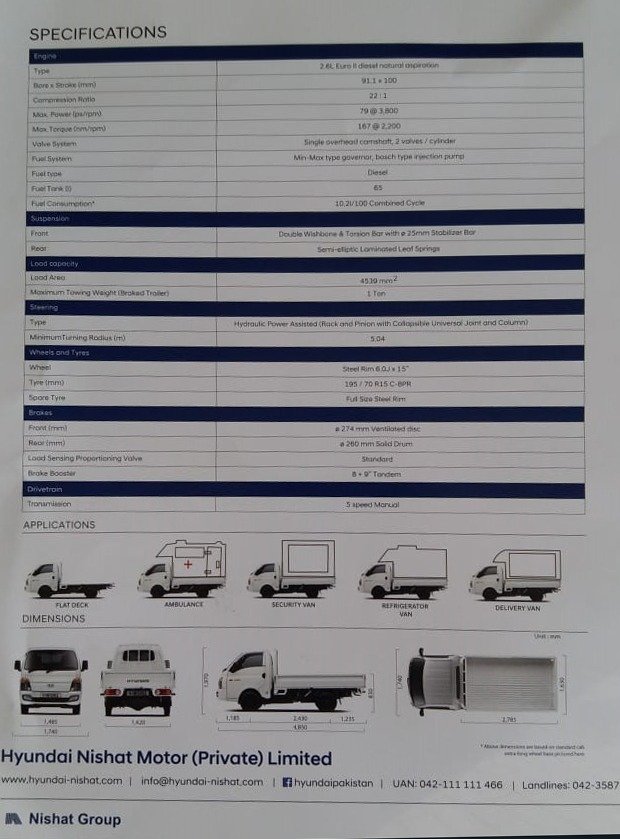
Amid bad weather, Hyundai Nishat Motors Private Limited (HNMPL) in October came with a good news regarding start local assembly of Porter H100 pickup with 20 per cent indigenisation from January next year.

The company also opened its 3S dealer and digital showroom in the city and introduced Hyundai Ioniq Hybrid car. HNMPL Chief Operating Officer (COO) Tatsuya Sato said the total investment at the Faisalabad manufacturing facility is $150 million with an annual production capacity of up to 15,000 units. The plant will employ 250 people directly.

HNMPL – a joint venture company between Nishat Group, Sojitz Corporation (Japan) and Millat Tractors Limited – is partnering with Hyundai Motor Company (Korea) to become a leading manufacturer, marketer and distributor of automobiles in the country.

The COO said localisation level would be increased to 45 per cent in the next five years which would also open new job avenues.

Uncertain rupee-dollar parity has changed the project feasibility. “One dollar was equal to Rs105 when we initiated the project as compared to current rate of Rs156-158,” he said, adding that the rupee-dollar parity is also hitting existing assemblers despite achieving 65 per cent localisation. “Higher indigenisation in vehicles can stabilize prices on which we are focusing more,” he said.

Apart from IONIQ hybrid car, Grand Starex –MPV powered by a 2.4L petrol engine and SUV Santa Fe are being imported from Korea.

Hyundai is aggressively expanding its 3S dealer network all over Pakistan, and more 10 3S dealers are online to come up in 2019 in eight major cities of Pakistan as the 1st phase, and more nationwide from 2,020.

Kia Lucky Motors (KLM) has introduced locally assembled KIA Sportage and Picanto car and was happy of getting good consumers’ response, though the vehicles are seen in limited numbers on the roads. KLM, a leading Korean auto assembler at Bin Qasim Industrial Park (BQIP), has also taken a stay order from the Sindh High Court against the imposition of turnover tax. The action has opened the door for other investors to take the matter to the courts.

Kia’s plant has been set up an investment of $175 million with annual capacity of 50,000 vehicles. Current employment stands at around 475 people. Vendors are surprised as how Kia is surviving at BQIP which lacks any facilities and incentives.

Regal Automobile Industries has already established an assembly plant in collaboration with Chinese company DFSK Motor Co. Limited and now it plans to roll out and launch 800cc car as completely knocked down kits has been imported. The company has already imported few units in CBU condition for consumers’ response. Regal is also working on automatic transmission with its Korean engineering company.

United Motors in partnership with China’s Louyang Dahe has already launched 800cc car Bravo and now plans for assembly of automatic transmission. According to sources, the company may launch automatic version in the first quarter of 2020.

Khalid Mushtaq Motors under an agreement with China’s Chongqing Kuayue Group had set up an assembly plant in Nooriabad after getting permission from the Ministry of Industries and Production (MoIP) in the end of 2017. Market sources said the company is now looking for buyers to sale the plant at Rs 1.5 to Rs two billon. Chinese officials are still working at the project.

Sources in the auto sector said 70 per cent work at the plant like installation of jigs and fixtures and ED paint shop had already been completed at the five acre plant but the local investor is now searching a prospective buyer for the project. The company has planned to assemble light commercial vehicles and mini passenger vans. The company had imported around 40 commercial vehicles from China for testing the market potential before starting local assembly.

KMMPL had changed production plans twice from December 2017 but later decided to roll out commercial vehicle by the name of “Mushtaq” in October 2019. The plant had the capacity to assemble 100 vehicles per day.

When the MoIP had allowed KMMPL in December 2017 to set up assembly plant in Nooriabad, the company had estimated investment of Rs one billion but so far it had invested Rs 500 million.

No progress has been made so far by Pak China Motors, which had planned brand Lifan in collaboration with Chongqing Lifan.

The project of Foton JW Auto Pak in collaboration with Changsha Foton Vehicle Technology is going on with its Foton brand. However, the company is quite perturbed over falling sales owing to economic slowdown. However, the company is working on bus project but has yet to officially announce it.

Changan Master Motor has already purchased land in Multan and has imported few units of trucks. However, construction has not started yet.

Premier Motors Limited has already brought a land at Hub to produce Volkswagon commercial vehicles. Construction work has been started and local production may start next year.

Khalid and Khalid Holding had started construction and was planning to order equipment for producing heavy commercial vehicles by the name of Shacman. But market reports said that work has been stopped and the company has adopted wait and see attitude. The company has imported few buses.

There has been no progress on Ka Hangten Motor which had planned to assemble Hangten hybrid SUV at Faisalabad.

Reports are coming that Deahan Dewan Motor Compnay, which had planned SUV and light commercial vehicles in collaboration with Korea’s Ssang Yong has stopped activities.

Al Haj Motors has received Greenfield investment for assembly of Proton cars in Karachi. Recently, the Al Haj Automotive, an emerging conglomerate has signed a memorandum of understating (MoU) with Zhong Tong Bus Company of China.
Sources said the MoU has been singed for an initial 50 units of buses in CBU condition and there would be a technology transfer and CKD cooperation agreement between the two companies. Later they would also apply for Greenfield investment for assembly of bus in Karachi.

Enjoy a wonderful car life: JAC shines at the 2019 Macau Auto Show

On October 25th, the 9th China (Macau) International Automobile Expo kicked off at the Venetian Macao Convention and Exhibition Center in Macau. As the core strength of China’s self-owned vehicle brand, JAC debuted for ninth times constantly. This time, it took six star models to amaze the audience with the latest achievements of new energy, right-wheel “heavy”and “brand upgrading”products, aiming to bring global users a safer, smarter and more comfortable travel solutions to create a green and wonderful car life.

Differentiate to meet customer needs and share green and wonderful car life

In order to better protect the blue sky and embrace the green future, JAC continues to explore new technologies for energy conservation and environmental protection, creating a better green life for customers. At this auto show, JAC’s new energy products include commercial and passenger vehicles, to fully meet the green needs of different customer groups.

For customers with household needs, JAC has brought the latest model of its new energy passenger car, long battery life pure electric SUV—iEVS4. In terms of endurance, iEVS4 is the first pure electric vehicles in China to break through the endurance distance of 470km under the comprehensive driving conditions, and the maximum endurance range is up to 600km; in battery life, the maximum mileage of 1 million kilometers can be realized, which can completely cover the whole vehicle’s life cycle; in terms of safety performance, after 3 years and 1700 times simulated thermal runaway test development, the first breakthrough in the country was finished, from the five levels including the battery core, simple module, multi-string module, battery pack and the whole vehicle, the test forced trigger monomer thermal runaway to achieve that battery pack does not explode and fire, combined with the world’s leading new generation of liquid cooling and eliminate battery risks; in terms of quality improvement, through the joint production with JV, the adjustment by VW expert and the high quality obtained by the German Volkswagen VDA quality standards, iEVS4 provides users with a more comfortable travel solution. In terms of intelligent configuration, iEVS4 is equipped with a new generation of Internet of Vehicle 3.0 system, which truly realizes the deep dialogue between people and vehicles and it has new network functions like checking and booking a trip schedule, in addition to the traditional functions of voice control navigation, air conditioning, music, search, emergency rescue, etc., which make the travel life more exciting.

For customers with commercial needs, JAC brings its high-end electric truck-i5 electric light truck. It integrates the superior resources of the two domestic high-end R&D platforms of JAC light truck and JAC pure electric vehicle. The i5 electric light truck adopts lithium iron phosphate battery, which has the advantages of higher safety performance, longer life, better performance under low temperature, light weight and environmental protection. With permanent magnet synchronous engine, its peak power can reach 130kW, bringing the highest speed to over 90km/h, the 0-50km/h acceleration time less than 15s. It can support 180km driving disatance; 30% maximum climbing makes it easy to face with the test of various steep slopes; i5 uses honeycomb panels light-weight cargo with a volume of 14 cubic meters, which can meet the distribution of urban logistics feeders. i5 right-wheel electric light truck was showed in the exhibition, which will more specifically meet the needs of users in right-wheel vehicle countries and regions such as Hong Kong, Macao and Southeast Asia.

To balance the needs of customers for home and business, JAC has given a travel solution for the T8-EV pure electric pickup. The T8-EV is the latest masterpiece of JAC’s new energy commercial vehicle, combining the advantages of reliability, safety, economy and long distance mileage. The whole vehicle adopts the bird cage body structure design, and uses high-strength steel in 43% proportion. The structural strength of the body is designed according to the C-NCAP collision standard, and the super-strength front anti-collision beam and the side anti-collision beam are always protecting the vehicle. In terms of power, the vehicle is equipped with Guoxuan lithium iron phosphate battery with a power of 67.2kWh and a peak power of 110kW. The power does not lower than the traditional pickup, which can fully meet the transportation needs of the city. In the commercial needs, the T8-EV has outstanding applicability in dealing with municipal, construction, telecom power repair, logistics and transportation. For the out-of-home travel, the T8-EV has the comfort feature like a passenger car, the economy of an electric car and the load-bearing and dynamic feature of a truck, which can make users enjoy the “family happiness”.

Courtesy: Automotive World

4th-gen Honda Jazz unveiled at Tokyo Motor Show

Honda unveiled the fourth-generation Jazz at the Tokyo Motor Show earlier this month.

The new Jazz features a redesigned exterior with a new grille and headlights with integrated U-shaped LED daytime running lights. The car has blacked out B-pillars and quarter glasses at the front and rear. At the rear, the new Jazz has redesigned wraparound tail lights, shark fin antenna and bumper with integrated reflectors.

Honda has also updated the interior of the Jazz with a new 2-spoke, multi-function steering wheel and a digital instrument cluster. The car has dual-tone interiors with a touchscreen head-unit in the centre.

Honda hasn’t disclosed the powertrain options that will be offered in the new Jazz. However, a two-motor hybrid option is expected to be available in global markets.

Courtesy: Team-BHP.com

Honda Activa India sells nearly 1.4 million units in first-half FY2020

In H1 FY2020, nearly 1.4 million units (1,393,256) Activas were sold. But this is still 22% down on year-ago sales (1,786,687), due to the impact of the economic slowdown.

The Honda Activa, India’s best-selling scooter and also currently best-selling two-wheeler, has sold nearly 1.4 million units (1,393,256 units) in the April to September 2019 period. This number, in the first six months of the ongoing fiscal year, translates into 7,740 units every single day!

Sales of the Activa, which popularised gearless scooters in the country, contribute 14% to the domestic two-wheeler industry. This also means if its sales are impacted, as they are during the ongoing slowdown in the scooter market, then overall industry growth takes a hit. 

For the April-September 2019 period, the sales of 13,93,256 Activas are down a sizeable 22% year on year (H1 FY2019: 17,86,687), which is also reflected in the scooter segment’s H1 sales being down by 16.60% YoY, what with the Activa being the overwhelming market leader.

Once the darling of the two-wheeler world, the scooter segment has felt the hammer of the economic slowdown, particularly in rural India. In September 2019, total scooter sales fell by 16.60% to 555,829 units and in the April-September period, overall numbers were down similarly by 17% to 3,177,433 units.

The Honda Activa is to the scooter market what Maruti is to the passenger vehicle market: a mover and shaker. While the Activa remains the unassailable scooter market leader, its sales have slowed over the past year. The Activa is India’s No. 1 two-wheeler and scooter in September with sales of 248,939 units. This performance is better than August’s 234,279, July’s 243,605 or June’s 236,739, which means month on month, the Activa numbers are going up, albeit marginally. A clutch of new products is helping.

In end-May, Honda Motorcycle & Scooter India launched the Activa 5G Limited Edition, with prices starting at Rs 55,032 (for the Activa 5G Limited Edition STD) and going up to Rs 56,897 for the Activa 5G Limited Edition DLX).  HMSI says this model, which gets 10 premium-style additions and two new striking dual-colour options, is seeing strong demand from all regions. HMSI says it has “more than doubled its production plan to meet the overwhelming demand.”

More recently, in mid-September, Honda launched the BS VI Activa 125 – the new Activa 125.  its first BS VI-compliant two-wheeler – in three variants – Standard, Alloy and Deluxe. The Standard is priced at Rs 67,490, while Alloy and Deluxe cost Rs 70,990 and Rs 74,490, respectively (all prices, ex-showroom Delhi). It is powered by a 124cc engine which develops 8.1hp, a slight drop from the 8.52hp on the outgoing model. However, while the BS IV model uses a carburetted engine, the one on the new BS VI Activa is fuel injected.

Courtesy: Autocar Professional

Al-Haj Automotive receives Greenfield status to manufacture Proton cars in Pakistan

As confirmed by sources, the Ministry of Industries and Production (MoI&P) has awarded Greenfield investment status to Al-Hajj automotive group to assemble Proton cars in Pakistan under automotive development policy 2016-21.

Greenfield investment is defined as the installation of new and independent automotive assembly and manufacturing facilities by an investor for the production of vehicles of a make not already being assembled/manufactured in Pakistan.

This Proton plant will be the first-ever CKD plant in Pakistan, the plan officially began back in 22nd of May 2019 when the Malaysian Prime Minister and Pakistani Prime Minister, Imran Khan signed a ceremonial marble plaque at an event held in Islamabad, Pakistan.

As per plans, the plant will be built in a site in Karachi, owned and ran by Al-Haj Automotive also they will be the official distributor of the Proton vehicles in Pakistan. The operations as per plans are to start before the end of the year 2020.   

The plans began back in the year 2017 when the Proton developers disclosed their plans to achieve the target of selling 400,000 units by 2027. The major part of their plan was to establish CKD plants in overseas markets. For making their way in Pakistan they choose Al-Haj Automotive and the agreement between both companies was signed on 29 August 2018. To take benefit of the subsidized duties offered to CKD vehicles a plan came in the form to establish an assembly plant in Pakistan.

Al-Haj Automotive group has the resources and the experience to give growth to Proton in Pakistan. The new CKD plant which will be built on Greenfield assembly has an initial investment of USD30 million. The assembly plant will create 2,000 direct employment opportunities in the first three initial years of commencement and 20,000 indirect jobs as the plant commissions.

At this time, when the auto industry is going through a recession period this comes as a silver lining to people who are losing jobs as the industry feels the pinch of taxation done by FBR.

The establishment of Proton CKD plants in Pakistan is another feather of achievement in the rapidly developing Al-Haj Automotive group’s achievement list.