Home Blog Page 71

Toyota recalls trucks, SUVs and cars to fix airbag problem in United States

DETROIT — Toyota is recalling more than 168,000 pickup trucks, SUVs and cars in the U.S. because the airbags may not inflate in a crash.
The recall covers 2018 and 2019 Tundra pickups and Sequoia SUVs, as well as 2019 Avalon sedans.
Toyota says the air bag control computer can erroneously detect a fault when the vehicles are started. With a fault, the air bags may not deploy in a crash.
Toyota will notify owners, and dealers will update the air bag control software. The recall is expected to begin Oct. 22.

PM has approved the revival of Engineering Development Board (EDB)

Auto industries welcome the decision of the PTI government

The government of Pakistan Tehreek-e-Insaf (PTI) has given the approval to revive the Engineering Development Board (EDB) by reversing the decision of the previous government which had closed the prime engineering board of the country.

However, the EDB officer verified the authenticity of the news but he said EDB has not received the official notice from the government yet.

EDB, a wing of the industries ministry was shut down by the previous government in mid 2017 due to charges of corruption and malpractices. The shutdown decision was made in a meeting of the Cabinet Committee on Energy in 2017, which was chaired by former Prime Minister Nawaz Sharif.

Ex-PM Nawaz Sharif gave approval for disbanding the EDB with immediate effect. During the energy committee meeting, he was informed that the EDB was not performing its duties and had failed to take appropriate steps to regulate and promote engineering enterprises. He was told that EDB is creating hurdles in the way of investment of billions of dollars.

Sources said new entrants in the green field area had reported to the PML-N government against the EDB for creating hurdles. The EDB also created problems in the implementation of Auto Development Policy 2016-2021 but later on government’s intervention the Board started favoring new players in the industry.

The Pakistan Automotive Manufacturers Association (PAMA) through a letter had requested the government to review the decision of shutting down the EDB or announce its successor to take over the existing day to day affairs.

In the letter written to the former Prime Minister of Pakistan Shahid Khaqan Abbasi, PAMA stated that the cabinet’s decision to dissolve the EDB will create a vacuum as there is no mention of any successor to look after the ongoing affairs.

The letter stated, “It has been the EDB, an arm of the Ministry of Industries, that provided support to the auto industry’s operations and also controlled and regulated the growth of the auto industry since the early nineties.’’

The cabinet was requested to review the decision regarding the closure of EDB as that step would adversely impact the industrial sector with damaging long-term consequences and collateral damage to the nascent national innovation campaign.

In a petition (Petition 1966 of 2018) filed by Pakistan Association of Automotive Parts and Manufacturers (PAAPAM), the court has been appealed to stop the implementation on the dissolution of EDB. Subsequently, the court has issued notices to the government through the secretary cabinet division to reverse the decision.. A similar petition was also filed in the court by employees of EDB seeking reversal of the cabinet decision.

It’s worth mentioning that the Engineering Development Board (EDB) is the only state-run organization on which the private sector has shown complete confidence. Pakistan Association of Automotive Parts and Accessories Manufacturers (PAAPAM) and Pakistan Automotive Manufacturers Association (PAMA) have played a key role in the revival of EDB. They have proved their long affection in making every possible effort to revert the government’s decision of closing down the EDB.

The EDB was established in 1995 and continued to work as an apex government body until the PML-N government decided to dissolve it and gave one year to complete the dissolution process.

Pakistan needs uniform taxation policy for SMEs and large scale units

Time has come to remove SRO culture

Current scenario of trade in Pakistan does not favor small and medium industries especially Chinese based manufacturing and assembling in
automobiles and electronics sectors.

Around nine per cent devaluation of the rupee against the dollar in the last four months, finalization of import/export data exchange with Chinese and Pakistani governments and country political environment may shake up
positive economic indicators.

When one dollar was equal to Rs 60 the trade and industry people were involved in misdeclaration and under invoicing in exports and imports. At that time tax rates were same as compared to current rates of taxation.

To come out this turmoil, the government must reduce customs duties on import of Chinese goods on maximum items to over 7,000 tariff lines especially spare parts for the assembly of motorcycles, cars, commercial vehicles and all electrical and electronic goods.

“This is the only solution which can bring out country out any financial crisis”, said Mohammad Sabir Sheikh, Chairman Pakistan Tajir Itehad and Association of Pakistan Motorcycle Assemblers (APMA).

He said the losing value of the rupee against the greenback is increasing production cost of local industries besides triggering increase in petroleum prices, raw material prices of auto sector, electrical and electronics and raising transportation cost.

Market is abuzz with rumors that the caretaker government would further devalue the rupee value before taking of power by the new government, he said.
Sources said the government, which is on verge of completing its five years term, is not ready to take responsibility for depreciating the rupee value. However, the government had already done devaluation in the last four months to improve exports especially of textiles goods.

Sabir said Pakistan produces 2.5 million bikes annually in which two million units are 70cc bikes. Of total 70cc bikes some 1.4 million units belong to Chinese based assemblers while Honda assembles 600,000 units of 70cc bikes.

He said rupee-dollar parity does not favor Chinese based assemblers who are already facing stiff competition. Only Honda can survive in this scenario because of its good brand image, higher volumes and no change in price of CD-70cc in the last four years.
However, any change in the policy, customs issues or rupee dollar parity make a big impact on Chinese bike assemblers while Honda survives the scare easily.

A real challenge for Chinese based bike assemblers is coming up as Pakistan and China are all set to launch online trade verification from April 2018 to authenticate the volume of import and exports of both the countries.

China is reported to have agreed to provide online certificate of origin to all its exports for Pakistan. The working for data verification between the two countries was started couple of years back in order to streamline the trade between the two countries. In this regard, both the countries under free trade agreement (FTA) have agreed to develop electronic data interchange.

Pakistan Customs was ready to roll out electronic payment solution from December 31, 2017. The e-payment system had been developed with
the help of State Bank of Pakistan (SBP) and 1Link – payment solution provider.

Under the e-payment system importers would be able to make payments related to goods declarations (GDs) online and through ATMs. Usually banks have restricted amount transaction limit through ATM. However, there will be no limit of payment through ATMs for consignment clearance.

The government has also been working on various modules to comply with trade facilitation agreement (TFA) under World Trade Organization (WTO).
Prime Minister has approved single window operation for trade clearance. A team had been constituted at the Federal Board of Revenue (FBR), which would complete the task in three years.

The single window programme would facilitate the trade as importer would have to file a single page document and all the relevant departments would submit their certificates / verifications of their own under this programme.

Currently the WeBOC system – online clearance system developed by Pakistan Customs – allowed 50 per cent import consignments for clearance through green channel. This will be increased to bring it at international standard of 90 percent.During the past ten years the customs clearance system witnessed massive changes.

The automated system is facilitating the trade and it reduced the time for clearance.The Online Verification of Goods would start in Pakistan and China from April 30. Traders from both the countries are advised to provide accurate packing lists of their goods to concerned authorities.

It has been further clarified that prices will be subjected to change according to changes in sales tax and customs tariff. Any extra charges imposed by custom will be paid by the customer.

Last year Pakistan had suggested this measure change through various high level meetings with Chinese authorities to end over-invoicing and under-invoicing menace by the traders in Pakistan, due to which actual amounts of import-export were difficult to assess by the authorities.

Published in Automark Magazine’s printed edition of April-2018

Dollar reaches a new high, vehicles assemblers might increase the prices

The value of US dollar has reached all-time high against the Pakistani rupee in the inter-bank market. According to Forex dealers, the value of dollar has increased by Rs 12.75 taking it to 137. When the rupee depreciation hits the nation, it jolts the entire economy of the country.

Devalue in rupee means that the rupee is getting weaker and less valuable as compared to the US dollar. Pakistan mostly relies on import products, and the rising dollar means the increase in the import cost, making a dent in the import sector.

When the rupee depreciates, the loss is felt across all sectors of the economy, and the auto sector is no exception

According to local car manufacturers, the rising dollar affects the imports of parts. The parts that are imported would cost more, increasing the cost to manufacture thus raising automakers are left with no choice but to increase ex-factory prices.

Owing to increase in dollar price, be it Toyota, Honda, Suzuki or FAW, every single car manufacturer including the bikes sector has increased prices multiple times in the past.

Road Prince local auto motorcycle assembler has also announced to increase the prices up to 1000 Rs of all its motobikes. The company announced the step has been taken due to increase in dollar price. With dollar reaching a new high, we are predicting that other local auto assemblers would also increase the price.

by Aqsa Mirza

MAN Diesel & Turbo Pakistan – Customer Day 2018

MAN Diesel & Turbo Pakistan hold Customer Day in Karachi on 29th September-2018

by Automark creative team

United Motors starts bookings for Bravo at Rs. 8.5 Lacs

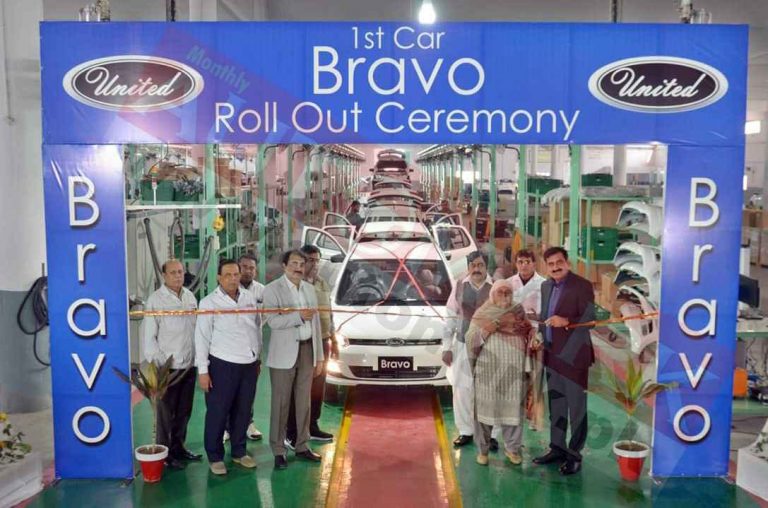
The newly introduced 800cc United Bravo has been officially launched in Punjab region and booking has been started with PKR 200,000. Car delivery time is approximately 2 months that has been given to customers, as sources said.

The car enthusiasts and the automotive industry are showing a great interest in the vehicle which was recently introduced to break the monopoly of other auto assemblers in the market. While company source also confirmed that dealers have an overcrowded response and they have booked all cars of the quota which they got from the company.


United Motors appointed 6 3S dealers in Punjab region as United Bedian Motor Engineers (Lahore), United Motor Experts (Islamabad), United Faisalabad Motors (Faisalabad), United Meer Motor (Faisalabad), United Jehlum Motors (Jehlum), SMR United Motors (Multan) and many more are in pipeline while they don’t have any dealer in Karachi. As per company policy, all dealers should have facilities of Sales, Service, and Parts (3S).

Launched on 8th September, the 800cc car comes equipped with a 3-cylinder water-cooled Euro II engine with 30 liters fuel capacity, 4-speed manual transmission enabling 60 nm torque and 50 BHP. It also boasts of an electric power steering, inside fuel led opener, power windows, central locking, fog lights, rear-view camera, alloy wheels, and interactive media panel with USB ports. The car comes with a price tag of 8.5 lacs.

Its launch has made a bigger impact in Pakistan’s developing auto market and is expected to push other auto manufacturers to focus on delivering features at economical price instead of the conventional products that have been continuously sold locally.

United Auto Industries (Pvt) Limited is the 1st local brand and 2nd Largest selling brand of United Motorcycles in Pakistan. The Company received Green Field Investment status under new auto policy 2016-2021 from Ministry of Industry and Production in June-2017.

by Aqsa Mirza

Honda Cars recalls for immediate replacement of Takata front airbag inflators in Pakistan

LAHORE (PR) – Honda Atlas Cars Pakistan Limited (HACPL) has announced the range of Honda vehicles in Pakistan which require replacement of Takata front airbag inflators. HACPL strongly encourages its customers for immediate replacement of front airbag inflator at its authorized dealerships as a precautionary measure to ensure safety for its customers. The Takata front airbag inflator (in specified models) may have a probability of malfunctioning if deployed, which can result in a safety risk to vehicle occupants.

The company is offering its consumers free replacement of airbag inflators. Customers can visit nearest Honda authorized dealerships for free replacement/checkup of airbag inflators. HACPL has already sent SMS and direct notification letters to the affected car owners, urging them to contact any authorized Honda dealer nationwide to schedule an appointment or contact Honda Customer care at 0300-8402509 for a free replacement of the affected parts. The replacement of the affected airbag inflator under this campaign will be done free of charge and will require approximately an hour.

Source : The Nation

Toyota car fault prompts massive recall

Japanese car giant Toyota has announced a recall of more than 2.4 million hybrid vehicles worldwide because of a fault in their systems that could cause them to lose power.

The recall of Prius and Auris cars includes 1.25 million vehicles sold in Japan, 830,000 in North America and 290,000 sold in Europe.

All those affected were produced between October 2008 and November 2014.
Toyota said it was not aware of any actual accidents caused by the fault.

However, the carmaker said that in “rare situations”, the fault could cause vehicles to stall when entering “failsafe” driving mode.

“While power steering and braking would remain operational, a vehicle stall while driving at higher speeds could increase the risk of a crash,” the company said.

Toyota said the cars affected had already been recalled previously for other reasons in 2014 and 2015.

“The remedy conducted then did not anticipate the new condition identified in this recall,” it added.

In recent years, Toyota has had to recall large numbers of cars for various reasons, including faulty airbags supplied by vehicle parts firm Takata.

In 2015, it had to recall 6.5 million vehicles globally over a faulty window switch that was liable to short-circuit.

Source: BBC

Renault’s China electric crossover may go global

Renault will introduce a low-cost urban vehicle in China next year — the electric K-ZE, based on the Kwid subcompact crossover sold in India and other emerging markets.

The K-ZE, shown as a concept but which is close to production form, will have a range of 250 km under the New European Driving Cycle emissions test. The EV was developed as part of a new joint venture with Renault alliance partner Nissan and Dongfeng Motor Group to build electric vehicles for China, where the K-ZE will be produced.

Carlos Ghosn, CEO of Renault and chairman of Nissan Motor and Mitsubishi Motors, would not say what the price would be, although last year he said the K-ZE would cost about $8,000. He said it would stand out from domestic competitors by offering a higher level of features, such as air conditioning, a large touchscreen, rearview camera and parking sensors, and connected navigation and services, Ghosn said.

“This is a very strong product, and we’re going to compete,” he said.
The K-ZE most likely will be sold outside China, Ghosn said, adding, “We’re starting with China, but the scope will be global.”

Renault plans to sell 550,000 cars in China by 2022 under the company’s Drive the Future strategic plans. Last year the company sold about 72,000 vehicles there, up from 35,000 in 2016.

Renault has long had a joint venture with Dongfeng to build internal-combustion vehicles, and it also hopes to boost sales through a new joint venture with Shenyang Brilliance Jinbei Automobile Co. to produce and sell light-commercial vehicles. Including the K-ZE, Renault plans to launch three EVs and nine new cars overall by 2022.

The Chinese government wants to increase annual output of new-energy vehicles — its term for battery-electric vehicles, plug-in hybrids and fuel-cell vehicles — to 2 million units by 2020, Bloomberg News reported last year. Such automobiles are expected to make up more than one-fifth of total sales by 2025, according to the latest auto industry plan released by the Ministry of Industry and Information Technology. Last year about 25 million cars were sold in China.

Source: Automotive News Europe

Kumho Signs Technology Transfer Agreement with Pakistani Manufacturer

Kumho Tire Co. signed an agreement to transfer its tire manufacturing technology to Century Engineering Industries of Pakistan.


Kumho called the agreement “monumental” for South Korea’s tire industry because it allows Kumho to enter into a developing country’s market. Under the 10-year agreement, Kumho will provide its technology to Century which also includes Kumho’s resources on design to quality control as well as education and problem-solving skills related to running a tire manufacturing business. Under the contract, Kumho will receive $5 million along with 2.5% of Century’s annual sales in royalties. A total of 28 tire products for passenger and commercial vehicles are subject to the deal, which will be renewable for another five years upon expiration.

Century, a Pakistani-based battery manufacturer, has been committed to expanding its business portfolio by building a tire manufacturing line in Pakistan since May 2017. After Century’s research on global scale tire manufacturers, Century approached Kumho about its global business and technology with the hope of partnering with the tiremaker.

Kumho said Century will improve upon Pakistan’s limited infrastructure for tire manufacturing by investing in a tire plant with hopes to expand its business in the automotive industry. Century forecasts it will manufacture a million tires per year and eventually aims to grow its annual capacity to 5 million units.

“Kumho has enjoyed a good reputation as a technology powerhouse. The deal will eliminate concerns caused by some issues over the years such as its acquisition by Double star and prove that Kumho’s quality and technology remain intact,” said Kim Jong-ho, CEO of Kumho Tire. “We will leverage this deal as a starting point to establish technology the transfer as a new revenue source and develop a variety of business models that build on our expertise in tire manufacturing in order to further enhance our business.”

Pakistan’s battery market saw a phenomenal growth during last decade, as the long hours of electricity blackouts compelled people to use available SLI batteries in their home and office Un-interrupted power supplies (UPS). SLI batteries are designed to provide high voltage current required at start an automobile for few seconds then they need to be charged. If exposed to long use- more than 40 percent of their total capacity-the thin lead plates start to break, making battery unusable. The disposable units are hard to repair.

After the gradual increase in electricity production in recent years and availability of thick lead plate- long lasting – deep cycle batteries for solar and UPS use- the SLI batteries were restricted to automobile use mainly. Cut-throat competition, availability of modern alternate secondary storage units and improved regulations were other reason to seek diversification for the relatively new company.

With robust network of existing battery sales force, the company is not eyeing new car entrants only but Suzuki, Honda and Toyota also in coming years, due to increasing bad quality perception of their existing vendor. Century is already supplying Phoenix batteries to Pak Suzuki Motors, Ghandhara Nissan cars and trucks, Al-Ghazi Tractors and Sazgar Rikshaw.