Home Blog Page 30

Honda’s Moving Car Showroom brings a unique concept to the City

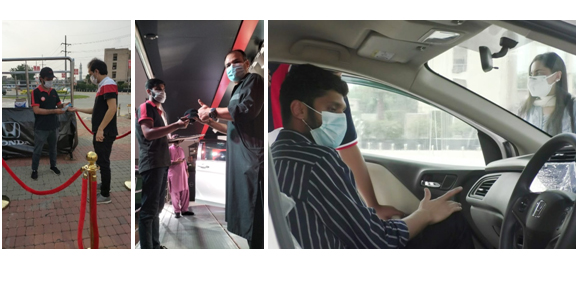
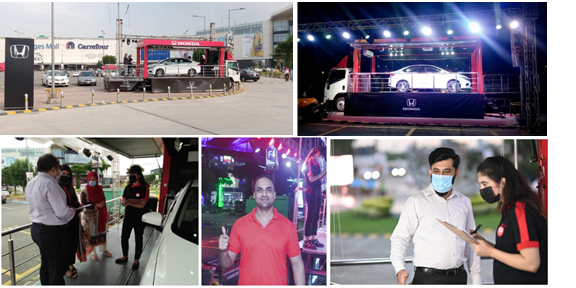
Honda Atlas has launched a rather unique idea to promote the newly launched Honda City in Pakistan. The company has introduced a Moving Showroom Car Display for its consumers, which is both unique and interesting.

The idea has resulted inhighly engaging and impactful activity around the new sedan.The moving showroom displays are attracting a large number of people who want to get a feel for the new model and want a hands-on experience of the new City.The unique concept behind this activity is creating a lot of impact in the market.

The entire showroom has been made with meticulous attention to detail and is easily accessible for people who want to hop on the float and checkout the features of the new City. Because the moving showroom, travels around the city, it is very convenient for the people and they do not need to drive very far to see the new car.

In short, the whole experience has become very exciting for Honda City lovers in Pakistan and the response by the people shows they have appreciated the initiative and unique display of the new model by Honda Atlas.

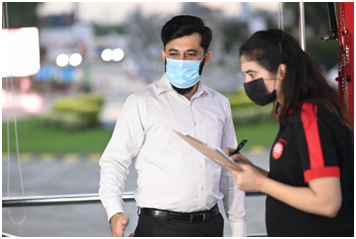
Since the country is going through a pandemic, Honda is taking steps to conduct this activity under proper COVID-19 SOPs and protocols to ensure the safety of people.

Honda’s staff are very welcoming,offering refreshments and giveaways to visitors. They are also very prompt in answering customer queries and facilitating them with further information in the form of flyers and smart brochures. This has made the whole experience even more informative and pleasant for visitors.

Honda is mainly displaying the Honda City Aspire 1.5L CVT on the Moving Showroom Car Display because it is the top-of-the-line variant and people have shown the most interest in it. The company has planned a further 10 displays in 6 cities across Punjab. In Lahore, the display is planned for 11 days at Packages Mall and 2 days at Liberty Market. Judging from the response in Lahore, Honda is looking forward to seeing an overwhelming response in the other cities of Punjab.

Honda’s Moving Showroom Car Display truly brings a unique automotive experience to Pakistan. It has not only been successful in attracting a lot of visitors, it is also introducing a new marketing concept of reaching out to the people instead of waiting for the people to come to you. So, if you are a Honda lover, drop by Honda’s Moving Showroom Car Display today and experience the new Honda City in an exciting and unique way.

TPL Trakker, Proton pen partnership for seamless and connected automotive future

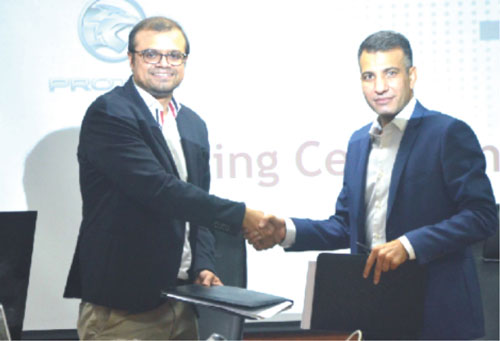
TPL Trakker, Pakistan’s leading IoT Company pro-viding Telematics, Mapping, and Location Based Services, has recently partnered with Proton, a world-class automotive Malaysian company, to offer automotive software and hardware solutions.

The world is moving fast towards next genera-tion automotive connectivity. It has been estimated that almost 70% of the vehicles world-wide will ship with embedded connectivity in the near future.

A connected vehicle is equipped with a host of smart features that enhance the overall driving ex-perience by making it seamless and exciting.

From advanced infotainment services on the go to swift navigation system, such intelligent vehicles are creating great disruption in the automobile industry

TPL Trakker and Proton have joined forces to revo-lutionize the automotive industry of Pakistan by delivering Pakistan’s first ‘Intelligent vehicle’.

In line with this partnership, TPL Trakker has offered Proton online and offline maps for Proton X-70 while other state-of-the-art hardware features such as Infotainment System, Camera, and Speakers will be installed in Proton SAGA in the future.

Pakistan Aerospace Council Member Companies Visit Pak Austria Institute of Applied Sciences and Technology, Haripur

“High Tech companies of Pakistan are committed to developing hands on technical manpower at university level”, said Dr Arshad Ali, Convener Pakistan Aerospace Council. Elaborating on the subject Dr. Arshad Ali underlined the role of close liaison between universities and their surrounding businesses have, on development of students’ employability skills in the next generation of technologies.

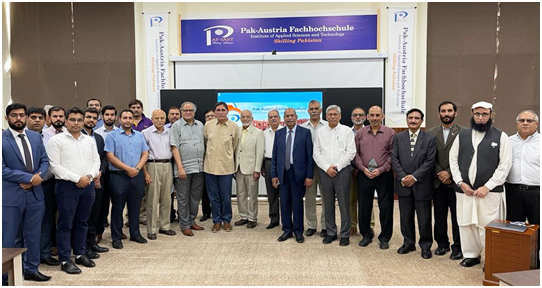
Dr. Muhammad Mujahid, Vice Chancellor Pak Austria Institute of Applied sciences and Technology (PAF-IAST), welcomed the 25 members delegation and made detailed presentation on university programs and facilities. He also shared the progress and future plans with regard to Artificial Intelligence, Data Storage and Technology Park. Dr Mujahid highlighted that university focuses on singular mission of skilling Pakistan in close cooperation with industry.

Each member of the visiting companies gave presentation on the technology, products, processes and technical resources of their companies. The interaction lasted for about six hours during which a detailed understanding was developed for various forms of collaboration between
PAF-IAST.

Dr. Nasser Khan, Project Director said that such Hi-tech industries are true strength of Pakistan and need to be respected at every level. He also spoke about the excellent prospects which could emerge for the day’s interaction and result in lasting, fruitful relationship and the resulting high quality of the students which would be produced as a result.

– Press Release

Pak Suzuki is the market leader in Pakistan Automobile sector by having more than 60% of share

Pak Suzuki since its inception is a market leader in small car, below 1000 cc, segment in Pakistan but not very successful in upper categories, although it tries its level best to capture the market of above 1000 cc but with little or in some cases no success. Before we move further let’s have a brief look about the history of Pak Suzuki.

Pak Suzuki was established in 1982 as a joint venture between the Government of Pakistan and Suzuki Motor Japan, formalizing the arrangement by which Awami Auto Ltd, a state owned company had produced the Suzuki SS80, having 360 cc two stroke, water cooled, rear engine car. This car was sold at a very attractive price of Rs 36,000. Pak Suzuki is the market leader in Pakistan Automobile market by having more than 60% of market.

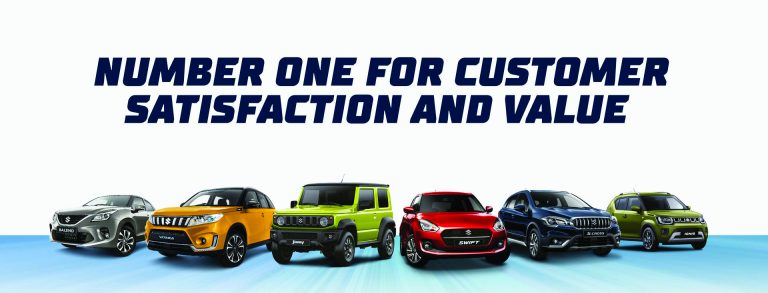
Pak Suzuki so far has launched six cars in 1300 and above category, this we are talking about cars and not SUV or Jeeps, which is altogether different category. Margella, Baleno, Liana, Swift, Ciaz and Kizashi. All these cars except Swift were Sedan, and were directly competing with Honda City and Toyota Corolla, with the exception of Kizashi, which well too expensive to compete any car with a price tag of Rs. 5 million at the time of introduction.

The sedan shape of Suzuki Cultus second generation was initially (1990) imported from Japan to test the market and sold under the name Suzuki Sedan and came with a carburetted 3-cylinder 993 cc engine. The market reception was good though the audience complained of low power. The same car was considered for local manufacture as an entry level executive car. Manufacturing started in 1992 under the name Suzuki Margalla having 4-cylinder, 1300 cc carburetted engine. The car was offered in variants such GL and GLX, with an upgrade variant called Margalla Plus launched later on.

Production was ceased in 1998. Since at that time it was the only 1300 car manufactured in Pakistan and due to government of Pakistan ban on using above 1300 cc cars by government officials it was met with great success, and no doubt this car was also reliable.

But with the introduction of locally manufactured Toyota Corolla in 1993 the sale of Margella was drastically declined and to complete the market Suzuki launched Beleno, a bigger and better looking car in 1998 as a replacement of Suzuki Margalla, till 2006 when it was replaced by the Liana.When introduced, it featured a number of improvements over Margalla, such standard power steering, wider tyres, tachometer as standard, 4-spoke steering wheel vs. 2-spoke steering wheel of Margalla, black interior vs grey interior, EFi vs carburettor and 16-valve vs 8-valve engine.

Initial trim levels included GL, GXi, Gli and GliP (also known as Gli Plus). Baleno featured highly advanced technology at its time, as it was the first one to offer distributorless EFi. But as the mechanic did not have the knowledge of EFI engines due to its new technology and only Suzuki Authorised dealers have the mechanics that were capable to handle this engine, and since we do not have any technical institutions to give training on new technologies the car was not very successful. The same happened with Liana which was introduced in 2006, the car was no doubt good looking but again suffered with gearbox and engine issues as again mechanics were not geared up to handle the complicated EFi engine, and this leads to its poor resale value and the car was not as successful as it should have been. And finally in 2014 production stopped. To fill the gap Pak-Suzuki introduced Ciaz both manual and automatic as CBU but since it was expensive as compared to Toyota Corolla and Honda City and having badge of Suzuki it was not a success and Pak Suzuki was able to sell very small numbers of units. Smaller the number costlier to maintain as parts are expensive. If we analyse the buyer’s mentality in Pakistan reliability and resales value is number one issue in making the decision.

And in both these areas all these cars did not get the full marks, further the name of Suzuki is synonymous as entry level car. Kizashi was imported in 2015 and 2016 by Suzuki but due to its price, it badly failed and was far expensive for a Suzuki buyer and perhaps a bad decision on the part of Pak Suzuki to offer such an expensive car in Pakistani market. At present they have only one car in 1300 cc category ie Swift and due to its high consumption of fuel it is also not very successful, but those companies who are bound to give 1300 cc cars to their employees are buying it as it is the cheapest 1300 cc car in the market. But now with the introduction of Saga and Alsvin the fate of Swift is in doldrums and therefore the production ends by the end of this year.

It is prudent that Pak Suzuki should focus on up to 1000 cc car market and improve their quality as many new entrants are coming up in this category which will give tough competition to Pak Suzuki, like Picanto by KIA.

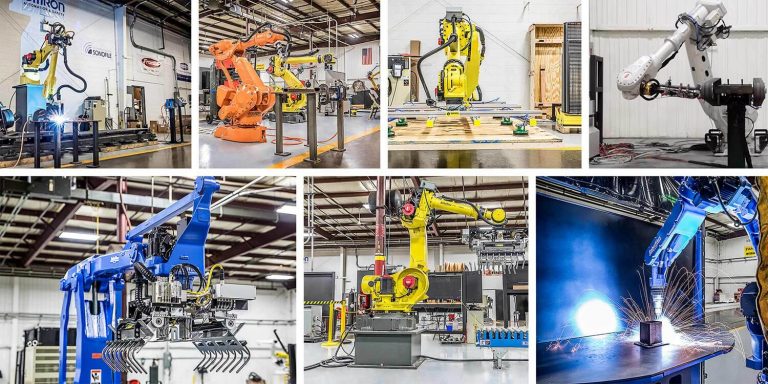
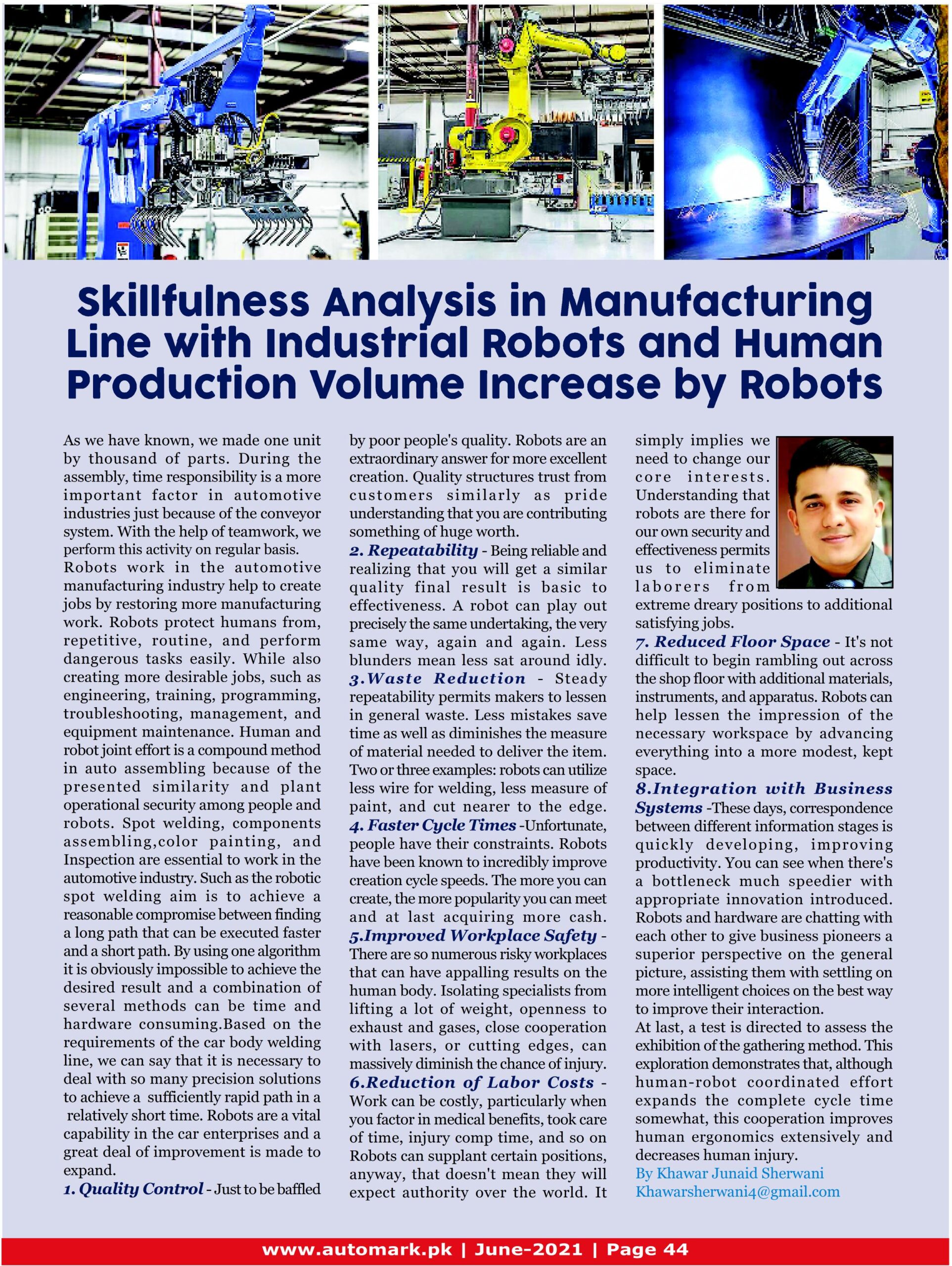
Skillfulness Analysis in Manufacturing Line with Industrial Robots and Human; Production Volume Increase by Robots

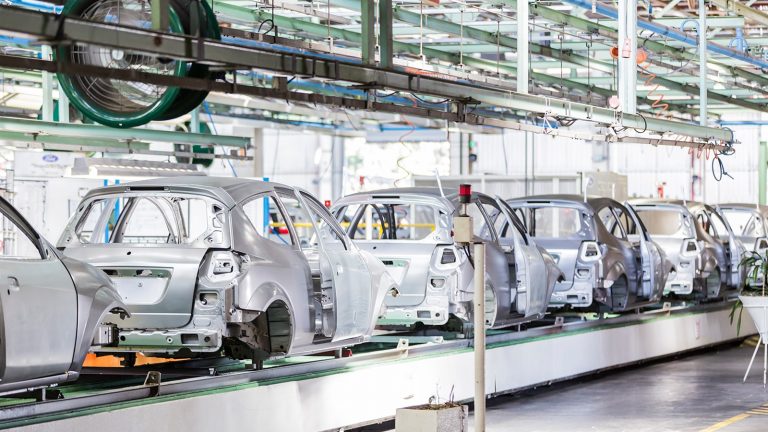
As we have known, we made one unit by thousand of parts. During the assembly, time responsibility is a more important factor in automotive industries just because of the conveyor system. With the help of teamwork, we perform this activity on regular basis.

Robots work in the automotive manufacturing industry help to create jobs by restoring more manufacturing work. Robots protect humans from, repetitive, routine, and perform dangerous tasks easily. while also creating more desirable jobs, such as engineering, training, programming, troubleshooting, management, and equipment maintenance.

Human and robot joint effort is a compound method in auto assembling because of the presented similarity and plant operational security among people and robots. Spot welding, components assembling, color painting, and Inspection are essential to work in the automotive industry. Such as the robotic spot welding aim is to achieve a reasonable compromise between finding a long path that can be executed faster and a short path.

By using one algorithm it is obviously impossible to achieve the desired result and a combination of several methods can be time and hardware consuming. Based on the requirements of the car body welding line, we can say that it is necessary to deal with so many precision solutions to achieve a sufficiently rapid path in a relatively short time.

Robots are a vital capability in the car enterprises and a great deal of improvement is made to expand.

1. Quality Control – Just to be baffled by poor people’s quality. Robots are an extraordinary answer for more excellent creation. Quality structures trust from customers similarly as pride understanding that you are contributing something of huge worth.

2. Repeatability – Being reliable and realizing that you will get a similar quality final result is basic to effectiveness. A robot can play out precisely the same undertaking, the very same way, again and again. Less blunders mean less sat around idly.

3.Waste Reduction – Steady repeatability permits makers to lessen in general waste. Less mistakes save time as well as diminishes the measure of material needed to deliver the item. Two or three examples: robots can utilize less wire for welding, less measure of paint, and cut nearer to the edge.

4.Faster Cycle Times -Unfortunate, people have their constraints. Robots have been known to incredibly improve creation cycle speeds. The more you can create, the more popularity you can meet and at last acquiring more cash.

5. Improved Workplace Safety – There are so numerous risky workplaces that can have appalling results on the human body. Isolating specialists from lifting a lot of weight, openness to exhaust and gases, close cooperation with lasers, or cutting edges, can massively diminish the chance of injury.


6. Reduction of Labour Costs – Work can be costly, particularly when you factor in medical benefits, took care of time, injury comp time, and so on Robots can supplant certain positions, anyway, that doesn’t mean they will expect authority over the world. It simply implies we need to change our core interests. Understanding that robots are there for our own security and effectiveness permits us to eliminate laborers from extreme dreary positions to additional satisfying jobs.

7. Reduced Floor Space – It’s not difficult to begin rambling out across the shop floor with additional materials, instruments, and apparatus. Robots can help lessen the impression of the necessary workspace by advancing everything into a more modest, kept space.

8. Integration with Business Systems – These days, correspondence between different information stages is quickly developing, improving productivity. You can see when there’s a bottleneck much speedier with appropriate innovation introduced. Robots and hardware are chatting with each other to give business pioneers a superior perspective on the general picture, assisting them with settling on more intelligent choices on the best way to improve their interaction.

At last, a test is directed to assess the exhibition of the gathering method. This exploration demonstrates that, although human-robot coordinated effort expands the complete cycle time somewhat, this cooperation improves human ergonomics extensively and decreases human injury.

By Khawar Junaid Sherwani; This article has been published in printed edition of Automark Magazine June-2021.

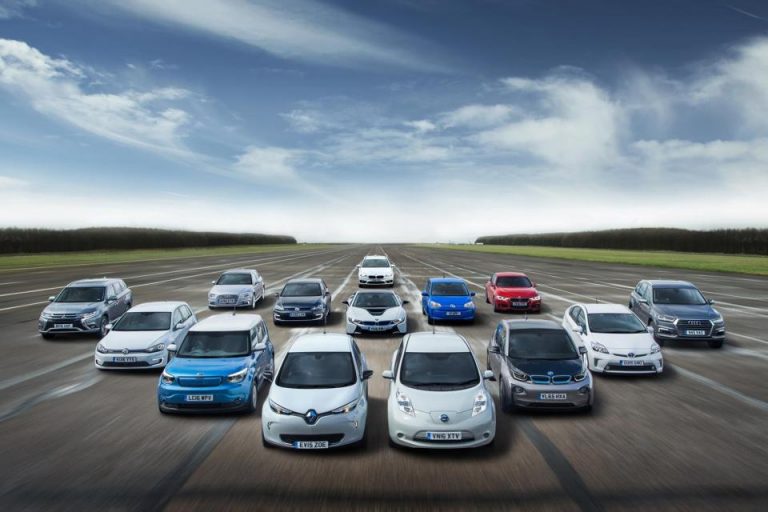
Progress on EV in Pakistan & Environmental Awareness, Potential Business Growth Opportunity

Overview on neighboring countries EV developments

According to reports Government is taking initiatives towards supporting EV industry in Pakistan, A comprehensive EV policy is expected in the upcoming budget of June 2021-22. Sources confirm that all related policies are being taken into consideration keeping in view futuristic approach which will not only address environmental concerns but industry growth as well.

A positive sign is that the renowned International EV assemblers are already in discussions with local Business Entities for setting up local operations & assembly lines.
Hope government introduces polices which not only secures investments in the area but also offers comprehensive incentives for a certain limit of time. Related authorizations for infrastructure setup have always been a tuff which would requires core focus of policy makers.

Potential area of related development will be
1- Charging Stations
2- Vendor’s Developments
3- Assembling Plants
Once said happens vacuum of private & commercial EV can be addressed for local & international markets as already has been observed in other developed countries.
It has been observed that our neighboring countries relevant Industry revenue has surged immensely, said wasn’t possible without a positive futuristic business vision / policies of governments.

ECC Approves EV Policy for Motorcycles
EV Markets

• Several countries made huge steps towards a cleaner future in 2020, with the electric vehicle market growing across the globe.
• China boasts the largest EV market, while Norway has the highest share of electric cars in total passenger car sales.
• In Europe, several EV markets saw triple digit growth in 2020 electric vehicle sales.
• Although the U.S. has the third-largest EV market, growth only reached 4% last year.

With Tesla’s meteoric stock market rise in 2020 and several countries and car manufacturers announcing new electric vehicle targets, electric cars have been in the spotlight for a while now. And while they still account for a single-digit percentage of global passenger car sales, several countries, especially across Europe, have made huge strides towards a cleaner future in 2020.
While Norway is by far the country with the highest share of electric cars in total passenger car sales, no country comes even close to China in terms of absolute market size. According to the China Association of Automobile Manufacturers (CAAM), sales of battery electric vehicles (BEV) and plug-in hybrids (PHEV) amounted to 1.00 and 0.25 million in 2020, respectively. That puts China way ahead of Germany (395,000), which overtook the United States in terms of EV sales.

• Electric car sales continued to grow in 2020 and global electric car stock passed the 10 million milestones.
• Europe became the world’s largest EV market for the first time.
• China still had the largest number of electric cars on its roads with a total of 4.5 million.

However, the world is still at the beginning of its transition to clean energy.


List of Chinese EV makers
Roughly in order of EV units shipped
• Tesla
• BYD
• SAIC Motor
• SAIC Volkswagen
• SAIC-GM-Wuling
• NIO
• Xpeng
• Li Auto
• WM Motors
• Geely
• Byton
• Enovate
• Zhiji
• Xiaomi
• Dongfeng Motor
• Chang’an Automobile
• Guangzhou Automobile
• Chery Automobile
• FAW Group
• FAW-Volkswagen Automobile
• Evergrande
• BAIC Motor

Media Reports of June 2020
Despite 2020 being a sluggish year for the global automobile industry, electric car sales continued to grow. According to the latest edition of the International Energy Agency’s Global EV Outlook, electric passenger car sales climbed despite the total automobile industry contracting by 16 percent. While Europe overtook China to become the world’s largest EV market for the first time last year, China still had the largest number of electric cars on its roads last year with a total stock of 4.5 million.
The Global EV Outlook is an annual publication that identifies and discusses recent developments in electric mobility across the globe. It is developed with the support of the members of the Electric Vehicles Initiative (EVI). Combining historical analysis with projections to 2030, the report examines key areas of interest such as electric vehicle and charging infrastructure deployment, ownership cost, energy use, carbon dioxide emissions and battery material demand.
The case studies on transit bus electrification in Kolkata (India), Shenzhen (China), Santiago (Chile) and Helsinki (Finland). The report includes policy recommendations that incorporate learning from frontrunner markets to inform policy makers and stakeholders that consider policy frameworks and market systems for electric vehicle adoption.

Further extends the life cycle analysis conducted in Global EV Outlook 2019, assessing the technologies and policies that will be needed to ensure that EV battery end-of-life treatment contributes to the fullest extent to sustainability and CO2 emissions reductions objectives. Finally, it analyses how off-peak electricity demand charging, dynamic controlled charging (V1G) and vehicle-to-grid (V2G) could mitigate the impact of EVs on peak demand, facilitate the integration of variable renewables and reduce electricity generation capacity needs.

Sales of passenger cars were slow in 2019 but electric cars had another bumper year.

Sales of electric cars topped 2.1 million globally in 2019, surpassing 2018 – already a record year – to boost the stock to 7.2 million electric cars. Electric cars, which accounted for 2.6% of global car sales and about 1% of global car stock in 2019, registered a 40% year-on-year increase. As technological progress in the electrification of two/three-wheelers, buses, and trucks advances and the market for them grows, electric vehicles are expanding significantly. Ambitious policy announcements have been critical in stimulating the electric-vehicle rollout in major vehicle markets in recent years. In 2019, indications of a continuing shift from direct subsidies to policy approaches that rely more on regulatory and other structural measures – including zero-emission vehicles mandates and fuel economy standards – have set clear, long-term signals to the auto industry and consumers that support the transition in an economically sustainable manner for governments.

INDIA ELECTRIC VEHICLE (EV) MARKET – GROWTH, TRENDS AND FORECASTS (2021 – 2026).
The India Electric Vehicle Market was valued at USD 5 billion in 2020 and is expected to reach USD 47 billion by 2026 registering a CAGR of above 44% during the forecast period (2021 – 2026).

The India Electric Vehicle Market has been impacted by the outbreak of COVID-19 pandemic due to supply chain disruptions and halt of manufacturing units due to continuous lockdowns and travel restrictions across the county. However, as electric vehicle (EV) market is still in its nascent stage in India. It is expected to grow at a much faster rate during the forecast period due to various government initiatives and policies.
E-Commerce companies (Amazon, for example) are launching initiatives to use e-Mobility for last-mile deliveries to reduce carbon footprint. India is experimenting with e-Mobility for public transport and has deployed electric inter-city buses across some of the major cities. In addition, state governments are also playing active role in deployment of policies encouraging EV. For instance,

• Kerala aims to put one million EV units on the road by 2022 and 6,000 e-buses in public transport by 2025.
• Telangana aims to have EV sales targets for 2025 to achieve 80% 2- and 3-wheelers (motorcycles, scooters, auto-rickshaws), 70% commercial cars (ride-hailing companies, such as Ola and Uber), 40% buses, 30% private cars, 15% electrification of all vehicles.

The EV market in India has gained significant momentum after the implementation of FAME India scheme with its aim of shifting towards e-mobility in wake of growing international policy commitments and environmental challenges. Moreover, India offers the world’s largest untapped market, especially in the Electric two-wheeler segment and as 100 percent foreign direct investment is allowed in this sector under the automatic route market is expected to gain momentum during forecast period.

SCOPE
An Electric vehicle is one that operates on an electric motor, instead of an internal-combustion engine which generates power by burning a mix of fuel and gases. Therefore, Electric vehicle is seen as a possible replacement for the current-generation automobile in near future to address environmental challenges. The report covers the latest trends and technologies followed by COVID-19 impact on the market.

The India Electric Vehicle Market is segmented by Vehicle Type and Power Source. By Vehicle type, the market is segmented into Passenger Cars, Commercial Vehicles, Two- and Three-wheelers and By Power Source Type, the market is segmented into Battery Electric Vehicle, Plug-in Electric Vehicle and Hybrid Electric Vehicle. For each segment market sizing and forecast has been done on basis of value (USD billion).

Growth of Electric Buses
India is the second most populated country in the world after China, and just like China, which has the largest electric bus fleet in the world, India is also pushing hard for the electrification of buses. Many state governments have already started the procurement of electric buses from Chinese and local electric bus manufacturers.
With growing need for controlling GHG (Greenhouse gases) emissions emitted by vehicles, the government is encouraging the use of electric powered vehicles across various states, which is boosting the demand for electric buses in India. The market is being driven by factors such as increase in domestic manufacturing, rapid urbanization, and rise in environmental awareness.

• In February 2020, Union transport minister inaugurated India’s first inter-city electric bus service, these buses are manufactured by Mitra Mobility Solution which has the range of 300 km on a full charge.
Many local bus manufacturers are in collaboration with some Chinese manufacturers are trying to catch the rising demand of the electric buses in India. For Instance,
• In 2019, Foton PMI announced that it was planning to invest around INR 5 Billion on a joint venture with Beiqi Foton Motor Co. of China to manufacture electric buses in India. The company has already given five electric buses to one of the airlines for internal operations.

Electric Two Wheeler Vehicles Growth
With transportation still being a challenge in India, a lot of people in these segments look forwards to the 2-Wheeler Industry in India. As a result of the surging pollution, the national government has launched stringent policies to curb vehicular emissions. In particular, the jump from Bharat Stage V (BSV) to BSVI emission standards is expected to benefit the Indian electric scooter and motorcycle market, by raising the prices of petrol-driven two-wheelers by 7¬–15%. From 1st April 2020 onward, automakers are only allowed to sell BSVI-compliant vehicles in the nation, which is driving the push toward electric variants.

For extracting the maximum revenue from the rapidly growing Indian electric scooter and motorcycle market, original equipment manufacturers (OEMs) are expanding their facilities. For instance,

• In January 2020, Ather Energy Pvt. Ltd. announced intentions to build a 400,000-square-foot factory in Hosur, Tamil Nadu, which would have an annual output of 1 lakh units. Currently, the company operates one manufacturing plant in Bengaluru, which has a capacity of 25,000 units. The idea of the company behind an additional facility is meeting the rising demand for electric two-wheelers in India.
• In the same vein, Okinawa AutoTech Pvt. Ltd. invested 28.4 million (INR 2 Billion) for its second manufacturing plant in May 2019. To be developed for electric two-wheeler vehicles in Rajasthan and planned to be commissioned in early 2020–21, the manufacturing plant will have an annual output of 10 lakh units.

Furthermore, the availability of a considerable number of electric two wheeler models, their low cost, as well as their availability as a substitute for conventional fuel-based vehicles and these are fueling the demand in the India Electric vehicle market.

Competitive Analysis
The India EV market is consolidated due to presence of major players active in the market owing to cheap and readily available manpower. However, established players in the market are introducing their new model’s, product launches to gain competitive edge over other players. For instance,
• In January 2020, Morris Garages Motor India launched the d ZS EV, which is the first electric internet SUV in India, the car has a driving range of 340 km on a full charge. The ZS EV vehicle has been awarded five stars at the Euro NCAP crash tests.
• In 2019, Tata Motors announced its electric vehicle technology ZIPTRON, which will power all future Tata electric cars. This technology consists of a highly efficient permanent magnet AC motor, providing excellent performance on demand. It will also offer a dust and waterproof battery system meeting IP67 standards.

The startups are expanding their presence by raising funds from investors, tapping in new and unexplored cities. Companies are investing a tremendous amount on R&D and launching new models to mark their presence in the market.

Major Players

  1. Tata Motors Limited
  2. Mahindra & Mahindra Limited
  3. MG Motor India
  4. Olectra Greentech Ltd
  5. JBM Auto Limited

Ongoing Developments
• In January 2020, the Department of Heavy Industries (DHI) of India, approved 2,636 electric vehicle charging stations in 62 cities across 24 Indian states and union territories (UTs) under the second phase of the FAME program to promote e-mobility.

• In February 2021, Ather Energy India’s first intelligence EV manufacturer moved its USD 86.5 million factory from Bengaluru (Karnataka) to Hosur (Tamil Nadu) to increase its two wheeler production capacity.

DEAR READERS THE ABOVE IMFORMATION IS GATHERED FROM DIFFERENT MEDIA SOURCES & HENCE ANY CONTRADICTION IN RELATED FIGURES OR REPORT IS REGRETTED IN ADVANCE.

Exclusive written by Aqeel Bashir for Automark Magazine, this article has been published in printed edition of Automark in June-2021
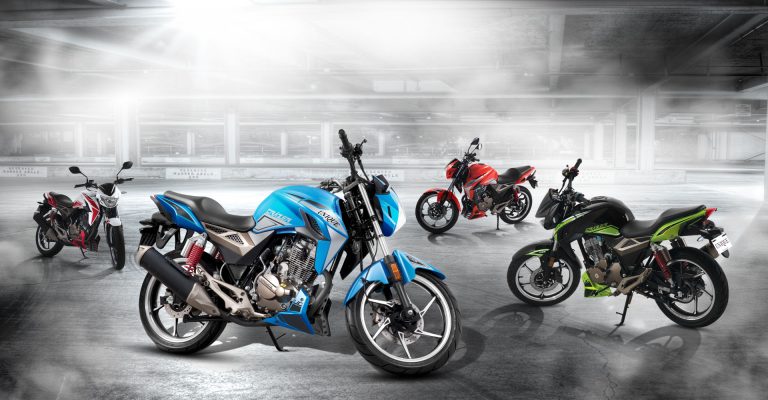
Bike sales to remain bullish amid frequent price shocks

Like a looming boom in the auto sectors, Pakistan’s two wheeler assemblers are also enjoying their best ever days owing to massive revival in demand especially after the lull period of March to May 2020 in which April was observed as a complete lock down all over the country.

Buyers, who had failed to buy two wheelers during March to May 2020, have flooded the markets which the industry has never expected.

The huge demand of bikes appears surprising amid rising cost of living of consumers triggered by high food prices, rising utility charges and loss of jobs of many people in small industries and business centres due to depressed sales of various items.

Besides soaring cost of living, many cash rich consumers did not bother over rising prices of two wheelers which the Chinese and Japanese bike assemblers are still jacking up the prices due to high demand.

Price increase in bikes is being made despite low cost of imports of parts and accessories on account of gaining rupee against the dollar.

The prices of bikes should have either remained unchanged or absorbed by the assemblers if they are not reduced after rupee recovery as one dollar is now equivalent to Rs 152-153 in the interbank market as compared to Rs 168.41 in August 2020.

Like an eye wash on other food items’ prices and lack of any price checking mechanism by the government, the assemblers have been enjoying their best ever time by fully utilizing high demand of bikes from the buyers.

Rising demand has also led to high premium on bikes on two wheelers which are parked at the showrooms on which the authorized dealers of the showrooms first deny about bike availability but later agree to sell the bike on premium.

The government, who had already failed in controlling huge premiums or on money on locally assembled cars, has also proved helpless in the two wheeler segment by remaining a silent spectator, leaving the consumers at the mercy of dealers to pay hefty premiums amid higher production of bikes.

Even the buyers are still being asked to book hot selling bikes and in this category, Honda CG-125, which is a more than three decades old model, enjoys an edge over its competitors. Those in a hurry to own a bike pay an extra price as they cannot afford to wait for 15-20 days to get the bike delivered.

Honda CG-125 has been in high demand for many years but its assembler is not ready to handle the premium issue either deliberately or genuinely. Honda dealers simply say that the assembler has been failing to meet its burgeoning demand.

It has been noticed in the markets that demand for products usually drops when prices have continuously been enhanced but in bikes and other segments of the auto sector, the situation is quite the reverse. Even in the essential items like chicken, sugar, wheat flour, meat varieties, rice, pulses etc, consumers had shown extra enthusiasm in buying these items despite persistent increase in their prices.

Bikes have remained a most sought after item also due to the pathetic public and private transport system. Besides, traffic jams have also forced the consumers to purchase two wheelers in order to reach the respective destinations without any hassle. Two wheelers is the only option for the consumers and this is a plus point for the assemblers to keep raising prices on demand and supply gap.

Another reason to switch over to bikes has been high prices of locally assembled and imported cars which force many people to buy two wheelers and even compromise on used bikes.

Besides, many people, who own a good car, also keep at least one bike in hand to meet daily requirements of markets and other daily routine works instead of going on the four wheelers.

High petrol prices can also be blamed in keeping two wheelers demand up as many consumers cannot afford costly petrol on their four wheelers.

Auto market has also seen a new trend in the last few years relating to rising sales of highly expensive 125-150cc bikes, but instead of showing any reluctance towards costly bikes, consumers have shown more passion towards heavy bikes due to better suspension and comfort than 70cc.


Besides, the 2020 heavy rains and thunderstorm had also proved devastative for the 70cc bike owners who faced a lot of problems in reaching their homes as water entered the bikes’ silencers and carburetors due to very little gap between the silencer and engine with the road.

In heavy bikes, silencers and carburetors are fixed much higher which allow a tension free ride to the bike owners in case of heavy rains and flood like situation.

High demand and rising sales of bikes can be gauged from the soaring import volume of completely and semi knocked down (CKD/SKD) kits in the last 10 months of the current fiscal.

According to figures of Pakistan Bureau of Statistics (PBS), import of completely and semi knocked down kits (CKD/SKD) in 10FY21 has increased by 13 per cent to $60.5 million from $53.3 million in the same period of last fiscal.

Increasing trend in imports of parts and accessories looks a bit contradictory to the assemblers’ claims of achieving over 95 percent localization in two wheelers. However, a problem exists with the parts makers who rely on many imported parts. The assemblers and vendors claim that raw material prices had almost doubled and tripled followed by a meteoric hike in steel and plastic items’ prices and in freight charges which have nullified the positive impact of low landed cost on account of rupee appreciation against the dollar.
They said local steel mills have been continuously pushing up steel related items’ prices for the last 10 months, thus putting extra pressure on cost of production.


Not only locally made bikes are in high demand, the PBS figures also suggest a whopping rise in import of completely built up (CBU) bikes in the last 10 months.
Import of CBU bikes in 10FY21 has swelled by 233 per cent to $2.7 million from $816,000 in the same period last fiscal.
Industry people attributed this sharp hike in imports of bikes to rising arrival of scooties and heavy used bikes.

The increasing trend in sales of imported and locally made bikes suggests that people have enough cash in hand, especially those people who belong to the agriculture sector.
Barring poor cotton crops, other cash crops like wheat, sugarcane, rice etc has shown growth in production thus encouraging growers and farmers to lift new bikes. Bike sales depend a lot on rural buying.

Investors in food items are also enjoying their heydays as prices of sugar, wheat flour, pulses, rice, fruits, chicken, meat etc have achieved new peaks in the last 2.5 years.
Among the main beneficiaries of rural buying has been Atlas Honda Limited (AHL). Its overall sales of two-wheelers grew 39 per cent to 1.076 million units in 10MFY21 while Suzuki and Yamaha sold 19,973 and 18,375 units. United Auto Motorcycle sales grew by 30 per cent to 314,393 units.

The financial results of AHL for the year ending March 31, 2021 recorded sales of Rs 93 billion as compared to Rs 84.7 billion in the same period last year.
The Japanese assembler made a profit of Rs 3.6 billion versus Rs three billion in the above period.

AHL has been frequently pushing up prices on exchange rate parity. From January 2021 till to date, the company has increased prices by at least four times.
Chinese bike assemblers have also been active in raising prices.
Many consumers believe that the government has been paying lip service only in checking prices of food items despite holding weekly meetings of the National Price Monitoring Committee. They feel that when the government has been unable to achieve any results in curbing food items’ prices, then what they can expect in the auto sector which is run by the powerful cartels.

However, bike sales are likely to remain bullish till the public and private transport remains ineffective.

Reality check on new and existing car assemblers

It is unfair to put the entire onus on the new entrants for not introducing any below 800cc cars especially 660cc under the Auto Policy 2016-2021 and keeping their focus more on bringing Sport Utility Vehicles (SUVs) and high engine power vehicles.

Before grilling the new players, let us go back and review Japanese assemblers’ dominance and their practices for providing obsolete and decades-old cars.

Chairman Pakistan Association of Automotive Parts and Accessories Manufacturers (PAAPAM), Abdul Rehman Aizaz in a print media report has hit the new entrants easily for ignoring middle class buyers and racing towards introducing SUVs. This attack on the new entrants has come at a time when the Auto Policy 2016-2021 is nearing end on June 30, 2021.

Certainly, Mr Rehman and their decades-old vendors under the umbrella of PAAPAM, who mostly rely on Japanese assemblers’ orders for parts and accessories manufacturing, are sure of not losing any big business in criticizing Korean and Chinese players. PAAPAM chief and his members know very well that they will invite their doomsday in case of raising eyebrows against the Japanese assemblers on various issues.

PAAPAM members, mostly dominated by blue-eyed vendors of Japanese assemblers, had never shown their anger loud and clear as to why decades old cars were still being rolled out which did not exist in any parts of the world.

Suzuki Mehran ruled the roads for 30 years without any complete change in models and engines followed by 12 years of Suzuki Alto, 16 years of Suzuki Cultus, 11 years of Honda Civic, eight to nine years of Toyota Corolla and 10-12 years of Daihatsu Coure. Surprisingly, Suzuki Bolan and Suzuki Ravi, which are also 20-30 years old technology, are still being assembled without any complete change in models.

PAAPAM members had remained tight-lipped after getting businesses from Japanese assemblers and their businesses kept on thriving without any additional investment and expenditures, thanks to the smooth flow of orders from the Japanese assemblers.

Japanese assemblers were clever enough too as they did not take any risk in completely changing the models when the demand was already upbeat and people did not have the option. Used small imported cars of 660cc had penetrated deep in the markets but it cannot give any serious dent to the iconic Suzuki Mehran, Alto 1000cc, Cultus and Bolan, which encouraged assemblers to keep the assembly line operational for decades.

However, a daring man emerged from the PAAPAM fraternity and that was Capt (retd) Muhammad Akram who as a chairman of PAAPAM before Rehman Aizaz had shaken the assemblers as well as their favorite part makers of Japanese assemblers.
For the first time in 15 years, during January 2020, Akram dared to speak out against the local vehicle assemblers over low localization and high prices.
He pointed out various SROs especially 655(I)/2006 which had only benefited local assemblers instead of auto vendors and consumers.

Akram claimed that the association’s website mentions 70 per cent localisation for production of Suzuki Mehran – which was discontinued in April, 2019 after three decades.
The real situation in cars was different as localization levels in 660-1,800cc cars ranged between 45-55pc while assemblers claimed higher localisation.

He had written a letter on low localisation, high prices and misuse of SROs to the Ministry of Industries. He claimed that it was the first time that PAAPAM has raised objections on the above issues especially SRO655 so far in the last 15 years.
Capt Akram is reported to have paid the price of being vocal against the assemblers as many vendors of Japanese car assemblers had indirectly criticized him as they felt that his outburst would cost them heavily. He was indirectly asked to keep a mum on various issues between assemblers and vendors. After that, Capt Akram had almost suspended appearing in the media before his tenure came to an end in August/September 2020.
Sources said Prime Minister Imran Khan is reported to have recently assured the Japanese and Pakistani executives of Toyota for supporting the hybrid assembly initiative. Honda is also ambitious in first introducing hybrid vehicles.
The government appears confused as it has already announced incentives for promoting electric vehicles assembly while on the other hand it is creating confusion by signalling support to hybrid vehicle assembly.

After Mr Muhammad Akram, Karachi Chamber of Commerce and Industry (KCCI) in its budget proposals for 2,021-2,022 has finally grilled the car assemblers. KCCI said in the last 40 years, auto assemblers have enjoyed protective duties, exemptions and virtual monopoly in Pakistan’s automobile car market.

Contrary to initial agreements, the assemblers failed to implement a deletion programme up to 90pc. Instead, they are importing completely knocked-down kits (CKD) while they have created vendors who mostly import auto parts and supply them to these assemblers.
Consequently, the so-called vendor industry is only producing low quality and non-mechanical parts which are clearly visible in locally assembled cars. So far the assemblers have only drained Pakistan’s foreign exchange reserves to the tune of billions of dollars. Quality of automobiles produced by the assemblers is so poor that not a single unit of these cars has ever been exported to any country.
Despite such poor quality, artificial shortage is created to fetch a premium on the early delivery and allow undocumented investors to exploit genuine buyers.

The KCCI believes that more than enough protection has been given for decades to assemblers. The chamber urged the government to allow commercial import of used cars of models up to five years old besides a 50pc cut in tariff rates for import of used cars followed by restoration of depreciation to 50pc.
Coming back to PAAPAM chief Abdul Rehman Aizaz, he said the key objective of the 2016-21 auto policy was to bring competition that would result in reduction of car prices, especially in the entry level segment so that the middle-class population of the country would be able to purchase smaller cars.
Unfortunately, after almost five years, though the auto market has been flooded with SUVs and high-end passenger cars, there is not a single entry level car below 800cc by any international brand of repute.
Under the 2016-21 policy, new entrants are allowed import of parts at concessionary custom duty of just 10 per cent, while old manufacturers are importing these parts at 30pc custom duty.

He said the assembly of SUVs is an easy option for new entrants. “They have been allowed to import most of its parts at a concessionary rate of duty due to a thin ‘A max part list’ of this segment, assemble the vehicle and sell these in the market easily which is already booming because of low interest rates and a high demand from consumers.”

“Actually the auto policy of 2016-21 has resulted in a price benefit for high-end consumers of SUVs and passenger cars,” he added. Concessions on import duty provided in the 2016-21 policy would continue till June 2026. These concessions have resulted in subsidisation of imports, loss of revenue to the government, employment generation in a foreign country instead of Pakistan, loss of GDP to the country etc, he lamented.

Without any doubt the 2016-21 policy, especially in case of new assemblers, resulted in slowdown of localisation and loss of business to auto part manufacturers who are key stakeholders in the automobile value chain and where bulk of the employment is generated, he added.
In the new Auto Policy 2021-26, there are indications that duties on completely built-up (CBU) and completely knocked-down (CKD) will be reduced across all segments of passenger cars and SUVs.

Reduction in CBU and CKD would once again result in subsidising the imports and that too mostly in the luxury cars and SUV segment.
The Paapam chief was of the opinion that to reduce the prices of entry level cars, concessions should be targeted towards this very segment only. Instead of reducing CKD and CBU duties, concessions in mark-up rates for financing smaller cars, abolishing federal excise duty and additional custom duty on raw materials and parts, reduction in sales tax rates etc. should be considered.

“Before finalisation, there is a need that all proposals shall be deliberated in detail with ample time and opportunity to discuss the pros and cons and come up with a policy that will support the Make in Pakistan vision of the Prime Minister,” Mr Aizaz summed up.
Here a question arises. PAAPAM chief was not happy over low localization from new entrants due to a policy of favouring new entrants. What about localization targets achieved by the existing assemblers.

Japanese assemblers especially the bike assemblers have been playing havoc with the prices despite gaining rupee against the dollar which was equal to Rs 168.42 during August 2020 as compared to Rs 152-153 currently, making a solid case of low landed cost of imported parts.

But the assemblers and the vendors had come out with a justification that rising raw material prices in world markets coupled with soaring steel prices have diluted the impact of rupee appreciation against the dollar. The assemblers are already flexing their muscles to further increase prices which they already did in the previous months.
Shankar Talreja at Topline Securities said car prices had already gone up by 4.3 per cent to 5.1 per cent from August 20 till to date.

He said there has been a global shift towards SUVs and that trend with auto policy 2016-21 has become more affordable for consumers as well.
In Pakistan, the market for SUVs remained untapped and hardly one to two models were offered to the consumers and that too at higher price brackets of over Rs seven million.
Mr Talreja said with new auto policy, assemblers have targeted top-notch sedans buyers and have provided them with more luxury at similar price brackets of sedan.
He said higher engine power vehicles have emerg¬ed as more profitable while smaller cars will have to face a direct competition with Suzuki Alto 660cc.

A Korean car and SUV assembler said very few companies have below 1,000cc models.
A Chinese assembler said that currently China does not have any small car like 660cc (petro engine) while the trend of small cars in China is fast fading after the electric vehicle revolution.
Besides, Pakistan is a competitive market for small cars where feasibility does not favor bringing small cars.

Small cars are only available in India which will prove price effective for the consumers but mounting political tensions between the two countries do not allow this option.
He said international new entrants are not in a position to invest in risky small car assembly in Pakistan keeping in view some Chinese small cars of 800-1000cc introduced by local investors as they have been struggling for their survival.
Pakistan has attracted over one billion dollars in investment from new entrants — mainly from Korea and China — under the Auto Policy 2016-2021 but not a single below 800cc cars were introduced.

New entrants feel that it is a total risk now in Pakistan to assemble below 800cc cars owing to lack of trust of buyers on Chinese cars which is much evident from deteriorating sales production and sales of various models like Prince, Alpha and Bravo (800-1,000cc). They are definitely cheaper than Korean and Japanese counterparts but have so far failed to attract new buyers. Lack of resale value and concerns of quality and durability are other concerns of consumers who think twice before purchasing Chinese vehicles. The next option for them at this price of Chinese cars is Japanese imported used cars.

Surprisingly, buyers, who ignore small Chinese cars, go wild for MG, Glory and other SUV Chinese brands which have been running side by side with Japanese brands and the numbers on the roads are growing.

Besides, the cost of assembly of small cars appears unfeasible for assemblers due to no concession on parts and accessories imports and limited profit margin.

Roshan Apni Car Financing

The State Bank of Pakistan started the Roshan Apni Car scheme with the collaboration of different Commercial Banks. The overseas Pakistani who want to deposit the amount in Roshan digital account car scheme can choose the foreign currency account or local currency account.

Financial Institutions offering Roshan apni car scheme:

Applicants for this scheme can apply through Roshan Apni Aar UBL, Roshan Apni Car HBL, Roshan Apni Car Faysal Bank, Roshan Apni Car Meezan Bank, Roshan Apni Car MCB Bank, Roshan Apni car BOP, Roshan Apni Car Bank AL Habib, Roshan Apni Car NBP Bank, Roshan Apni Car Alfalah Bank.
More local Banks are in process of internal policy which will be highlighted in the coming days / weeks. The above active Banks can be approached through their websites or email address available on social media.

• An initiative by State Bank of Pakistan to facilitate overseas Pakistanis having active Roshan Digital Accounts.
• Roshan Apni Car can be applied by Salaried Individuals, Business Men & Can also be offered to individuals wanting to Lien their amounts against car loan.
• The loan period / tenure is between One to Seven Years.
• Special K+ rates & Terms options are being offered by Different local Islamic & Conventional Financial Institutions with reference to SBP schedule rates.

Roshan Apni Car facility is available on Locally Manufactured Brand-New Vehicles only

Terms reference on Roshan Apni Car Conventional Bank (1).
Loan Size:

• Minimum PKR 200,000/- and Maximum PKR 7,500,000/-
Down Payment / Equity Requirement:
• Min 15% of Vehicle’s Value Up to Rs.6.0M Financing & Min 20% of Vehicle’s Value for Financing above Rs. 6.0M
• 0% Equity against Lien Based Financing
Financing Tenor:
• 2 – 7 Years for all vehicles
Eligibility criteria for Roshan Apni Car
• Must be Bank Roshan Digital Account Holder.
• Local Nominee in Pakistan is mandatory.

Lien Based Financing:
• 100% lien shall be marked equivalent to finance amount on Roshan Digital Account or Naya Pakistan Certificate till the maturity of loan.
• Minimum balance in Roshan Digital Account or investment in Naya Pakistan Certificate should be equivalent to finance amount.

Salaried:
• Minimum Age 21 Years to 65 Years at time of loan maturity
• U$D 3,000/- per month or equivalent
• Currently employed, with a total employment experience of 06 months

Self Employed Businessmen / Professional:
• Minimum Age 21 to 70 years at time of loan maturity
• U$D 4,000/- per month or equivalent
• Minimum 1 Years in current Business

  • Documentation as per Segment

Lien Based Segment
• Only Basic Documentation
• Salaried Individuals
• Salary Slip / Salary Certificate
• Bureau Report of Country of Residence

Self Employed Individuals / Professionals:
• Tax Returns
• Commercial Registration Certificate (where applicable)
• 06 months Bank Statement or Income Verification Report
• Account Maintenance Certificate
• Bureau Report of Country of Residence

Remittance Based:
• Remitter Job / Income Proof
• Remitter Passport Copy
• 6 months remittance slips / 6 months Bank Statement of Remittee.

Terms reference on Roshan Apni Car Conventional Bank (2).

Roshan Apni Car (RAC) Facility for Roshan Digital Account (RDA) holders.
This facility would be offered to individuals having Roshan Digital Account (RDA) at Bank to purchase vehicle for himself / herself, or for his / her spouse, parents, or children living in Pakistan. The vehicle shall be registered in the name of applicant or co-applicant with HPA in favor of BANK, whether the facility is lien based or non-lien based.

Application stage procedure:
Customer will fill online application form and attach required documents on online portal. Customer’s information with attached documents shall be digitally transmitted to authorized person at CBD. The proposal shall be processed based on digitally transmitted data and documents. In case of any shortcoming / discrepancy, shall be resolved in coordination with the customer via email / phone call.
After approval of the facility, legal documents shall be dispatched first to
co-applicant, and then to applicant (overseas) for his / her signature. In case the customer is visiting Pakistan, documents shall be executed here as per existing practice, otherwise his / her signature shall be verified from BANK account instead of embassy endorsement. Product

Eligibility Criteria:
Non-Resident RDA holder with Resident (Spouse, Parent, or Children) co-applicant. Where the applicant is Resident, co-applicant is not necessary.
• Regular Salaried individuals with minimum 2 years experience of current employer
• Contractual Salaried individuals with minimum 3 years experience
• Self-Employed Professionals (SEP) and Business Individuals with minimum 3 years experience of similar business / profession.
• Holder of Permanent Resident Card / Nationality for Non-Gulf Countries, and Residency / Resident Card for Gulf Countries
• Having clear credit history in eCIB, Data Check, and credit report of country of stay (wherever possible)
• Minimum age at the time of application: 25 year
• Maximum age at maturity of financing: 60 years for salaried, 65 years for SEP and Business Individuals. For lien based facility, minimum experience shall not be applicable, whereas DBR may be up to regulatory requirement.

Product Pricing Lien Based or Variable Rates:
SBP Floor + 1.0% of Fixed Rates: COD* + 1.0% Non-Lien Based or Variable Rates: 1 Year KIBOR + 1.0% of Fixed Rates: Respective PKRV + 1.5% * Certificate of Deposit rate of Mahana Munafa Account for respective tenure to be applied.
Similar to KIBOR, SBP Floor and Respective PKRV of last working day of previous month shall be considered at the time of approval of the facility.
The facility shall be valid for 60 days from the date of approval. For lien based fixed rates, the tenure of financing shall be up to the maturity of deposit Insurance rates shall be arranged in line with SBP guidelines.
Co-Applicant for Non-Resident RDA holder, Resident Pakistani shall be added as co-applicant for vehicle registration and legal documentation purpose.

Minimum Net Monthly Income:
• Employed / Working in Gulf Countries: Equivalent to DHS 10,000/-
• Employed / Working in UK, USA, Canada, Australia, and countries where

BANK has branches / representative offices:
Equivalent to USD 3,000/- Conversion rate of foreign currency shall be calculated according to privilege exchange rate. Where the co-borrower is added for income clubbing as well, income requirement and verifications of the co-borrower shall be conducted in line with Apni Car product program. Where the co-borrower is added other than income clubbing, his/her income and related documents shall not be required. For lien based facility, minimum income requirement, and restrictions of stated jurisdictions shall not be applicable.

Required Documents:
• Valid copy of CNIC / SNIC / NICOP, Passport, Visa, and residency card / work permit.
• Recent photographs of applicant and co-applicant.
• Online application form
• Credit report from country of stay (wherever possible).

Income related Documents for Salaried:
• Latest 3 months salary slips
• Latest employment certificate with date of joining
• Last six month bank statement; where salary is being credited
• Contact detail of HR representative for verification of applicant’s

Credential (1) For Self Employed Professionals / Business Individuals:
• Valid proof of business setup / license / registration certificate
• Last six month bank statement For lien based facility, credit report from country of stay, and income related documents shall not be mandatory.

Approving Authorities Financing Amount Recommending Authority Approving Authority Up to Rs. 5mn N/A any three members of CBD CC Above Rs. 5mn and up to Rs. 10mn N/A GHB along with any three members of CBD CC Above Rs. 10mn GHB Sub-CC
Verifications: Verifications for lien based facility shall not be required. For non-lien based facility, following shall be observed;

• Verifications of current residence to be waived, however the residence address in Pakistan (where the co-borrower resides) to be verified.  Physical verification of office would not be possible, however confirmation be obtained via email wherever possible.

• Bank Statement Verification to be conducted through email address of respective bank.
• Telephonic Verification of office and from customer to be conducted wherever possible.
• Verification of income related documents; (2) For Salaried: To be verified from employer’s official email address (3) For SEP and Business Individuals: To be verified from registered business association’s email address / licensor (where available) the above mentioned addition shall also be applicable for Islamic Auto Finance under Diminishing Musharaka. All other product parameters of Apni Car Product Program shall remain unchanged.

Who will register & can receive the vehicle?

The applicant will give authorization to his family members: wife, children, mother, father and real siblings to receive the vehicle after dealing with the banks in Pakistan. And the vehicle will be registered in the name of your family member who made deal with the bank. (Terms & Conditions of Banks / Financing Institution may differ in some cases). The ultimate Goal of all Institutions are to accommodate maximum number of customers).

Priority Delivery of Roshin Apni Car.
In order to promote Local Assembled Vehicles Sales in current Covid situation & to promote Government’s / SBP Roshan Apni Car Scheme some local Vehicle Assemblers are taking bold steps by expediting deliveries of booked vehicles. (Vehicle Delivery Period may differ from Assembler to Assembler).

Dear viewers as SBP has initiated said lending on a broader spectrum with the supportof local Banks & local Automobile Assemblers a lot of improvements & ease in processes / terms & conditionwill be observed in the coming days.

The above information has been gathered from different media sources & hence any variation in figures / report is regretted in advance.

Note: Written by Aqeel Bashir for Automark, published in Automark Magazine June-2021 printed edition.

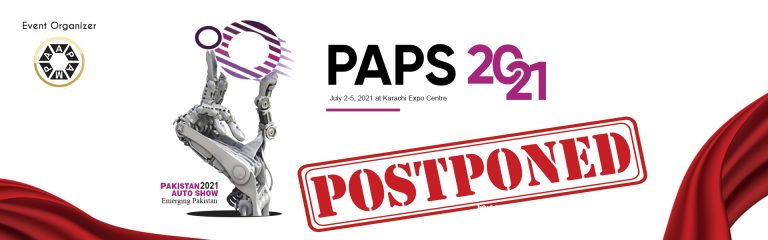
2021 Pakistan Auto Show postponed; new dates announced

Pakistan Association of Automotive Parts & Accessories Manufacturers postponed the 2021 “Pakistan Auto Show-2021” in the wake of COVID-19 outbreak. The event was originally slated for July 2-5, 2021 at Karachi Expo Centre.

As per the association’s website www.paps.pk. the new dates for the show has been announced as 12- 14 November-2021. It is assumed that this future event will take place at the Karachi Expo Center on given dates, where postponed event has been planned.

Like other events around the country, the Karachi Auto Show is a great opportunity for attendees to witness many new vehicles all at one place, often without the hassle of dealing with sales personnel.

As per our sources most of the leading assemblers of cars, commercial vehicles and 2-3 wheelers have booked their spaces for this show while many leading parts manufacturers and accessories companies had booked spaces to exhibit their products.

Many Chinese companies had shown their interest and booked spaces. Organizer has planned to reserve a complete hall of Expo Center for the foreign exhibitors. Last year Chinese and foreign exhibitors could not attended the Pakistan Auto Show at Lahore due to the pandemic.

At Karachi Expo Centre, local government has established COVID-19 vaccine center since last month and due the ongoing vaccination process it will take a little longer to evacuate the center and availability of the hall for any current exhibitions.